Author

Jesse Mostipak
Director of Growth
Jesse Mostipak is the Director of Growth at Voxel51, where the work is helping humans find and trust what the brand knows, and teaching the Google knowledge graph and the LLMs answering on their behalf to do the same. That question, how knowledge gets built inside a system, is one Jesse has been chasing for years. Earlier versions of it ran through a New York City high school science classroom, data science and machine learning, and developer relations at Kaggle, Posit (formerly RStudio), and Baseten. The answer doesn't change much depending on whether the learner is a teenager, a software engineer, or a knowledge graph. Jesse holds a Master's in Education from CUNY Hunter College. LinkedIn
See all articles by Jesse Mostipak
In this article
Talk to an AI expert
A warehouse robot picks boxes flawlessly in a closed lab, then drops one in the real world when sunlight glints off the plastic wrap. It holds one brand of tote but drops another because the handles are slightly different. The robot fails not because the model is too small, but because its training data didn't cover these cases.
To generalize, a robot needs training data diverse enough to cover the situations it will actually encounter in the real world. Those are the long tail—the rare cases it sees infrequently—and the out-of-distribution cases it never trained on.
Generalization is the central challenge for Vision-Language-Action (VLA) models, which turn what a robot sees and a natural language instruction into action, learning a task end to end.
Language and vision AI made their gains in generalization by scaling the amount of training data they used, but that data doesn’t exist for robotics. The LAION-5B dataset (arXiv:2210.08402), an open source foundation dataset for generative models, contains more than 5 billion image-text pairs. Open X-Embodiment (arXiv:2310.08864), the largest open robotics dataset, contains roughly 1 million robot trajectories. Robotics is trying to build general-purpose agents with several orders of magnitude less training data.
That data shortage isn't a temporary lag that resolves with more funding. Robot data can’t be scraped the way web data is. It has to be generated on hardware, one run at a time, and it’s nothing like the text and images on the web. That scarcity is why VLA generalization depends on how varied the training data is, and why the highest-leverage work in robotics has become mining the long tail: finding the rare cases a model fails on.
Key Takeaways
- Robotics trains on orders of magnitude less data than language and vision AI: roughly 1 million trajectories in the largest open robotics dataset, against billions of image-text pairs for vision models.
- Robot data can't be scraped. It has to capture the actions, forces, and proprioception that web text and video lack, so it can only be generated on real or simulated hardware.
- Diversity drives VLA generalization. A model's performance on rare, long-tailed, and out-of-distribution cases tracks how varied its training data is, not how much of it there is.
- Once the common cases are covered, curation is what improves a model further: finding the rare, long-tailed cases that expand what it can do, most of them already in a team's logs.
Why robot data is fundamentally scarce
Robot data differs from web data in three structural ways: the information it captures doesn’t exist in 2D web data, each step depends on the step that came before, and it doesn’t combine cleanly across different robot bodies. Together, these properties make robot data scarce and hard to combine. And even then, collecting more of it isn’t automatically the answer.
The action grounding gap
A video generation model trained on YouTube footage can produce a plausible clip of a basketball player dribbling down the court and shooting. A robot trained on the same footage can learn what the task looks like, but not how to perform it. The video contains no forces, no joint angles, and no sensor readings. This gap between recognizing an action and executing one is the action grounding gap (arXiv:2404.19664). Video remains useful for pretraining VLAs, but it cannot close the gap on its own (arXiv:2607.08639).
“...web-scale video is abundant, but generic video objectives do not teach how actions reshape the world, so the action signal remains tied to expensive robot data, limiting the control knowledge learned before downstream adaptation.” Xu, et al 2026
Temporal dependencies
A defect-detection model on a manufacturing line operates on an open loop. When it misses a defect, the next part on the line arrives unaffected. A robot operates on a closed loop: each action the robot takes changes the situation it faces next. A small miscalculation in force means the robot drops the mug instead of lifting it, and the robot must now act from a state it wasn't trained on, where its next action is a worse guess. In robotics, errors compound instead of staying put (arXiv:1011.0686). The states a robot lands in after a mistake are, by definition, ones its training data rarely covers, which is why a single error tends to cascade.
Proprioceptive integration
A robot needs a continuous sense of its own configuration: joint positions, velocities, and forces. This proprioceptive stream has to be fused with high-dimensional inputs like multi-camera views, LiDAR, and depth, each with different update rates, resolutions, and failure modes. And because proprioceptive data appears nowhere in web-scale text and video (arXiv:2510.07077), it can only come from a real or simulated robot.
Embodiment heterogeneity
Text from any corpus shares a single vocabulary, so datasets combine freely. Robot actions don't. At each timestep in a robot’s action, a controller emits an action vector shaped by the robot's specific body, often one value per actuated joint: seven for a single seven-joint arm, 14 for a two-armed setup, dozens for a humanoid. Vectors from different bodies are not interchangeable, which is why a demonstration on one robot doesn't transfer automatically to another. This is embodiment heterogeneity.
Open X-Embodiment pools data from 22 robot platforms into a standardized format, and reports positive transfer, with models improving as they borrow experience across platforms (arXiv:2310.08864). But pooling mismatched data should be done with care, as it can also produce negative transfer, where another robot's data makes a model worse (arXiv:2507.06219). DROID tackles the issue from a different angle, holding hardware constant while varying everything else: 76,000 demonstrations across 564 scenes and 86 tasks (arXiv:2403.12945). Together Open X-Embodiment and DROID illustrate two strategies for increasing diversity while managing embodiment differences: standardize the data, or standardize the body.
The shift from model-centric to data-centric AI
For most of robotics' history, a better robot meant a better model. In the standard modular pipeline, one model perceived the scene, another planned, and a third executed. Progress meant improving a module by improving the model.
VLAs offer an alternative to the standard pipeline. A VLA maps what the robot sees and is translated directly to an action, allowing the robot to learn the whole task end to end (arXiv:2307.15818). This changes what a robot learns from. A modular stack trains each module on narrow, task-specific data. A VLA trains on diverse, whole-task demonstrations (arXiv:2406.09246, arXiv:2507.06219). The constraint moved from the model to the data.
That shift is real but not universal. Classical and modular methods still win where the job demands sub-millimeter precision, force and tactile feedback, or safety-critical control that cannot tolerate a black-box action. In practice the strongest stacks hybridize, running a VLA at a low rate to decide what to do and handing off to a classical controller at a high rate to execute it safely.
Collection costs are also falling. According to industry surveys, teleoperation dropped from about $340 an hour in 2024 to $136 by late 2025, and leader-follower rigs now cost under $2,000 (State of Robotics 2026, EVS teleop guide). Cheaper collection makes one response obvious: collect more. But more of the same data fills training sets with situations robots can already handle.
Why data diversity drives generalization
The situations that break robots have a name in machine learning: long-tail data, and beyond it, out-of-distribution cases. A policy generalizes when its training data covers the range of situations it will meet in deployment: the unfamiliar object, the odd lighting, the grip that slips.
A robot trained mostly on common cases performs well in a demo, because a demo is built from situations it has seen thousands of times. A warehouse hands the robot new situations all day: a pallet at the wrong angle, a glare across a sensor, a box that tears when it should hold. Most of what a robot meets in deployment never appeared in its demos, and its reliability depends on how much of that rare data its training already contained.
One clarification before the numbers. Training a VLA foundation model from scratch is enormously data-hungry, closer to training a large language model. Most teams never do that. They fine-tune a pretrained VLA, which needs far less data, and that is the regime these results describe. Even there, the lever is diversity rather than volume.
The evidence is consistent across labs. Figure reports that its Helix model reached strong real-world generalization on roughly 500 hours of curated demonstrations, which the company says is under 5% of the data used by earlier VLAs (figure.ai). Physical Intelligence reports the inverse: in ablations of π0.5, out-of-distribution success fell from 94% to 74%, 49%, and 31% as data sources were removed from the training mix (arXiv:2504.16054). Toyota Research Institute found that multitask pretraining allowed its large behavior modes to learn new tasks with roughly three to five times less data than single-task baselines (arXiv:2507.05331). And a 2025 study found task diversity mattered more for performance than additional demonstrations of the same task (arXiv:2507.06219).
Increasing dataset diversity improves generalization more than adding additional demonstrations of already-common tasks. As teleoperation costs fall and foundation models become more widely available, this shifts attention toward identifying and collecting deployment failures and other rare scenarios.
Finding those cases in a mountain of routine footage is the remaining problem. Physical-world data will not become abundant the way web data did. The practical question is not how to collect more but how to identify the data that improves model behavior.
Finding long-tail examples in existing data
Reviewing thousands of hours of robot logs by hand isn't practical. FiftyOne indexes the data with multimodal embeddings, which place images and text in the same space and open up two ways to search.
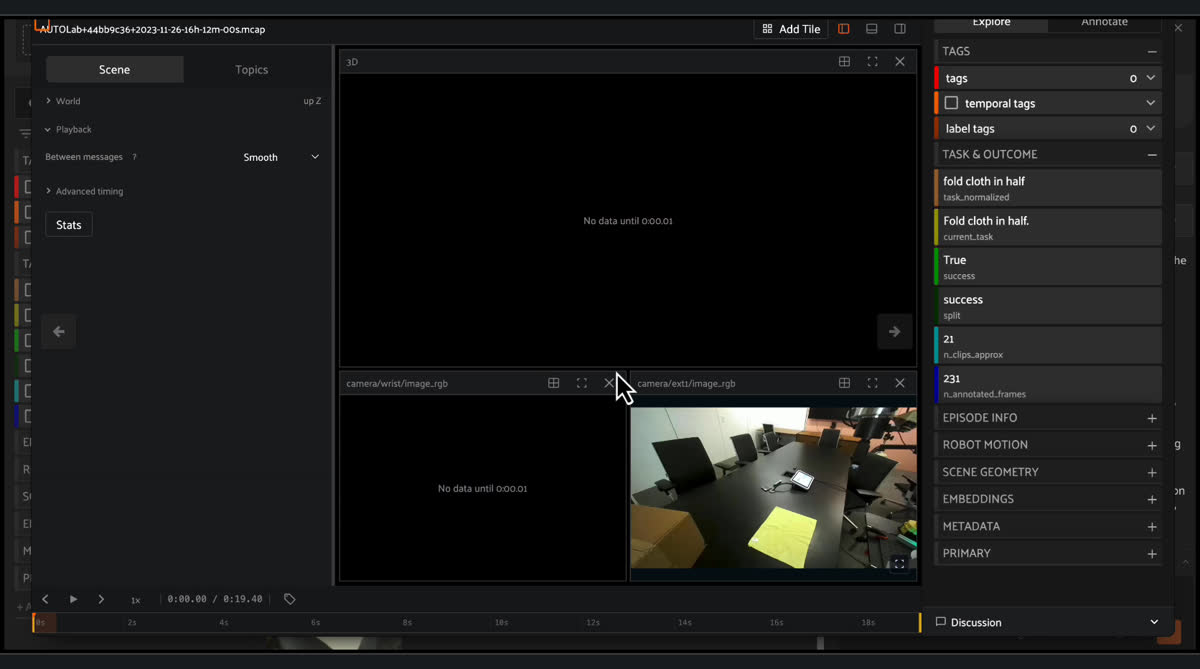
You can describe what you're looking for in plain language, for example 'a tote slipping mid-lift,' and pull up matching moments across the dataset.
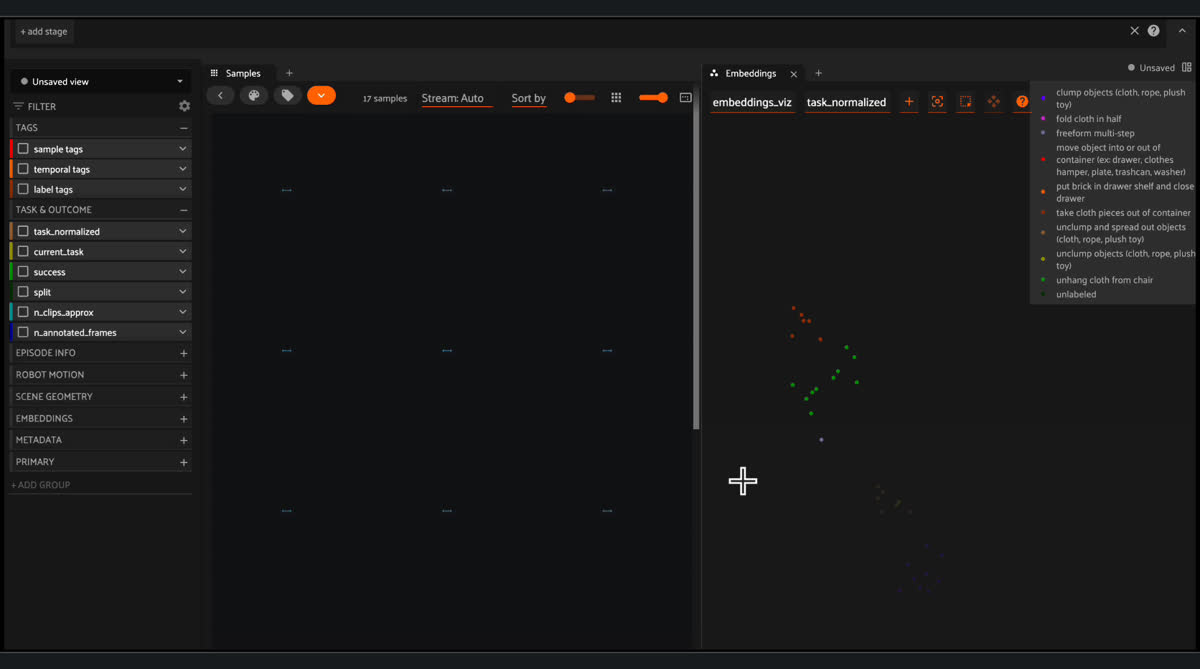
Or you can start from a single observed failure, like a glare-induced grasp miss, and surface every visually and semantically similar instance in unlabeled data.
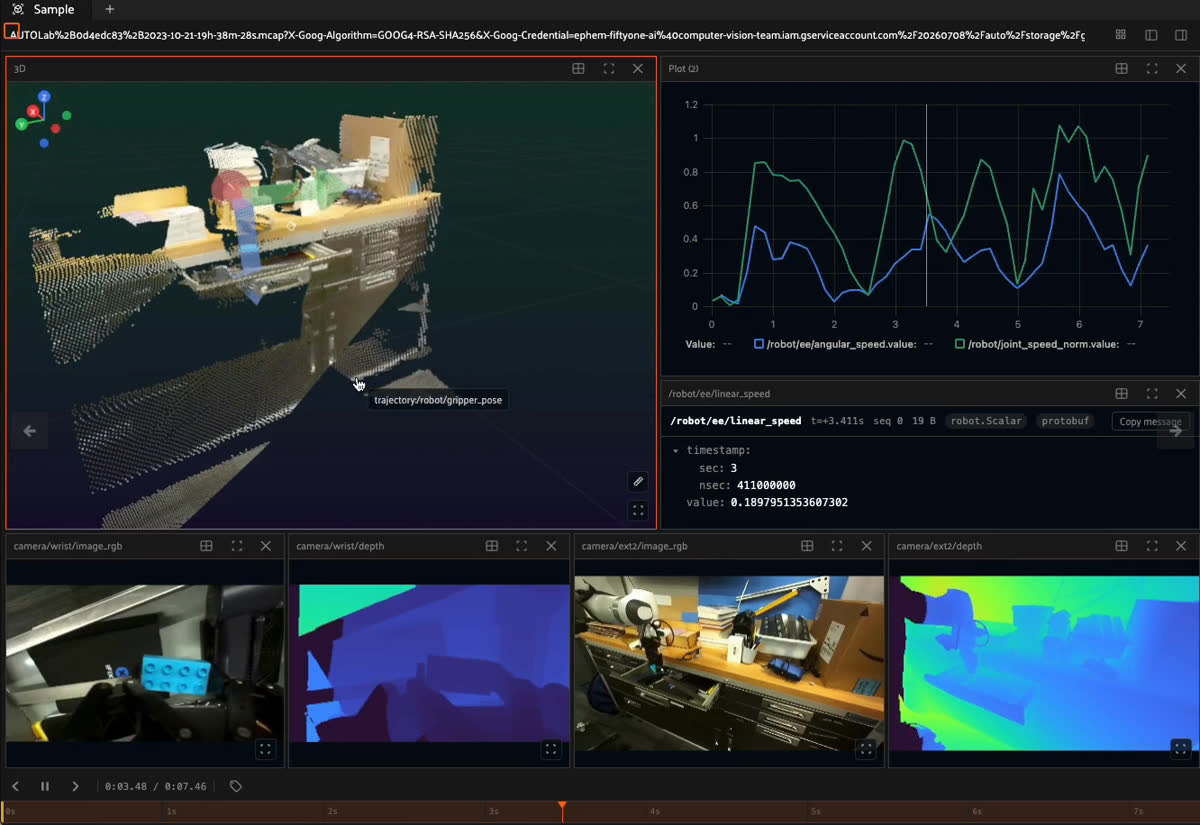
Either way, the matches drop straight into the next training set. Native MCAP support lets you load raw robot logs and play the camera, LiDAR, depth, and proprioceptive streams back in sync on a shared timeline.
FAQ
Why is robotics data so scarce compared to language and vision models?
It can't be scraped. Language and vision models train on data people have already produced. Robot data has to be generated deliberately, on real or simulated hardware, one demonstration at a time. The largest open robotics dataset, Open X-Embodiment, holds roughly 1 million trajectories (arXiv:2310.08864).
What is the action grounding gap?
The distance between recognizing a task and knowing how to physically perform it. Internet video shows what happened but not the forces, joint angles, and sensor readings a robot needs to act (arXiv:2404.19664).
What is a Vision-Language-Action (VLA) model, and why does it matter for generalization?
A VLA maps what a robot sees and is told directly to what it does, learning a whole task end to end rather than chaining separate perception, planning, and control models (arXiv:2307.15818). Its generalization depends on the diversity of its training demonstrations.
Does more training data make a robot generalize better?
Not on its own. Generalization tracks diversity: coverage of rare, long-tailed, and out-of-distribution cases (arXiv:2507.06219). Figure reports Helix reached strong real-world generalization on about 500 curated hours (figure.ai).
What are long-tailed and out-of-distribution cases, and why do they matter?
Situations a robot meets rarely (long tail) or never saw in training (out-of-distribution): odd lighting, an unfamiliar object, a grip that slips. Deployment is full of them, and a robot's own compounding errors produce more (arXiv:1011.0686).
How do teams find rare edge cases in a large robot dataset?
FiftyOne uses multimodal embeddings to surface visually and semantically similar cases across an entire dataset, so one observed failure can be used to find every similar instance hiding in unlabeled data.
What is MCAP, and does FiftyOne support it?
MCAP is the standard container format for synchronized robot sensor logs and the default for ROS 2. FiftyOne's native MCAP support lets teams load and explore raw robot logs without lossy custom extraction. FiftyOne also reads LeRobot v3 datasets natively, starting with FiftyOne 1.22.0 in September 2026. See LeRobot support in Voxel51.
Jesse Mostipak
Director of Growth
Jesse Mostipak is the Director of Growth at Voxel51, where the work is helping humans find and trust what the brand knows, and teaching the Google knowledge graph and the LLMs answering on their behalf to do the same. That question, how knowledge gets built inside a system, is one Jesse has been chasing for years. Earlier versions of it ran through a New York City high school science classroom, data science and machine learning, and developer relations at Kaggle, Posit (formerly RStudio), and Baseten. The answer doesn't change much depending on whether the learner is a teenager, a software engineer, or a knowledge graph. Jesse holds a Master's in Education from CUNY Hunter College. LinkedIn
See all articles by Jesse Mostipak
Talk to an AI expert
Loading related posts...
© 2026 Voxel51 All Rights Reserved


