Visualize Rare Driving Scenarios with FiftyOne: Inside the KITScenes-LongTail Dataset
Author

Hacker-in-Residence
Harpreet is Hacker-in-Residence at Voxel51, where he turns cutting-edge AI ideas into open-source prototypes and demos that push the boundaries of deep learning. From building tools that inspire to creating content that educates, Harpreet helps the AI community level up—one wild idea at a time.
See all articles by Harpreet Sahota
In this article
Key takeawaysWhy is the hardest driving data also the rarest?Six synchronized cameras, one nine-second moment (360° surround view)Trilingual expert reasoning traces, authored not translatedTrajectory prediction overlays baked into every frameThe FiftyOne port: eight slices, one 3D reconstruction, zero extra toolingQwen3-VL embeddings and Brain indexes, pre-computedLoading KITScenes-LongTail with FiftyOneWhat you can do with it todayTry it yourselfFrequently asked questions
In this article
Key takeawaysWhy is the hardest driving data also the rarest?Six synchronized cameras, one nine-second moment (360° surround view)Trilingual expert reasoning traces, authored not translatedTrajectory prediction overlays baked into every frameThe FiftyOne port: eight slices, one 3D reconstruction, zero extra toolingQwen3-VL embeddings and Brain indexes, pre-computedLoading KITScenes-LongTail with FiftyOneWhat you can do with it todayTry it yourselfFrequently asked questions
Try Voxel51 for yourself
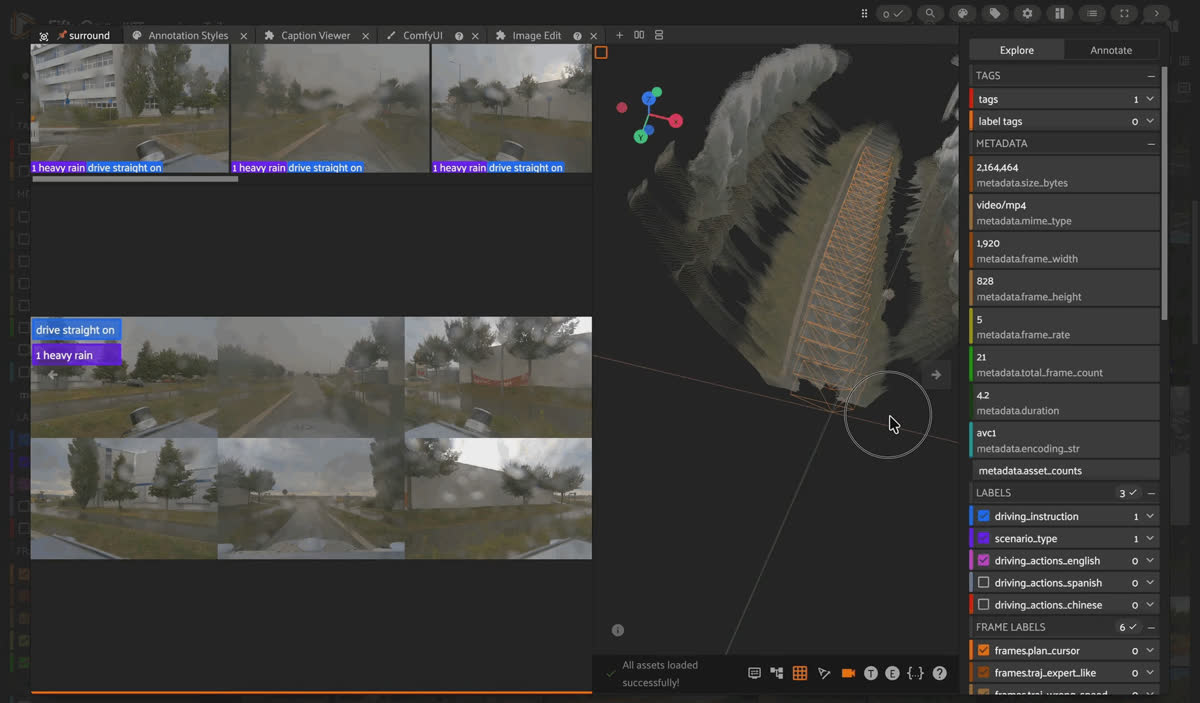
All 103 KITScenes-LongTail scenarios in the FiftyOne App, each tile a six-camera surround montage labeled by scenario type and driving instruction.
KITScenes-LongTail packs 103 real, nine-second driving events, handpicked for how rarely they occur, into a FiftyOne-grouped dataset with six-camera video, a VGGT-Omega 3D reconstruction, and expert reasoning traces in three languages.
Your model can handle everyday traffic. Clear weather, marked lanes, a pedestrian who looks both ways. That part is basically solved.
What it can’t handle is the fog bank at 2 a.m., the construction detour that erases every lane marking it was trained on, the truck stalled sideways in an intersection. It has seen thousands of hours of ordinary driving and, at most, a handful of seconds of the driving that actually matters for safety.
That’s the long-tail problem. The events that are hardest to collect, because they’re rare, are the same events where a wrong prediction is the difference between a near-miss and a crash. Closing that gap isn’t a research nicety. It’s the whole point.
Researchers at KIT's Institute of Measurement and Control Systems (MRT), with the FZI Research Center and partners in Madrid, Toronto, and Delft, built a benchmark around exactly this gap: KITScenes-LongTail, a dataset of 103 real, nine-second long-tail driving events. Voxel51 ported it into a FiftyOne grouped dataset with six-camera video, trajectory overlays, a VGGT-Omega 3D reconstruction, and pre-computed embeddings, all queryable the moment you call
fo.launch_app()Key takeaways
- Each of the 103 released scenarios is one FiftyOne group with 8 slices: the six surround cameras (
front_left,front,front_right,rear_left,rear,rear_right), a synced 2×3surroundmontage, and athreedslice, a VGGT-Omega point cloud reconstructed from the front camera. - The
frontslice carries per-framedepth_mapheatmaps, pluscamera_translation,camera_rotation_matrix,camera_quaternion, andintrinsic_matrixfields, all model-estimated by VGGT-Omega rather than sensor-measured LiDAR. - On the 3
trainscenarios, four trajectory variants (traj_expert_like,traj_wrong_speed,traj_off_road,traj_crash) are baked in as per-framePolylines, alongside apast_trailbreadcrumb and aplan_cursorKeypoint that advances frame by frame. - The
reasoning_english,reasoning_spanish, andreasoning_chinesefields each hold a 9-part expert reasoning trace, independently authored (not machine-translated) and transcribed with Whisper, so you can compare how reasoning style shifts across languages for the identical driving moment. - 2048-d Qwen3-VL embeddings on the
surround,front, andrearslices are pre-indexed with FiftyOne Brain: similarity search, a UMAP visualization, and per-clipuniqueness_*/representativeness_*scores, all computed already. - This is a curated preview, not the full corpus: 103 of an eventual 1,000 scenarios (100
test+ 3trainfew-shot examples), released under CC BY-NC 4.0 (non-commercial).
Why is the hardest driving data also the rarest?
The core difficulty is statistical, not technical. A model trained on typical driving logs sees car-follows-car-on-a-clear-day thousands of times over and rare events, if it sees them at all, only a handful of times. It never builds a robust internal representation of them, so when one shows up in the real world, it has nothing to draw on.
Good to know. How did the researchers decide what counts as “long-tail”? They used nuScenes as a reference distribution and applied the Pareto principle: any event type that fell below a 20% cumulative-frequency threshold on a rank-frequency plot was a candidate for inclusion. In practice, that pulls in heavy rain, snow, and fog; road closures and construction zones; accidents and emergency vehicles; complex maneuvers like “overtake truck driving on the right”; and sharp urban turns at ambiguous intersections.
scenario_type values in the actual data look like coded labels, e.g. "4 intersection" or "0 specifically selected", rather than free text.The data itself isn’t synthetic. It was recorded over two years starting in late 2023, across urban, suburban, and highway routes around Karlsruhe, Heidelberg, Mannheim, and the Black Forest, with routes deliberately adjusted toward construction zones and intersections likely to produce the events above.
Six synchronized cameras, one nine-second moment (360° surround view)
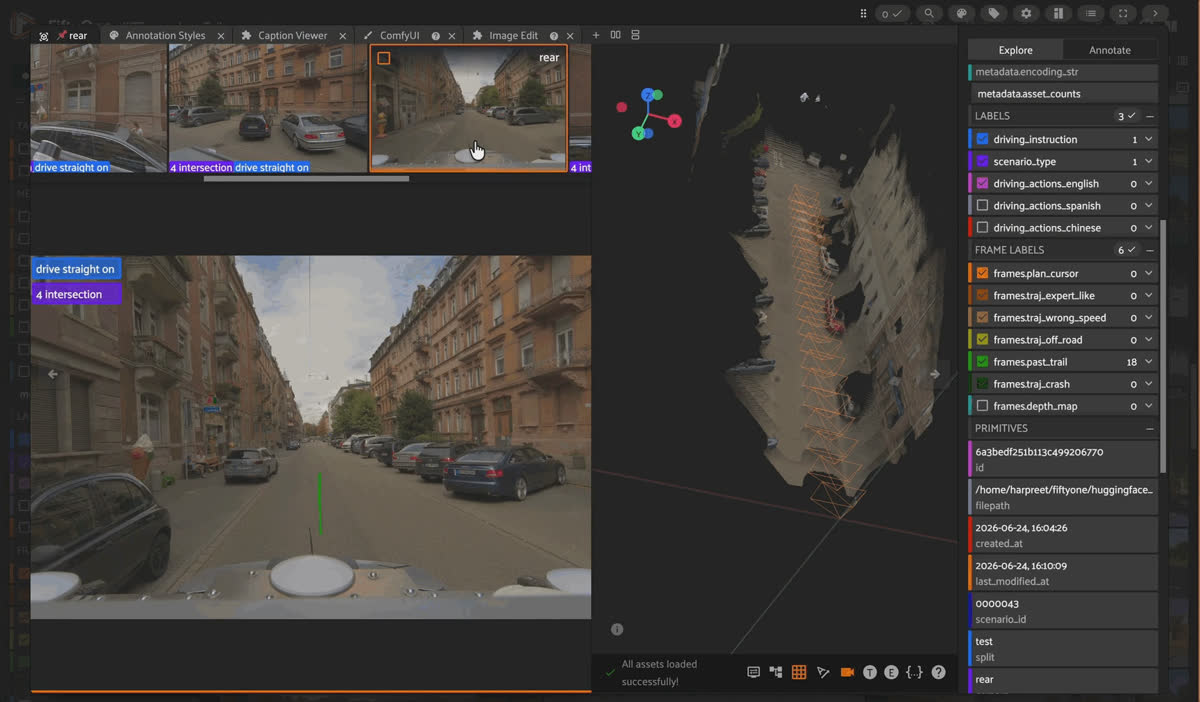
A single nine-second scenario in FiftyOne, with the 2x3 surround-camera montage playing beside the VGGT-Omega point cloud reconstructed from the front camera.
Every scenario is built the same way: six synchronized cameras (front-left, front, front-right, rear-left, rear, rear-right) captured at 3504×2272 resolution, giving a full 360° surround view. The observed window is 21 frames at 5 Hz, about 4 seconds of real footage. On the 3 released
train scenarios, FiftyOne extends that with the labeled 5-second prediction horizon (25 waypoints), giving you a target trajectory to evaluate against.Keep it honest. On
train, the video frames after that 4-second mark aren’t real footage. They’re the last observed frame frozen and repeated, existing purely so the future trajectory overlays and reasoning windows have valid frame supports to render against. If you’re doing anything photometric or geometric with those frames, you’re working with a still image, not new imagery.Trilingual expert reasoning traces, authored not translated
What sets KITScenes-LongTail apart from a typical trajectory-prediction benchmark is the reasoning layer. For each
train scenario, a domain expert and a self-driving researcher answered five questions: one open-ended situational-awareness prompt, followed by acceleration and steering decisions for the first 0–3 seconds and the final window of the horizon, each with a stated reason.Crucially, experts answered in their own language, and the responses were transcribed with Whisper rather than translated after the fact. That’s why
reasoning_english, reasoning_spanish, and reasoning_chinese exist as three independent 9-field dicts on every train sample, each one a native articulation of the same driving decision. It’s a genuinely unusual resource for studying whether reasoning style or language affects the coherence of a model’s stated logic with its predicted trajectory.Keep it honest. Only 3
train scenarios are in this release, meant as few-shot in-context examples, not training data for a model from scratch. The qa_english_reconstructed and reasoning_cot_english_reconstructed fields are FiftyOne-assembled: the paper’s English question templates wrapped around the experts’ verbatim answers. The Spanish and Chinese equivalents were intentionally not generated, so don’t expect a reasoning_cot_spanish_reconstructed field to show up.Trajectory prediction overlays baked into every frame
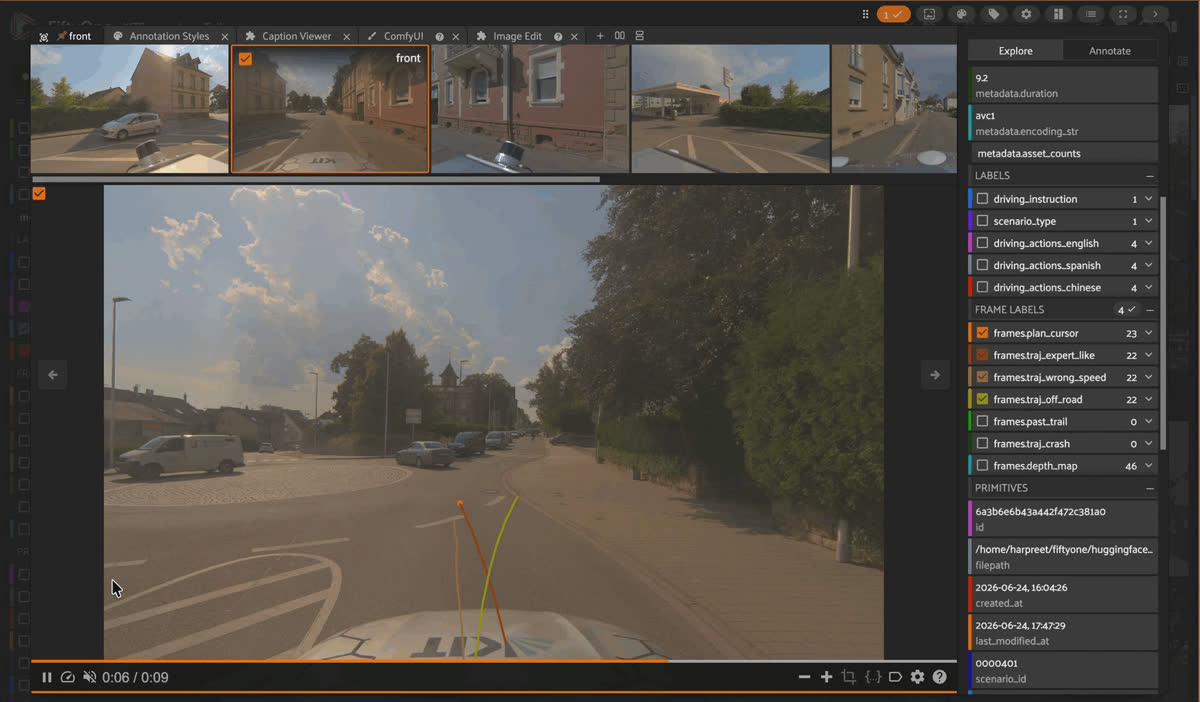
Trajectory variants overlaid frame by frame on the front camera, with the plan_cursor advancing along the expert path through a nine-second scenario.
The paper doesn’t score models against a single “correct” path. It introduces a multi-maneuver score (MMS) that evaluates a model’s plausibility against several candidate futures, which is why the dataset ships four trajectory variants as per-frame
Polylines on the six camera slices:traj_expert_like, the ground-truth expert plantraj_wrong_speed, an adversarial variant with incorrect speedtraj_off_road, an adversarial variant that leaves the roadtraj_crash, a crash trajectory, where annotations exist
A
past_trail Polylines field builds up the vehicle’s driven history frame by frame, and a plan_cursor Keypoint advances along the expert path so you can watch, frame by frame, whether a predicted trajectory stays semantically coherent with the scenario.Keep it honest. These aren’t four equally “real” recordings.
traj_expert_like reflects an actually driven path; traj_wrong_speed is generated via state estimation and spline modification; the remaining categories are manually labeled. None of them are model predictions; they’re reference trajectories built into the benchmark, though they vary in the degree of human construction.The FiftyOne port: eight slices, one 3D reconstruction, zero extra tooling
Voxel51’s conversion isn’t a repackaging of the raw files. Each of the 103 scenarios becomes one FiftyOne group with 8 slices: the six camera videos, the synced
surround montage, and a threed slice, a .fo3d point cloud reconstructed from the front camera using VGGT-Omega, opening directly in the FiftyOne 3D viewer. The matching per-frame depth_map heatmaps and camera pose fields (camera_translation, camera_rotation_matrix, camera_quaternion, intrinsic_matrix) reside on the front slice itself; no separate tooling is required to align them.Keep it honest. The
threed point cloud and depth_map values are model-estimated by VGGT-Omega from the monocular front video. They’re useful for understanding scene geometry, but they are not sensor-measured LiDAR ground truth and shouldn’t be treated as depth labels.Qwen3-VL embeddings and Brain indexes, pre-computed
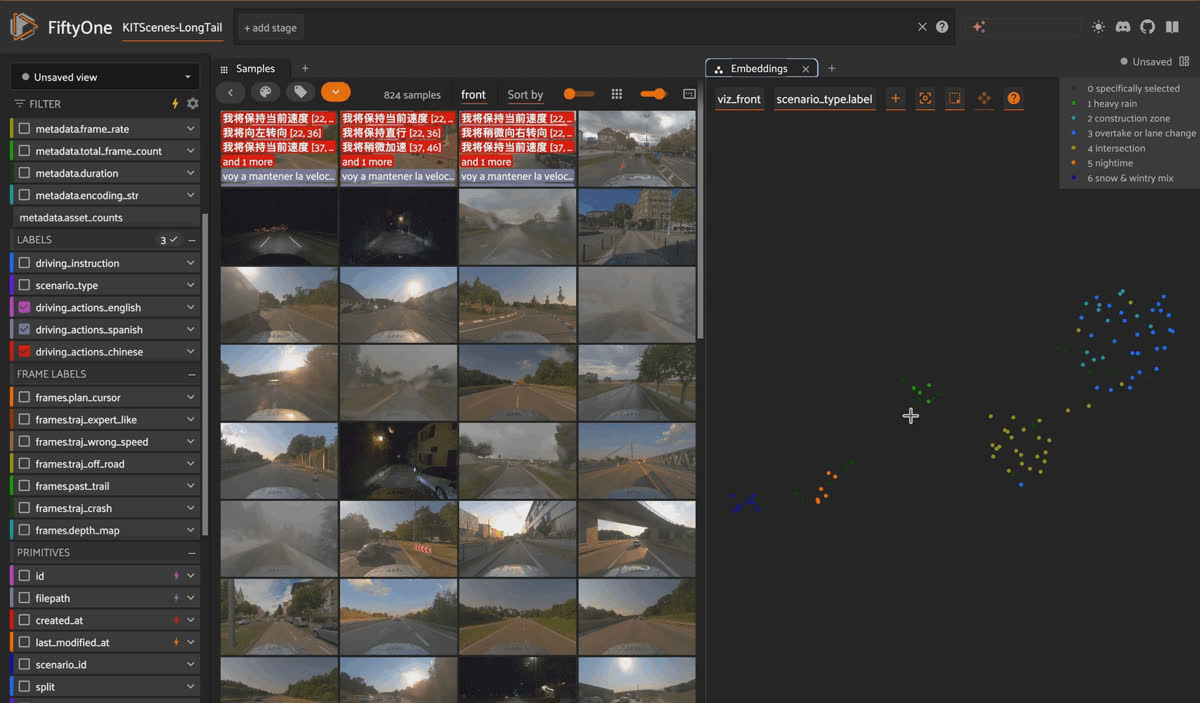
Pre-computed 2048-dimensional Qwen3-VL embeddings shown as a UMAP scatter plot in the FiftyOne Brain panel, colored by scenario type beside the sample grid.
Voxel51 computed 2048-dimensional Qwen3-VL clip embeddings for the
surround, front, and rear slices and indexed them with FiftyOne Brain. Out of the box, that gets you:- Nearest-neighbour similarity search across clips
- A UMAP 2D embedding scatter plot for interactive exploration
- A
uniqueness_*score per clip, to surface the rarest outlier scenarios - A
representativeness_*score per clip, to find the most prototypical examples for few-shot prompting
None of this requires you to load a model or compute an embedding yourself. It ships with the dataset.
Loading KITScenes-LongTail with FiftyOne
Step 1: Install FiftyOne
pip install -U fiftyoneStep 2: Import what you need
import fiftyone as fo
from fiftyone.utils.huggingface import load_from_hub
from huggingface_hub import snapshot_download
Step 3: Download and load the dataset
# Download the dataset snapshot to the current working directory
snapshot_download(
    repo_id="Voxel51/KITScenes-LongTail",
    local_dir=".",
    repo_type="dataset"
)

# Load the dataset from the current directory using FiftyOne's native format
dataset = fo.Dataset.from_dir(
    dataset_dir=".",
    dataset_type=fo.types.FiftyOneDataset,
    name="KITScenes-LongTail"
)
Step 4: Launch the App
session = fo.launch_app(dataset)The App ships with saved views ready to go from the view dropdown:
slice__front, slice__front_left, and one per camera flatten the group to a single viewpoint for scanning all 103 clips, and by_scenario_type_and_instruction groups clips by scenario_type, ordered by driving_instruction within each group.What you can do with it today
Zero-shot and few-shot benchmarking of VLMs
Feed the 3
train scenarios as in-context examples to a VLM and run inference over the 100 test scenarios. The benchmark is designed to evaluate instruction-following and the semantic coherence between a model’s reasoning chain and its predicted trajectory, a richer signal than raw displacement error alone.Surfacing the rarest scenarios
The pre-computed uniqueness scores let you sort clips by how unusual they are within their slice. Sorting is one line:
view = dataset.sort_by("uniqueness_surround", reverse=True)
session.view = view
Multilingual reasoning research
For anyone studying chain-of-thought reasoning across languages, the trilingual traces are immediately usable. FiftyOne’s sample panel lets you display
reasoning_english, reasoning_spanish, and reasoning_chinese side by side in any scenario, without preprocessing.3D scene reconstruction and depth analysis
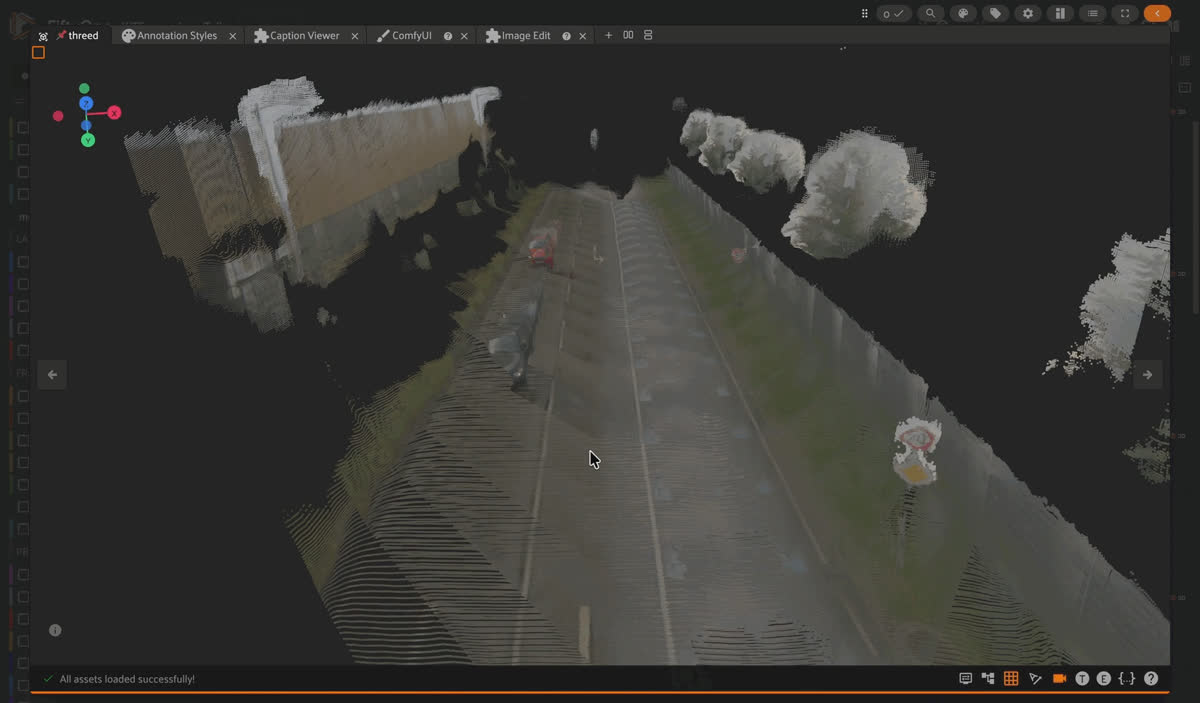
The threed slice in the FiftyOne 3D viewer, a VGGT-Omega point cloud reconstructed from the monocular front video, not sensor-measured LiDAR.
The
threed slice and the front slice’s depth_map heatmaps let you inspect scene geometry and stress-test depth-aware models directly in the App, no separate viewer needed. Remember: this is VGGT-Omega’s monocular estimate, not LiDAR.Try it yourself
- Dataset: Voxel51/KITScenes-LongTail
- Original dataset: KIT-MRT/KITScenes-LongTail
- Paper: Wagner et al., “LongTail Driving Scenarios with Reasoning Traces: The KITScenes LongTail Dataset”, arXiv:2603.23607 (2026)
- Demo Space: KIT-MRT/KITScenes-LongTail-Challenge
- FiftyOne docs: docs.voxel51.com
Frequently asked questions
Is the threed slice real LiDAR data?
No. It’s a
.fo3d point cloud reconstructed from the monocular front camera video using VGGT-Omega. The per-frame depth_map, camera_translation, camera_rotation_matrix, camera_quaternion, and intrinsic_matrix fields on the front slice are all part of that same model-estimated reconstruction, not sensor ground truth.Can I use this dataset commercially?
No. It’s released under CC BY-NC 4.0 with additional non-commercial dataset terms: cite the publication, respect the anonymized faces/plates, and use the data “as is.” Where the dataset terms conflict with CC BY-NC 4.0, the dataset terms prevail.
How many scenarios are actually in this release?
103: 100
test and 3 train (few-shot examples). The full collection is 1,000 nine-second scenarios (train 500 / test 400 / validation 100); the remaining train and validation splits, plus stitched 360° images, are announced for a future release.Are the “future” video frames on train real footage?
No. Frames after the 21-frame (~4 s) observed window freeze the last observed frame and repeat it. They exist so the future trajectory overlays and reasoning action windows have valid frame supports to render against, not to represent new imagery.
What’s the difference between traj_expert_like and the other trajectory fields?
traj_expert_like reflects an actual expert-driven path. traj_wrong_speed is generated via state estimation and spline modification from that path. traj_off_road and traj_crash are manually labeled, and traj_crash is only present where annotations exist. None of the four are model predictions; they’re the benchmark’s reference trajectories for scoring plausibility against multiple plausible maneuvers (the paper’s MMS metric), not a single ground-truth path.Do I need to compute my own embeddings to use similarity search or uniqueness scores?
No.
qwen_emb_surround, qwen_emb_front, and qwen_emb_rear (2048-d Qwen3-VL embeddings) and their FiftyOne Brain indexes (sim_*, viz_*, uniqueness_*, representativeness_*) ship with the dataset already computed.The long tail is where autonomous driving systems fail, and where progress is hardest to measure. KITScenes-LongTail doesn’t fix that by collecting more of the same. It fixes it by refusing to.
Hacker-in-Residence
Harpreet is Hacker-in-Residence at Voxel51, where he turns cutting-edge AI ideas into open-source prototypes and demos that push the boundaries of deep learning. From building tools that inspire to creating content that educates, Harpreet helps the AI community level up—one wild idea at a time.
See all articles by Harpreet Sahota
Try Voxel51 for yourself
Loading related posts...
© 2026 Voxel51 All Rights Reserved


