Voxel51 Adds LeRobot Support for Robotics Data
Author

Machine Learning Engineer
Passionate about Artificial Intelligence, Entrepreneurship and the intersection of the two.
See all articles by Prerna Dhareshwar
In this article
Key takeawaysWhy LeRobot has become an important robotics data formatExplore LeRobot datasets with synchronized playbackSearch LeRobot data at scaleUse embeddings to find similar behaviors across LeRobot datasetsGo beyond episode-level analysis with segment-level embeddingsTurn LeRobot demonstrations into better training datasetsOne platform for LeRobot and MCAP dataGet started with LeRobot in Voxel51FAQ
In this article
Key takeawaysWhy LeRobot has become an important robotics data formatExplore LeRobot datasets with synchronized playbackSearch LeRobot data at scaleUse embeddings to find similar behaviors across LeRobot datasetsGo beyond episode-level analysis with segment-level embeddingsTurn LeRobot demonstrations into better training datasetsOne platform for LeRobot and MCAP dataGet started with LeRobot in Voxel51FAQ
Try Voxel51 for yourself
A note on product naming: The commercial platform previously known as “FiftyOne Enterprise” is now called Voxel51. The open-source project continues under the name FiftyOne.
LeRobot has quickly become one of the most important open-source ecosystems for robot learning. Developed by Hugging Face, it provides a common framework for collecting data, training policies, and sharing robotics datasets across different embodiments and tasks.
That ecosystem is growing fast. The LeRobot organization on Hugging Face now hosts nearly 200 datasets, while its Community Dataset v3 alone brings together more than 50,000 episodes from 235 contributors across 46 robot embodiments.
Voxel51 now supports LeRobot datasets as a first-class multimodal data format, alongside MCAP. LeRobot standardizes the data used to train robotics models. Voxel51 helps teams understand what’s in that data, find the examples that matter, and turn them into better training and evaluation datasets.
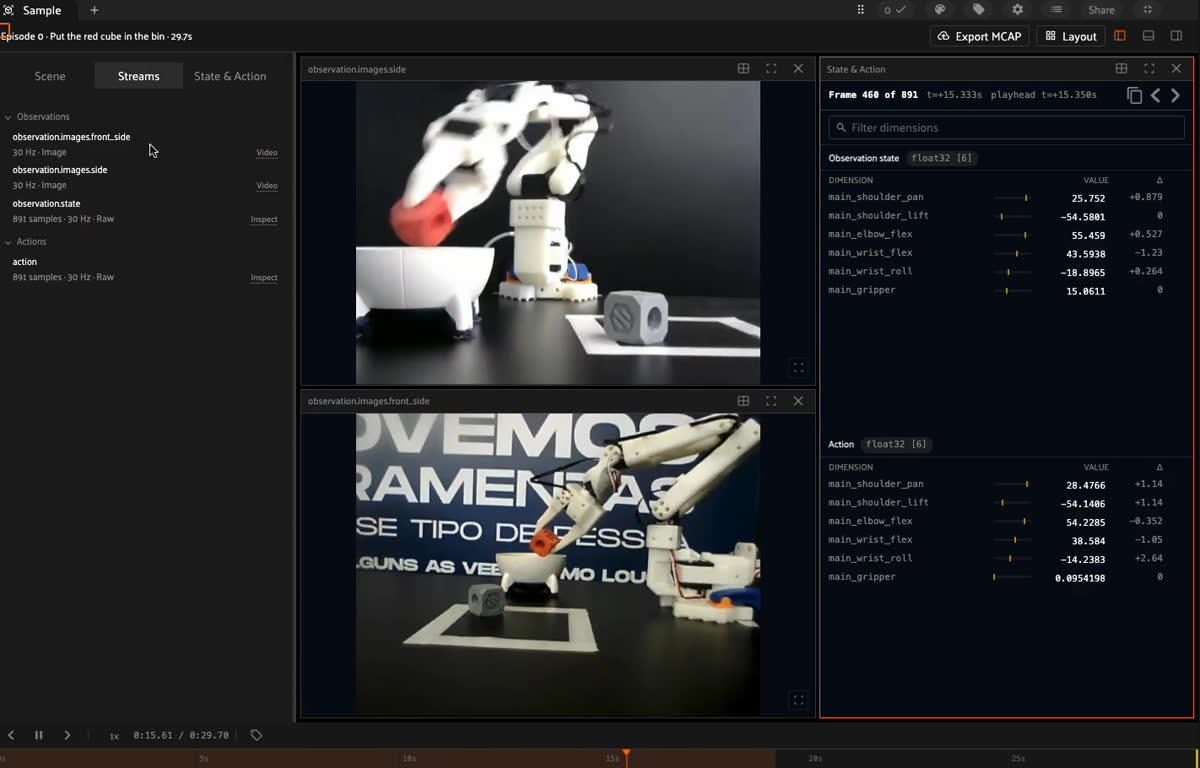
LeRobot visualization inside Voxel51
Key takeaways
- Native support for LeRobot datasets. Work directly with LeRobot's episode-based robotics data without building a custom visualization or curation pipeline.
- Synchronized multimodal playback. Explore camera streams, robot state, actions, sensor signals, annotations, and predictions together on a shared timeline.
- Label tracks and timelines. Inspect objects, events, and behaviors as they evolve across complete episodes rather than as isolated frames.
- Search across entire robotics datasets. Query episodes and temporal segments using natural language, visual similarity, embeddings, events, metadata, and labels.
- Segment-level embeddings. Retrieve the specific moments inside robot demonstrations that match a semantic or visual query.
- Fine-grained temporal curation. Tag arbitrary intervals, create reusable cohorts, and turn interesting behaviors or failures into training and evaluation data.
Why LeRobot has become an important robotics data format
Robot learning data doesn't fit neatly into collections of independent images. A single demonstration may combine several camera views with joint positions, actions, timestamps, task descriptions, and other time-series signals.
LeRobot standardizes that structure for robot learning. Its current v3 format stores high-frequency state and action data in Parquet, visual observations in MP4, and metadata describing features, tasks, statistics, and episode boundaries. The format is designed to scale while exposing an intuitive episode-level interface to researchers and training pipelines.
As those datasets grow, teams still need to answer a different set of questions: What behaviors are represented? Where are the failures? Which demonstrations are redundant? What scenarios are missing?
Voxel51 gives teams a dataset-level view of LeRobot data so they can search, compare, and curate episodes and segments before they become inputs to the next training run.
Explore LeRobot datasets with synchronized playback
Voxel51 turns a LeRobot dataset into an interactive multimodal dataset.
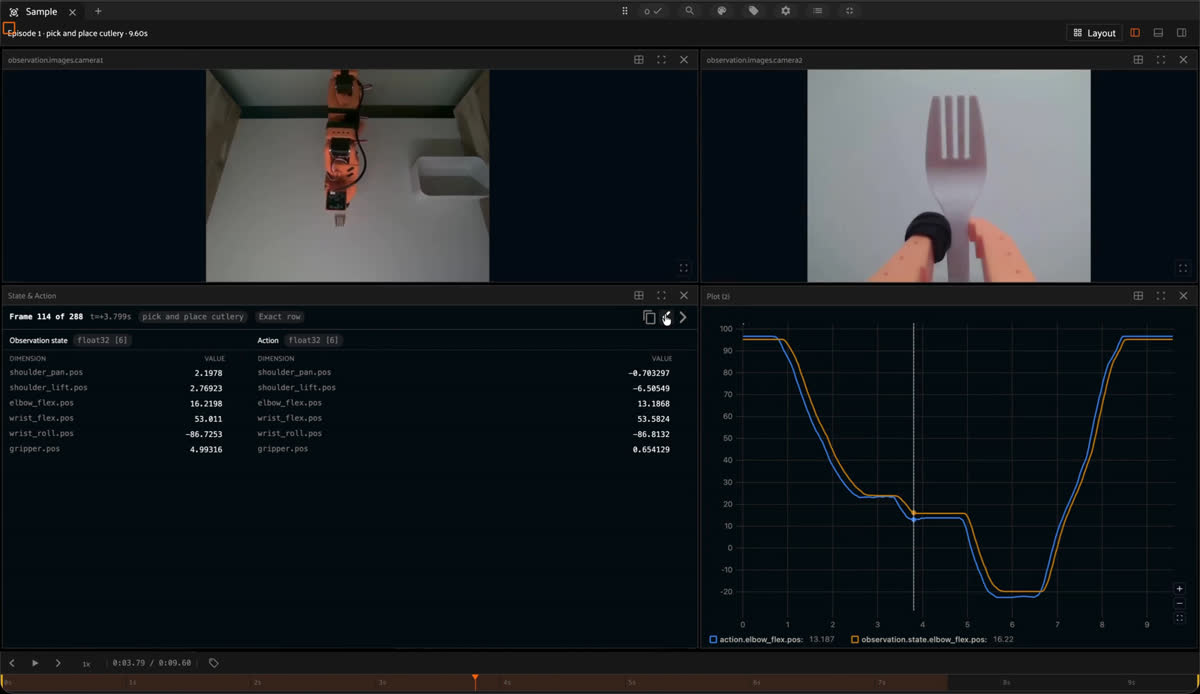
Playback of synchronized LeRobot data streams
Open an episode and inspect camera feeds, actions, robot state, time-series signals, annotations, model predictions, and other fields together on a synchronized timeline. Configurable Tiles let you arrange the views that matter for a particular robot or investigation.
Instead of debugging each modality separately, you can inspect the complete demonstration in context.
Search LeRobot data at scale
Watching demonstrations one at a time doesn't scale.
Voxel51 indexes multimodal robotics data so you can search across an entire LeRobot dataset using natural language, visual similarity, embeddings, metadata, labels, and derived events.
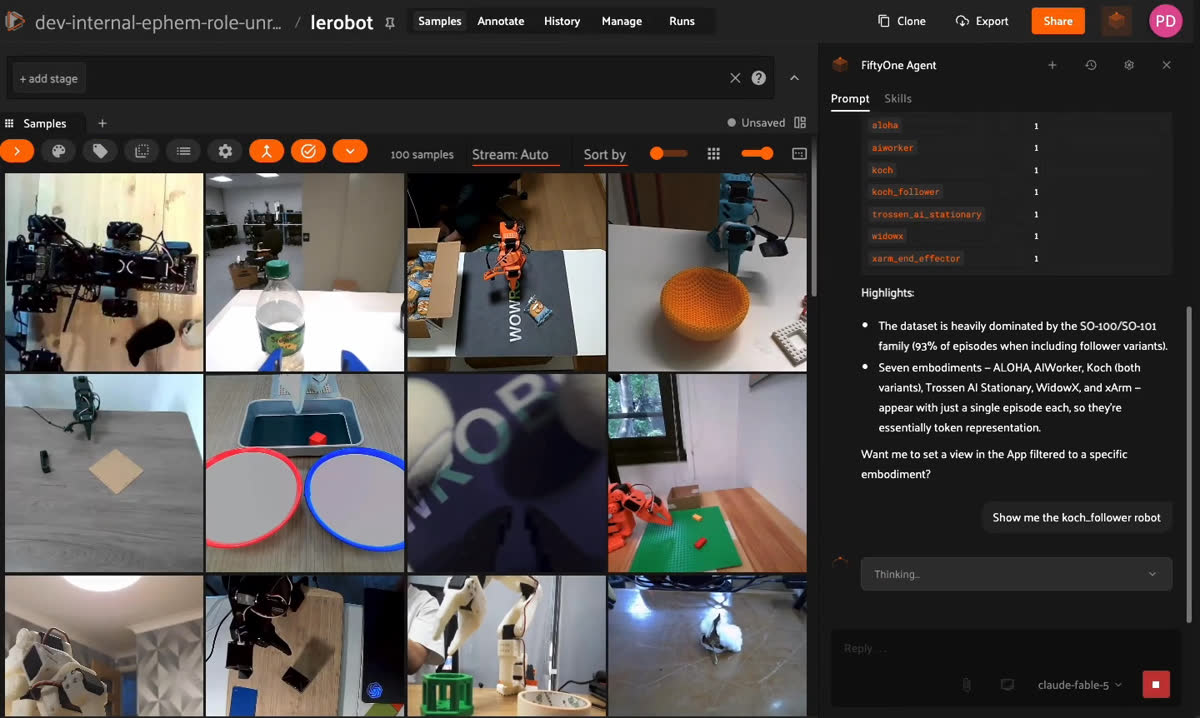
Voxel51 Agent searches for robot embodiments in a LeRobot dataset.
You might start with a failed manipulation and retrieve similar demonstrations. Or search for a behavior using natural language, then combine those results with task, embodiment, environment, or other metadata.
Search results remain connected to the original episode, so every result can immediately be inspected in full multimodal context.
Use embeddings to find similar behaviors across LeRobot datasets
Embeddings make it possible to search robotics data by what is happening in the scene, not just by the metadata or labels attached to it.
Voxel51 can compute embeddings across LeRobot data at multiple levels, including images, objects, temporal segments, and full episodes. You can use those representations to find visually or semantically similar data, explore clusters, surface outliers, and compare how behaviors are distributed across a dataset.
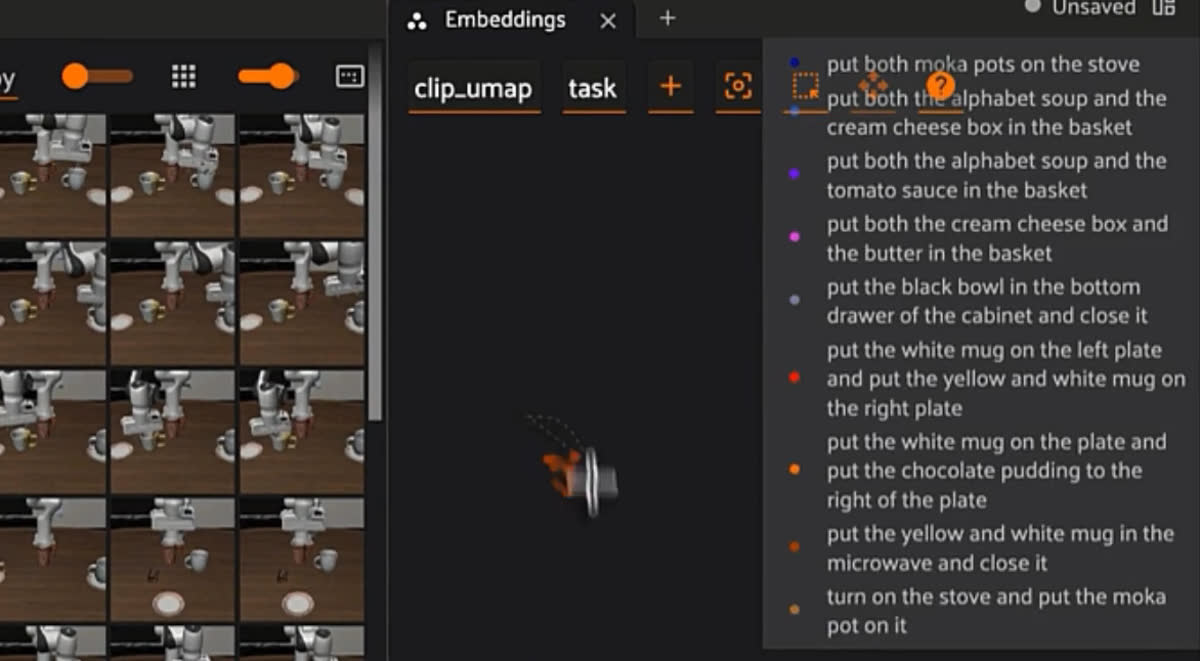
Opening the FiftyOne Embeddings panel to view a UMAP projection of CLIP embeddings for LIBERO frames
Go beyond episode-level analysis with segment-level embeddings
A robot demonstration may last tens of seconds or minutes, while the behavior you care about lasts only a fraction of that time.
Voxel51 lets you work at both levels. Explore complete LeRobot episodes for context, then search, tag, embed, and curate the specific temporal segments where meaningful behaviors occur.
For time-series robotics data, segment-level embeddings are especially useful. Instead of representing an entire demonstration with a single embedding, Voxel51 can embed individual temporal segments and retrieve the specific moments that match a natural language or similarity query.
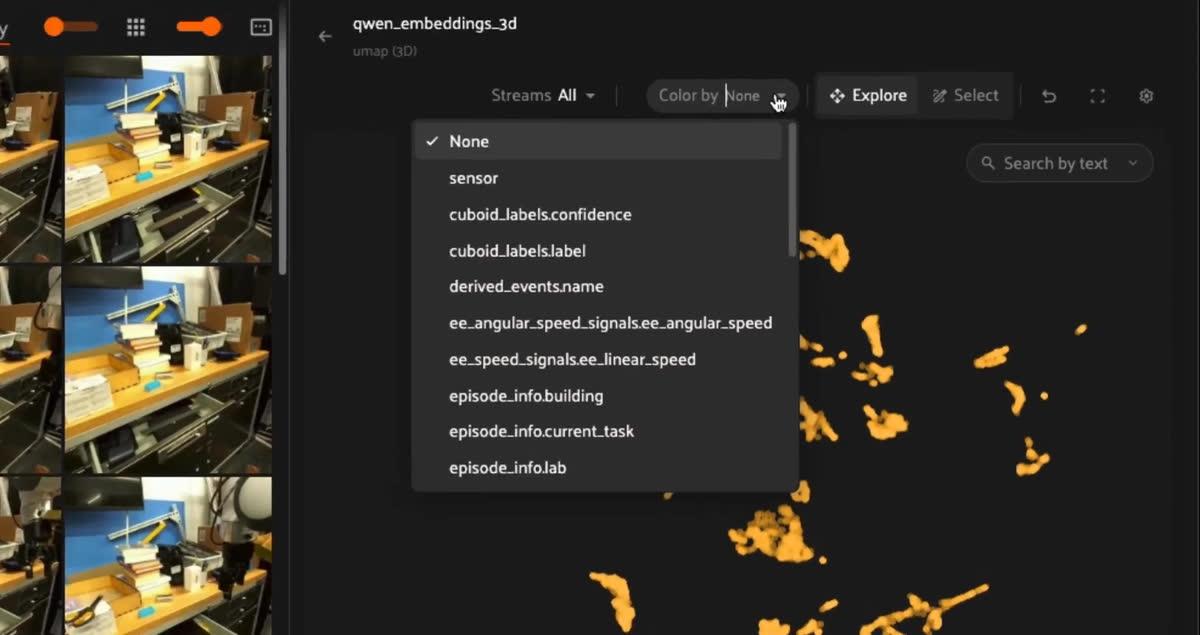
Segment-level embeddings on MCAP data with support for LeRobot coming soon.
That makes it easier to find recurring behaviors, edge cases, and failure modes that may appear only briefly within much longer episodes — and turn those segments into targeted training or evaluation data.
Turn LeRobot demonstrations into better training datasets
With Voxel51, teams can turn LeRobot search results into persistent dataset cohorts for training, evaluation, annotation, or additional investigation.
Tag arbitrary temporal intervals, isolate recurring policy failures, surface unusual demonstrations, identify redundant data, or find gaps in task and environment coverage.
One platform for LeRobot and MCAP data
Robotics teams rarely operate with a single data source.
LeRobot is increasingly common for robot learning datasets and demonstrations, while MCAP is widely used for recording ROS-based multimodal sensor data. Voxel51 now supports both formats with the same core visualization, search, and curation workflows.
That means teams can use the data format that makes sense for each part of their robotics stack without creating a separate analysis workflow for each one.
Whether your data begins as a LeRobot dataset or an MCAP recording, Voxel51 provides a common environment for understanding model behavior, finding the data that matters, and building better datasets for vision-language-action (VLA) and robotics models.
Comparing LeRobot & MCAP formats for robotics data
| LeRobot | MCAP | |
|---|---|---|
| Best suited for | Robot learning datasets and demonstrations | Multimodal robotics and autonomy logs |
| Typical data | Camera observations, robot state, actions, task metadata, episodes | Camera, LiDAR, radar, IMU, transforms, control signals, ROS messages |
| Data organization | Episode-based dataset format | Time-series log / recording format |
| Common use cases | Policy training, VLA fine-tuning, imitation learning, dataset sharing | Data logging, debugging, autonomy development, sensor analysis |
| Ecosystem | Hugging Face LeRobot | ROS 2, autonomous systems tooling |
| In Voxel51 | Synchronized visualization, search, embeddings, label tracks, temporal tagging, curation | Synchronized visualization, search, embeddings, label tracks, temporal tagging, curation |
Get started with LeRobot in Voxel51
The value of a robotics dataset isn't just how many demonstrations it contains. It's whether those demonstrations help the policy generalize.
Voxel51 lets teams connect dataset exploration with model evaluation: isolate failure modes, find related demonstrations, identify coverage gaps, and turn those findings into targeted training or evaluation cohorts.
If you're already collecting demonstrations with LeRobot, you can bring those datasets into Voxel51 and start exploring them with synchronized visualization, multimodal search, embeddings, curation, and annotation workflows.
Get started with LeRobot in Voxel51 today.
| Feature | FiftyOne OSS | Voxel51 |
|---|---|---|
| Native LeRobot visualization | ✅ Yes | ✅ Yes |
| Temporal tags | ✅ Yes | ✅ Yes |
| Search and filter | ❌ No | ✅ Yes |
| Embeddings-based search | ❌ No | ✅ Yes |
| Label tracks & timelines | ❌ No | ✅ Yes |
FAQ
LeRobot is an open source robot learning library and dataset format from Hugging Face that standardizes camera observations, robot state, actions, and task metadata into episode-based datasets. Its Hugging Face organization hosts nearly 200 datasets.
Voxel51 loads LeRobot datasets natively and plays camera feeds, actions, robot state, time-series signals, and annotations on a synchronized timeline, with configurable tiles per view.
LeRobot is an episode-based dataset format for robot learning and demonstrations, while MCAP is a time-series container format for recording ROS-based multimodal sensor logs. Voxel51 supports both with the same workflows.
Yes. Voxel51 indexes LeRobot data so you can query episodes and temporal segments with natural language, visual similarity, embeddings, events, metadata, and labels.
FiftyOne is the open-source project for visualizing and curating multimodal datasets. Voxel51 is the commercial platform that extends FiftyOne with scalable team collaboration, fine-grained access control, and enterprise-grade data infrastructure. Voxel51 was formerly called FiftyOne Enterprise, and Voxel51 is also the name of the company that builds both.
For LeRobot datasets, visualization and temporal tags are available in open-source FiftyOne. Search and embedding functionality require a Voxel51 license.
Machine Learning Engineer
Passionate about Artificial Intelligence, Entrepreneurship and the intersection of the two.
See all articles by Prerna Dhareshwar
Try Voxel51 for yourself
Loading related posts...
© 2026 Voxel51 All Rights Reserved


