Introducing Voxel51 3.0: The end-to-end multimodal platform for physical AI
Author

Co-founder and CEO
Dr. Brian Moore is Co-founder and CEO of Voxel51, where he leads the strategy and vision of the company and is actively involved in the design and execution of the core software infrastructure. Brian holds a Ph.D. in Electrical Engineering from the University of Michigan, where his research was focused on efficient algorithms for large-scale machine learning problems with a particular emphasis on computer vision applications. He has authored dozens of articles in peer-reviewed journals and conference proceedings on various topics in machine learning, statistics, and optimization.
See all articles by Brian Moore
In this article
Key takeawaysVoxel51 adds multimodal time-series support and annotation to existing curation and model evaluation workflowsIndex multimodal data with Voxel51 SearchDeploy agentic workflows across your physical AI data loop with Voxel51 AgentTrack data provenance with activity logs, edit history, and dataset versioningBring your own models to Voxel51 into the data loopVoxel51 and Nebius partner to make physical AI workflows easier to tryHow to try Voxel51 3.0 for freeFAQ
In this article
Key takeawaysVoxel51 adds multimodal time-series support and annotation to existing curation and model evaluation workflowsIndex multimodal data with Voxel51 SearchDeploy agentic workflows across your physical AI data loop with Voxel51 AgentTrack data provenance with activity logs, edit history, and dataset versioningBring your own models to Voxel51 into the data loopVoxel51 and Nebius partner to make physical AI workflows easier to tryHow to try Voxel51 3.0 for freeFAQ
Try Voxel51 for yourself
We’ve spent years working with teams deploying AI in some of the most demanding environments — from autonomous systems and robotics to manufacturing and healthcare.
Once a model moves beyond prototype, the data problem changes. Teams aren’t just training a model against a fixed dataset. They’re continuously working with new data, investigating failures, curating training sets, and evaluating how models perform across real-world scenarios.
These workflows are interconnected, which makes a collection of point tools difficult to manage as teams scale AI into production. Teams need a platform that supports the full data flywheel for physical AI while still giving them the flexibility, control, and integration they need to fit into their existing stack.
Over the past several months, we’ve been rebuilding Voxel51 around those lessons. Today, we’re introducing Voxel51 3.0: our most significant release yet, bringing the full data loop into a single, extensible platform for physical AI — with persistent multimodal search, agentic workflows, data provenance, and the freedom to bring your own models and infrastructure.
Best of all, you can now check out all of these capabilities for free at app.voxel51.com. You’ll be in good company. Voxel51 already powers AI workflows at some of the world’s leading companies.
Key takeaways
- Voxel51 3.0 brings search, curation, annotation, and evaluation of multimodal data for physical AI into a single, extensible platform.
- Voxel51 3.0 adds first-class support for time-series multimodal data, unified annotation workflows, and Agentic Labeling, which uses vision-language models (VLMs) to generate labels from natural-language instructions.
- Voxel51 Agent chains search, curation, annotation, and evaluation into repeatable workflows, using 45+ MCP tools, 80+ operators, and 18 open-source skills.
- Try Voxel51 3.0 at app.voxel51.com, on your data, for free.
Voxel51 adds multimodal time-series support and annotation to existing curation and model evaluation workflows
One thing we hear consistently from teams operating AI at scale is that data workflows are too fragmented. Every handoff adds friction, duplicated infrastructure, and another place where context gets lost.
That is why we’ve spent the last few months expanding Voxel51 beyond its roots in visual data. We’ve added:
- First-class support for time-series multimodal data, including the ability to visualize multiple sensor streams on the same timeline, compute segment-level embeddings, and search for specific moments within long-running recordings.
- Unified annotation workflows for 2D, 3D, video, and multimodal data, with automated QA, annotator metrics, and tools for managing human-in-the-loop review.
- Agentic Labeling, which uses VLMs to generate labels from natural-language instructions and examples, with intelligent review workflows for validating the results.
| Capability | What it does | Data loop stage |
|---|---|---|
| Time-series multimodal support | Visualizes multiple sensor streams on one timeline and searches moments inside long recordings | Search, Curate |
| Voxel51 Search | A persistent hybrid search index combining semantic and lexical search with structured metadata and multimodal events. | Search |
| Unified annotation | 2D, 3D, video, and multimodal labeling with automated QA and annotator metrics | Annotate |
| Agentic Labeling | Generates labels with VLMs from natural-language instructions and examples | Annotate |
| Voxel51 Agent | Chains search, curation, annotation, and evaluation into repeatable workflows | All stages |
| Data provenance | Activity logs, sample edit history, and dataset versioning | All stages |
| Bring your own models | Model-agnostic support for embeddings, labeling, inference, and evaluation | All stages |
Built for teams taking models to production — with governance, extensibility, and flexible deployment options — Voxel51 now supports the core data loop for physical AI in a single platform: search, curate, annotate, and evaluate multimodal data.
Index multimodal data with Voxel51 Search
As datasets grow larger and more complex, finding the right data shouldn’t require rebuilding search infrastructure for every new query. Voxel51 Search is built to handle the different ways machine learning teams actually look for data, automatically indexing datasets and computing embeddings so search is available from day one.
Voxel51 Search combines semantic retrieval with lexical queries and filters to handle both unstructured content and structured metadata in multimodal datasets. Embeddings surface visually or semantically similar moments even when they don’t share the same labels or text, while lexical and structured queries handle exact terms, timestamps, sensor fields, metadata, and derived events.
Rather than forcing all of that information into a single representation, Voxel51 Search keeps embeddings and structured fields queryable in their native form and combines them at retrieval. That gives teams hybrid search across semantic similarity, lexical content, metadata, and multimodal events while preserving precise filtering and range queries.
For vector retrieval, Voxel51 uses LanceDB, whose columnar architecture is designed for large-scale AI workloads. It supports vector search alongside scalar and full-text indexes, while separating storage from compute so search can scale as datasets and query volume grow.
Teams also control the embedding pipeline itself, including what data gets embedded, which model and compute to use, and when embeddings are generated. Voxel51 supports incremental updates and evolving dataset schemas without requiring teams to rebuild the full dataset as new samples arrive, embeddings are recomputed with new models, and derived fields accumulate over time.
Natural-language search, visual similarity, lexical search, metadata queries, and agentic workflows can all operate over the same persistent dataset, making it easier to move from a question to the relevant samples, segments, episodes, or behaviors.
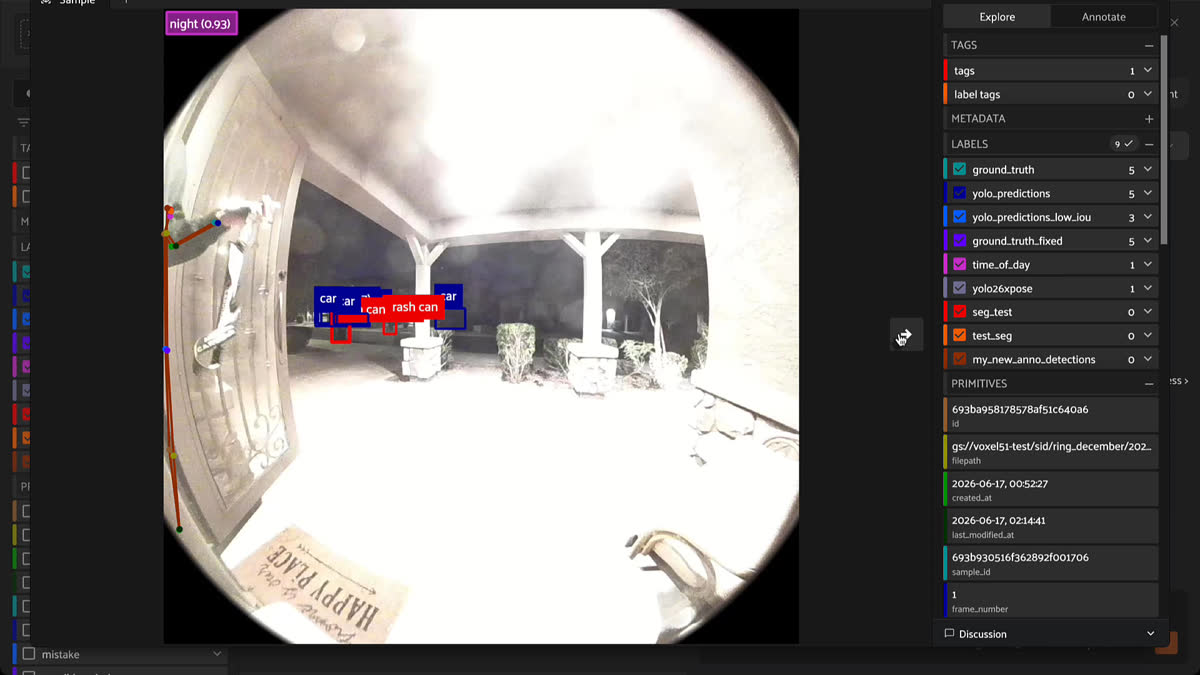
Natural language search for rare lighting scenarios in Voxel51
For time-series multimodal data, segment-level embeddings add another level of precision. Instead of representing an entire recording or episode with a single embedding, Voxel51 can embed individual temporal segments so teams can retrieve the specific moments that matter inside long recordings.
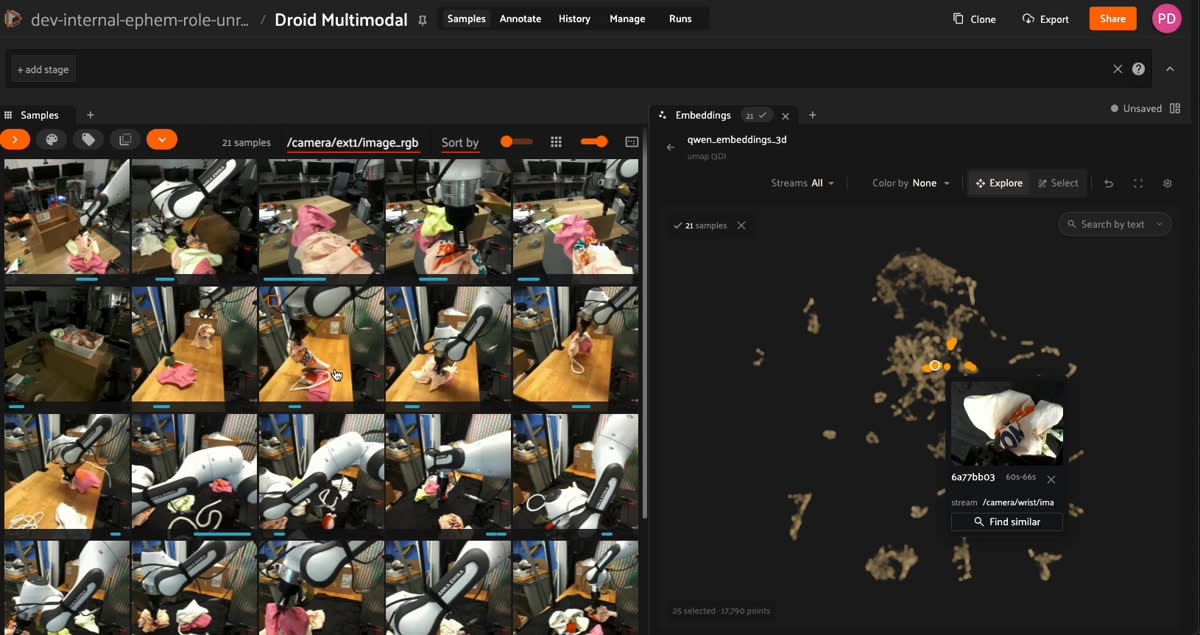
Clicking a point in the Voxel51 embedding space and selecting "Find Similar" instantly surfaces visually and semantically related robot manipulation segments.
The result is a dataset that stays searchable and explorable as it grows, rather than a collection of files that has to be reprocessed every time an ML engineer wants to investigate a new problem.
Deploy agentic workflows across your physical AI data loop with Voxel51 Agent
A unified platform also creates the foundation for something more powerful: agents that can execute data workflows across your entire data loop. An agent on an annotation platform can help label data. An agent built around robotics observability can help teams inspect runs and debug what happened. But an agent built on an end-to-end data platform can operate across the full data loop from visualization to model improvement.
Machine learning engineers still spend too much time on work that is necessary but repetitive. According to the 2026 State of Physical AI survey, exceptional teams spend more than half their project time on data work at nearly 3x the rate of struggling teams.
Instead of only answering questions about a dataset, Voxel51 Agent uses the capabilities already available across Voxel51 to search, curate, annotate, evaluate, and chain those operations into repeatable workflows.
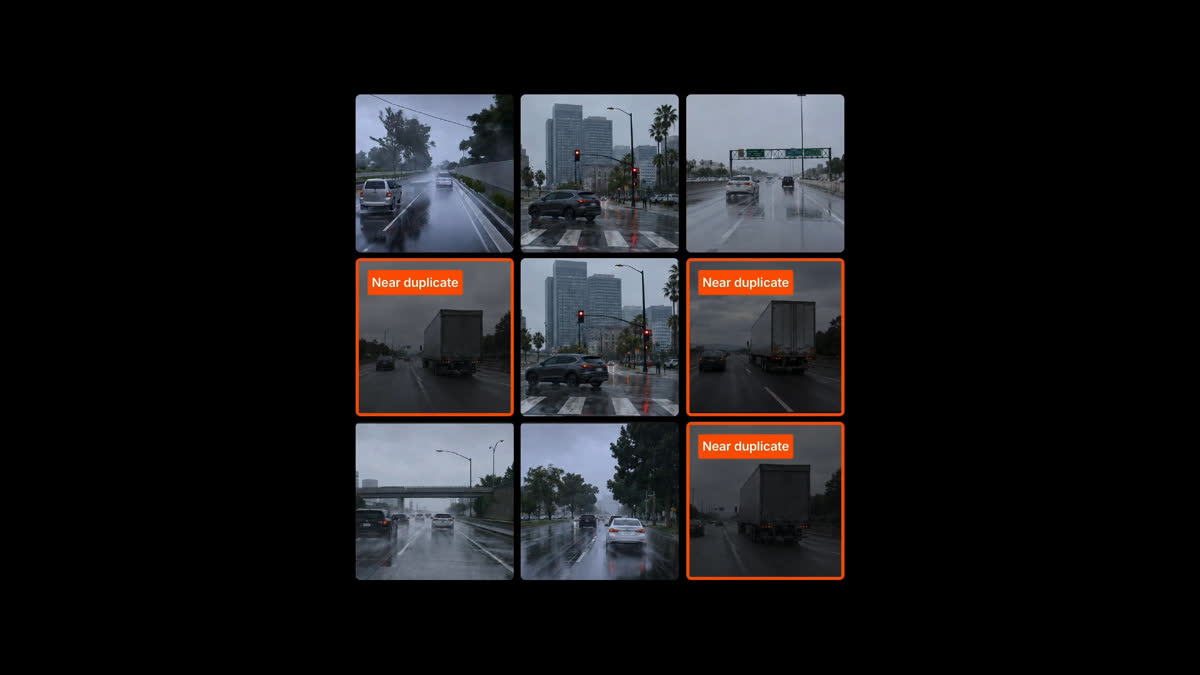
- A robotics team can search for specific behaviors across thousands of episodes, identify where those behaviors are over- or underrepresented, and curate targeted datasets for training and evaluation.
- A perception team can start with a model failure and find similar longtail scenarios, send new samples for annotation, evaluate the next model, and repeat.
- A team preparing data for annotation can identify the highest-value samples, generate labels with Agentic Labeling, route uncertain cases to human reviewers, and build repeatable HITL workflows.
- A data platform team can build a custom plugin to evaluate robot episode quality
And those workflows are not limited to what ships out of the box (45+ MCP tools, 80+ operators, and 18 open-source skills, to be exact).
Production workflows are never one-size-fits-all. Teams need to integrate proprietary models, internal infrastructure, and domain-specific processes, while operating within strict security and governance requirements.
Voxel51 can be extended through plugins, operators, APIs, and custom skills. The Agent can also write code to add new functionality when a workflow requires something custom. All workflows inherit the same permissions, security, and governance controls set by your organization.
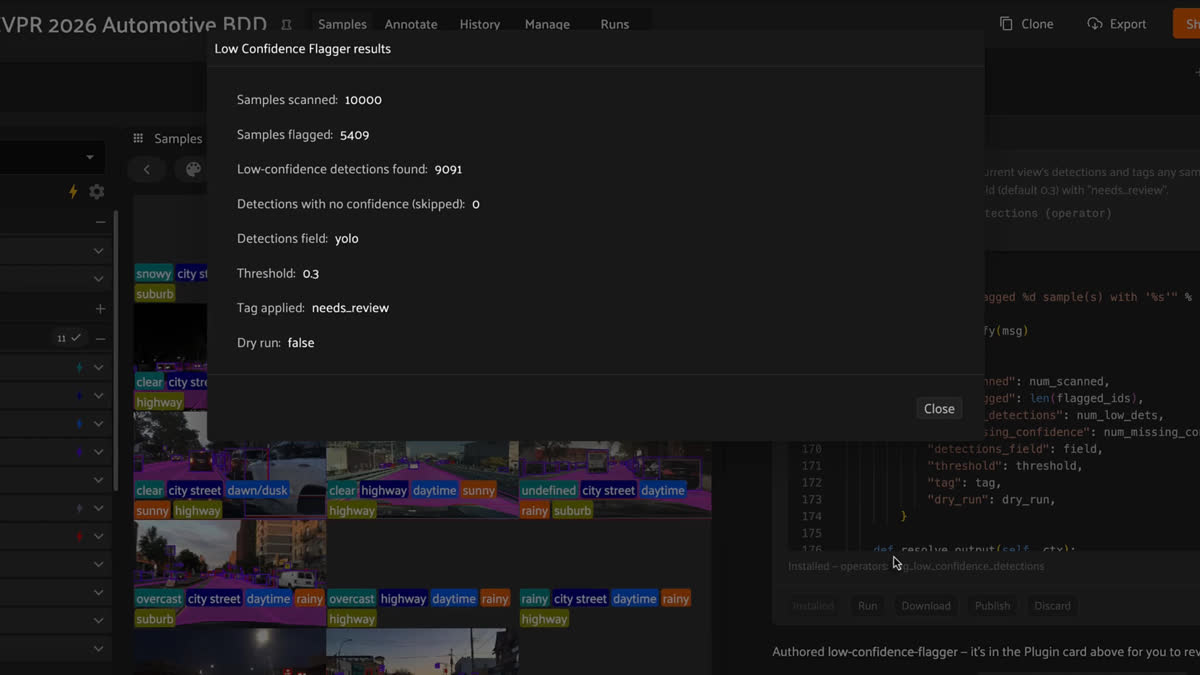
Voxel51 Agent can write code to build custom plugins that extend the product's functionality for your use case.
We’ve spent the past year working with ML teams to understand what it takes to make agents genuinely useful for physical AI workflows. Learn more about Voxel51 Agent — or better yet, try it yourself and ask Voxel51 Agent anything.
Track data provenance with activity logs, edit history, and dataset versioning
A system of record needs to preserve more than the current state of your data. Voxel51 gives teams visibility into how datasets change over time, with activity logs at the deployment and dataset level, edit history for individual samples, and dataset versioning for capturing and comparing historical states.
Today’s launch brings together data provenance capabilities that make it possible to trace what changed, who changed it, and which version of a dataset was used—giving ML teams a reliable history of their data as it moves through the data loop.
- Deployment-level activity log: See who performed an action, when it happened, and what it affected across your Voxel51 deployment. Gives administrators organization-wide visibility for operational oversight and auditing.
- Dataset-level activity log: Track changes and actions within individual datasets to understand how they evolved over time.
- Sample-level edit history: Trace changes to individual samples, including labels, metadata, and other properties, to investigate data quality issues and understand how each sample reached its current state.
- Dataset versioning: Capture immutable snapshots of datasets to compare historical states, reproduce workflows, and identify the exact data used for training or evaluation.

Bring your own models to Voxel51 into the data loop
Teams running AI in production rarely standardize on a single model provider or model family. They use different models for different workloads, and those choices change as their systems mature.
That matters even more in physical AI. General-purpose foundation models have learned primarily from text and visual data scraped from the internet, with limited exposure to the embodied multimodal sensor data that physical systems generate. Outside a handful of well-funded domains (like autonomous driving), teams often need to combine foundation models with domain-specific models and their own training data.
Voxel51 is model-agnostic by design, so teams can bring those models back into the data workflow. A foundation model might help bootstrap an initial dataset through embeddings or auto-labeling. Once a team has trained a domain-specific model, that model can take its place in the next iteration—producing more relevant embeddings, improving annotation, surfacing useful training examples, or evaluating model behavior.
That creates a compounding loop: better data produces better models, and better models make it easier to find and improve the next round of data.
Teams can use their own models across embeddings, auto-labeling, inference, and evaluation without being locked into a predefined stack. That flexibility matters in production, where model choices change as requirements for quality, cost, latency, and infrastructure evolve.
Voxel51 and Nebius partner to make physical AI workflows easier to try
We’re also collaborating with Nebius, the AI cloud company, to make it easier for teams to experience Voxel51 on your data.
Together, we’ve been taking Voxel51 on the road. At a series of hands-on events, developers and ML teams have been using Nebius AI cloud purpose-built for physical AI workloads to run Voxel51 workflows across multimodal data, giving them an easy way to experience compute-intensive workflows like embeddings and auto-labeling.
Nebius and Voxel51 are hosting nine additional Physical AI Workshops across the Canada and US through November 2026. Space is limited, so register to get hands-on with Voxel51 and Nebius and experience these workflows for yourself.
How to try Voxel51 3.0 for free
Historically, experiencing Voxel51’s enterprise capabilities meant speaking to our team first. With Voxel51 3.0, teams can now try features directly and explore the platform on their own, on their data, for free.
Can’t upload your data to a hosted environment? Get in touch with us to arrange a self-hosted Voxel51 deployment.
In physical AI, data strategy starts on day one. Robot demonstrations may be scarce, but each recording is dense with information: sensor observations, actions, behaviors, successes, failures, and edge cases that can inform the next model iteration. The advantage isn’t simply having more data. It’s being able to find, understand, and use what you already have.
That advantage compounds as you collect more data. The earlier teams build the infrastructure and workflows to turn raw recordings into better training and evaluation data, the more valuable every new demonstration becomes.
Voxel51 3.0 represents a major step toward the platform we believe physical AI teams need as they move from prototype to production. And now, you don’t have to take our word for it. Try it for yourself at app.voxel51.com.
FAQ
Voxel51 3.0 is the latest release of the Voxel51 platform, bringing search, curation, annotation, and evaluation of multimodal data for physical AI into one platform. It adds time-series multimodal support, unified annotation, Agentic Labeling, persistent search indexing, Voxel51 Agent, and data provenance tools.
Voxel51 Agent runs data workflows across the full physical AI data loop, including search, curation, annotation, and evaluation, and chains them into repeatable workflows. It can also write code to add new functionality, and it inherits your organization's permissions and governance controls.
Yes. Voxel51 is model-agnostic, so you can use your own models for embeddings, auto-labeling, inference, evaluation, and other domain-specific workflows.
Sign up at app.voxel51.com to explore the platform. If you can't upload data to a hosted environment, contact the Voxel51 team to discuss other ways to evaluate it.
Co-founder and CEO
Dr. Brian Moore is Co-founder and CEO of Voxel51, where he leads the strategy and vision of the company and is actively involved in the design and execution of the core software infrastructure.
Brian holds a Ph.D. in Electrical Engineering from the University of Michigan, where his research was focused on efficient algorithms for large-scale machine learning problems with a particular emphasis on computer vision applications. He has authored dozens of articles in peer-reviewed journals and conference proceedings on various topics in machine learning, statistics, and optimization.
See all articles by Brian Moore
Try Voxel51 for yourself
Loading related posts...
© 2026 Voxel51 All Rights Reserved