Failure Mining in Robotics: Find One Failure, Surface Every Similar Case
Author

Machine Learning Engineer
I’m a Machine Learning Engineer at Voxel51, where I help customers build their ML workflows with FiftyOne. I’m also an MS CS student at Georgia Tech. My research interest is understanding when and why learned representations transfer across domains, modalities, and tasks, and building models that transfer better. My work has focused on fine-grained recognition, from bridging the focal-to-soundscape domain gap in bioacoustics to multi-label plant classification. I also co-founded DS@GT Applied Research & Competitions (ARC), a student-run group advancing ML research through competitive challenges and peer-reviewed publications.
See all articles by Murilo Gustineli
In this article
Key TakeawaysStep 1: Find the seed failure and mark it with a temporal tagStep 2 (Voxel51): Find similar cases with segment-level embeddingsStep 3: Narrow the list to real failuresStep 4: Tag the confirmed failures and save the setRun failure mining on your own dataRun it yourselfCredits and licenseFAQ
In this article
Key TakeawaysStep 1: Find the seed failure and mark it with a temporal tagStep 2 (Voxel51): Find similar cases with segment-level embeddingsStep 3: Narrow the list to real failuresStep 4: Tag the confirmed failures and save the setRun failure mining on your own dataRun it yourselfCredits and licenseFAQ
Try Voxel51 for yourself
You review an episode and spot it: the gripper is folding a cloth in half, and halfway through the fold the corner slips out of its fingers. One failure, found. The harder question is how many more are sitting in the rest of your data.
For most teams, the answer comes from scrubbing recordings one at a time. That's the needle-in-a-haystack problem robotics teams describe over and over: one team has 4,000 hours of recordings to search, another says the edge cases that matter are exactly the ones that are hardest to capture. A single failure tells you what went wrong. Failure mining tells you how often and where else, and that's what you need before you can fix it with data.
This post walks through failure mining on a real robot dataset in FiftyOne: start from one failure, use embedding similarity search to surface every similar moment, narrow the list to real failures, and tag them into a curated set ready for retraining or evaluation.
What you'll need: the companion notebook,
pip install fiftyone, and the DROID multimodal dataset on Hugging Face: 100 teleoperated robot episodes stored as MCAP recordings, with three synchronized cameras, point clouds, and per-episode task and outcome fields. Steps 1, 3 and 4 work in open source FiftyOne. Step 2, the similarity search, uses Voxel51 and is marked as such.Key Takeaways
- Failure mining starts from one confirmed robot failure and searches the rest of your recordings for similar moments, so you learn how often and where a failure happens before you fix it with data.
- Segment-level embeddings make failure mining work at the level of moments, because Voxel51 embeds short windows of each camera stream instead of whole episodes.
- Embedding similarity search finds similar situations, not failures, so a cloth dropped by accident and a cloth placed on purpose look nearly identical to the model.
- Scoping similarity search with DROID's
successfield cut the dropped-cloth candidates from 16 episodes to 2. - Temporal tags in FiftyOne mark the exact interval of each confirmed failure, so a saved view of tagged failures doubles as a set of training or evaluation clips.
Step 1: Find the seed failure and mark it with a temporal tag
Load the dataset and open it in the App:
import fiftyone as fo
from fiftyone.utils.huggingface import load_from_hub

dataset = load_from_hub("dgural/droid-mcap-demo")
session = fo.launch_app(dataset)
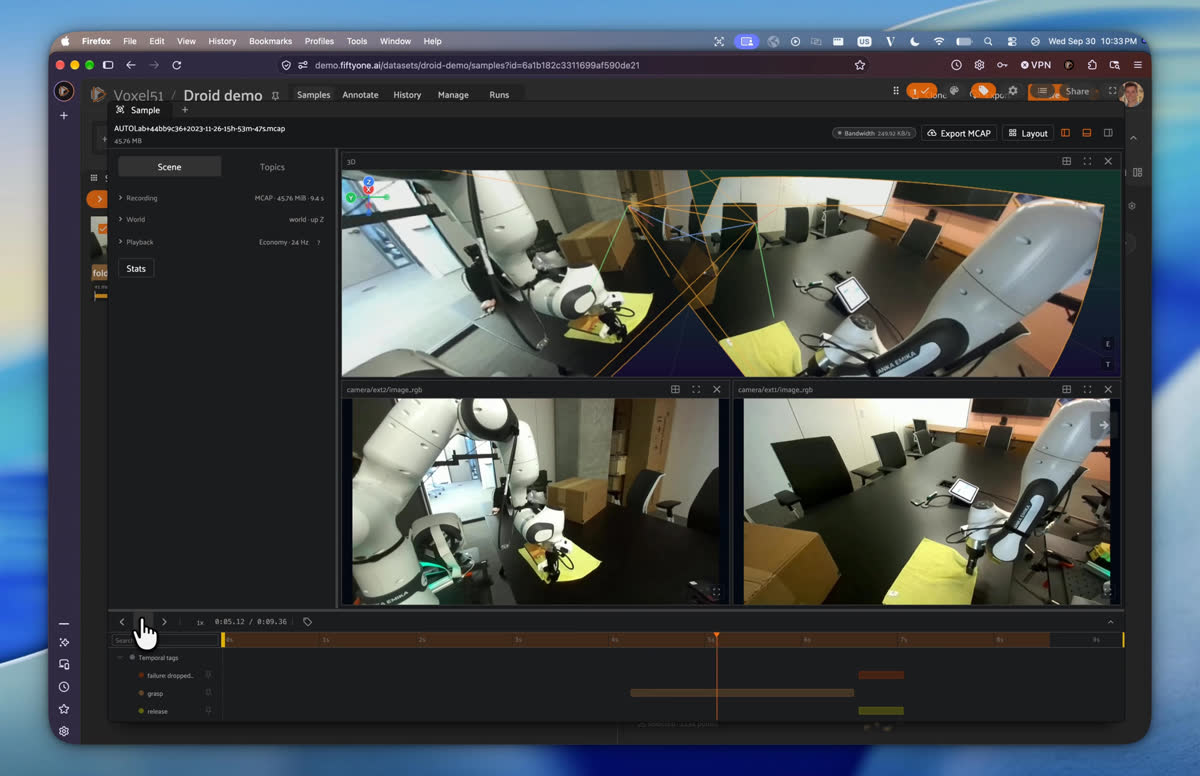
Each sample is one episode. Opening it shows every sensor on a shared playback clock, so the external cameras, the wrist camera and the 3D view all scrub together. Our seed is episode
AUTOLab+44bb9c36+2023-11-26-15h-53m-47s, a "Fold cloth in half" task: at about 6.6 seconds, the cloth corner drops out of the gripper before the fold completes.The dataset already has automatically generated phase tags on its timeline,
grasp and release. Look at what they call this moment:To the phase labeler, the drop is a normal
release: the gripper opened and the cloth left it. Only a reviewer knows the robot didn't mean to let go. Keep that in mind; it comes back in step 3.Record the failure with a temporal tag, which marks a time interval inside an episode rather than the whole episode. In the App, Shift+drag across the timeline and type the tag. Or in code:
import fiftyone.core.tags as fota
from fiftyone import ViewField as F

seed = dataset.match(
    F("filepath").ends_with("AUTOLab+44bb9c36+2023-11-26-15h-53m-47s.mcap")
).first()

# start/end are nanoseconds from the start of the recording
dataset.temporal_tags.add(
    fota.TemporalTag(seed.id, start=6_600_000_000, end=7_070_000_000,
                     tag="failure: dropped cloth")
)
Step 2 (Voxel51): Find similar cases with segment-level embeddings
🚀 Voxel51, our Enterprise offering. Segment-level embeddings search runs on Voxel51, where it indexes every window of every recording across your full fleet.
Voxel51 computes an embedding for each short window of each camera stream (here, 5-second windows with the Qwen3-VL-Embedding-2B model), so search works at the level of moments, not whole episodes.
In the Embeddings panel, pick the run, set Streams to a single camera, click the point for the seed's dropped-cloth window, and choose Find similar. Every window that looks like the seed lights up, and the grid fills with the episodes they come from:
From a single failure, the search surfaced 16 cloth-handling episodes across different scenes and tasks: folding, unclumping, unhanging cloth from a chair. Two tips if you try this on your own data: compare one camera stream at a time (otherwise the same moment seen by the robot's other cameras ranks first), and clear grid filters first, since the search is scoped to the current view.
Step 3: Narrow the list to real failures
Here's the part most write-ups skip. Similarity search finds similar situations, not failures. Embeddings capture what's visible: a gripper, a cloth, the cloth leaving the gripper. They don't capture intent. A cloth dropped by accident and a cloth placed on purpose look nearly identical, which is why text queries like "failed to pick up cloth" mostly return deliberate placements, and why the phase labeler called our failure a
release.So the useful move is to combine the search with what you already know about each episode. DROID records whether each episode succeeded, so scope the search to failed episodes before running it:
failed = dataset.match(F("success") == False)Then run Find similar from the same seed again:
The list drops to two episodes: the seed and a second failed fold, where the cloth slips at about 11.2 seconds and the robot re-grasps at the end. Two candidates to review instead of scrubbing every failed episode by hand. The same approach generalizes: a seed from a cloth-and-string separating task returned three matching episodes of that task.
This is the honest version of failure mining: search turns a haystack into a short review list, and a human confirms. Metadata like success flags, task labels or model confidence makes the list shorter; review makes it correct.
Step 4: Tag the confirmed failures and save the set
Review each candidate with synced playback, and temporal-tag the ones that are real failures, the same way as the seed. Then turn the tags into a reusable set:
view = dataset.match_temporal_tags(tags="failure: dropped cloth")
dataset.save_view("failure-mining: dropped cloth", view)The saved view updates as you tag more failures, and anyone on your team can open it from the views menu. Because the tags mark exact intervals, they also give you the training or evaluation clips themselves, not just the episodes that contain them. To hand the set to a training or evaluation pipeline, export the tags of the episodes in the view (this includes their phase tags, so the failure interval comes with its context):
fota.export_tags(view, "dropped_cloth_tags.json")Run failure mining on your own data
The loop is short: find one failure, search for similar moments, narrow with the metadata you have, confirm, and tag. Every pass adds labeled failures to the set you retrain and evaluate on, which is how a data flywheel actually turns.
- Companion notebook:
failure_mining.ipynbruns steps 1, 3 and 4 in open source FiftyOne and describes the Enterprise search step - Related: Introducing Voxel51 Search, Segment-Level Embeddings
| Step | What you do | Runs in | Result in this post |
|---|---|---|---|
| 1. Find the seed failure | Load DROID, temporal-tag the dropped cloth | FiftyOne (open source) | 1 tagged failure at about 6.6 seconds |
| 2. Search for similar cases | Find similar on segment-level embeddings | Voxel51 | 16 cloth-handling episodes |
| 3. Narrow to real failures | Filter to success == False, rerun search | Filter in open source, search in Voxel51 | 2 candidate episodes |
| 4. Tag and save | Temporal-tag confirmed failures, save_view, export_tags | FiftyOne (open source) | Saved view plus exported JSON |
Run it yourself
Clone the companion repo, then run:
pip install -r requirements.txt
jupyter notebook failure_mining.ipynb
The notebook loads a 10-episode subset by default (
dgural/droid-mcap-workshop, 0.8 GB) that includes the seed episode; switch REPO to dgural/droid-mcap-demo for all 100 episodes (10.4 GB).Credits and license
The data is derived from DROID and is licensed CC-BY-4.0. The code in the companion repo is licensed under Apache 2.0.
FAQ
Failure mining starts from one known failure and searches your recorded robot data for every similar case. In this post, one dropped-cloth moment in the DROID dataset becomes the query for the rest of the dataset.
No. Embeddings capture what is visible, not intent, so similarity search returns similar situations. Narrow the results with metadata such as success flags, then confirm each candidate by reviewing it.
They let you search for moments instead of whole episodes. Voxel51 embeds each short window of each camera stream (5-second windows in this post), so Find similar matches the dropped-cloth moment itself.
Use a temporal tag, which marks a time interval inside an episode rather than the whole episode. In the App, Shift+drag across the timeline and type the tag. In code, use
fota.TemporalTag with dataset.temporal_tags.add().Steps 1, 3, and 4 work in FiftyOne (open source), and the notebook runs them. Step 2, segment-level similarity search, uses Voxel51.
Machine Learning Engineer
I’m a Machine Learning Engineer at Voxel51, where I help customers build their ML workflows with FiftyOne.
I’m also an MS CS student at Georgia Tech. My research interest is understanding when and why learned representations transfer across domains, modalities, and tasks, and building models that transfer better. My work has focused on fine-grained recognition, from bridging the focal-to-soundscape domain gap in bioacoustics to multi-label plant classification.
I also co-founded DS@GT Applied Research & Competitions (ARC), a student-run group advancing ML research through competitive challenges and peer-reviewed publications.
See all articles by Murilo Gustineli
Try Voxel51 for yourself
Loading related posts...
© 2026 Voxel51 All Rights Reserved


