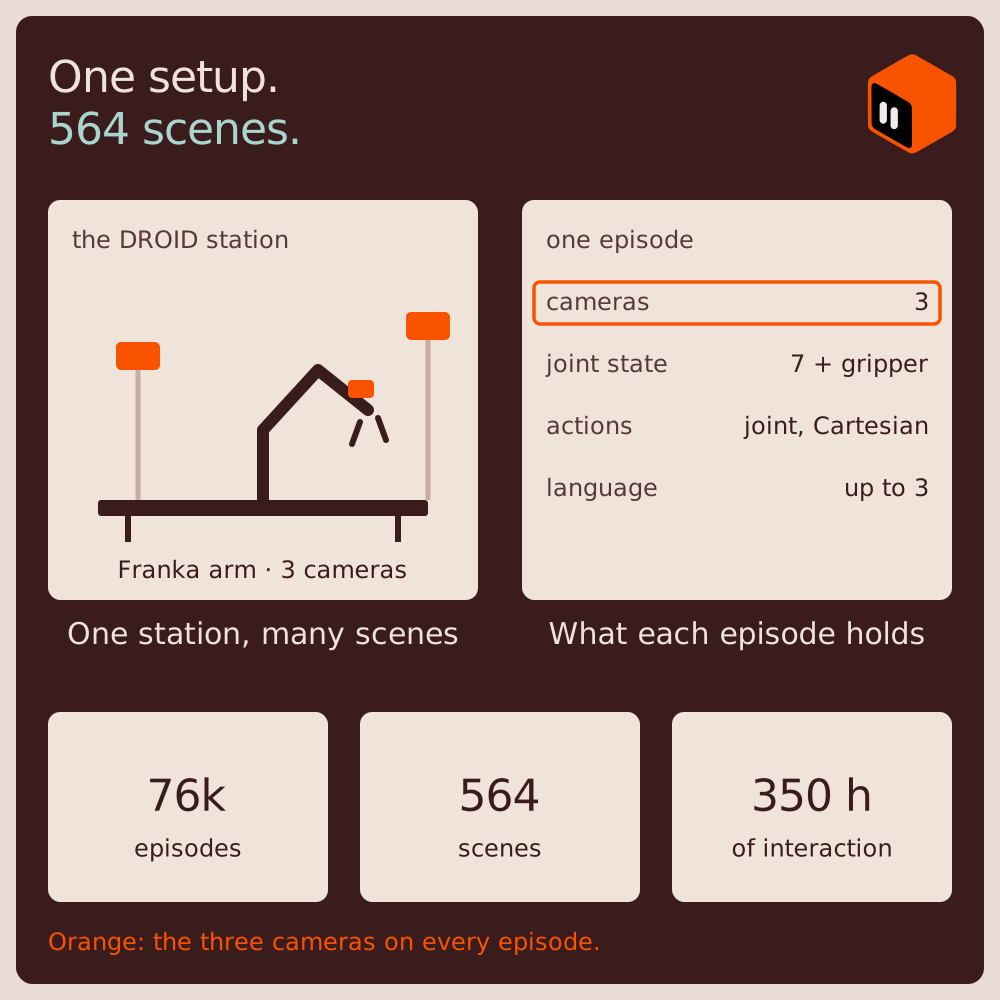
DROID, the Distributed Robot Interaction Dataset, is a large real-world robot manipulation dataset released in 2024. It contains about 76,000 teleoperated demonstration trajectories, roughly 350 hours of interaction, collected across 564 scenes by 50 data collectors on three continents over 12 months. Every episode uses the same hardware, a Franka Panda arm with two external stereo cameras and a wrist camera, which makes DROID a common choice for training and co-training manipulation policies.
DROID, the Distributed Robot Interaction Dataset, is a large real-world robot manipulation dataset released in 2024 by a team of about 100 researchers across 13 institutions. It contains about 76,000 teleoperated demonstration trajectories, roughly 350 hours of interaction, collected across 564 scenes and 86 tasks (per the project site, while the paper lists 84) by 50 data collectors in North America, Asia, and Europe over 12 months.
DROID's diversity comes from one fixed setup. Every episode was recorded with the same hardware: a Franka Panda 7-DoF arm, two adjustable Zed 2 stereo cameras, a wrist-mounted Zed Mini, and an Oculus Quest 2 headset for teleoperation, all on a portable desk that could be moved between labs, offices, and homes. The result spans 1,417 camera viewpoints and an order of magnitude more scenes than earlier large manipulation datasets. In the authors' experiments, co-training with DROID improved policy success rates by 22 percentage points in distribution and 17 points out of distribution over the next best option.
DROID used one standard station across 564 scenes, so every episode carries the same three cameras, robot state, actions, and language.
Key takeaways
DROID is a real-world robot manipulation dataset of about 76,000 teleoperated demonstrations, collected across 564 scenes.
Every episode uses the same Franka Panda arm and camera setup, so diversity comes from scenes, tasks, and viewpoints rather than hardware.
DROID is widely used to train and co-train manipulation policies, and its scale makes search and filtering, rather than watching, the practical way to curate it.
What a DROID episode contains
Part
What it holds
Cameras
RGB from two exterior cameras and one wrist camera, plus stereo and depth in the raw release
Robot state
Joint positions, end-effector (Cartesian) pose, and gripper position
Actions
Commanded joint positions and velocities, Cartesian positions and velocities, and gripper position and velocity
Language
Up to three natural-language instructions per episode, updated in December 2024 for 95% of successful episodes
Formats
RLDS for training (about 1.7 TB) and raw stereo HD video (about 8.7 TB)
The streams stored with each DROID episode, per the DROID dataset documentation.
How it works
Data collectors moved the DROID station to a new scene, set up objects, and teleoperated the arm through a series of tasks. Each session recorded synchronized camera streams, robot proprioception, and the commands sent to the arm, along with camera calibration. The full dataset is distributed in RLDS for policy training and as raw recordings for work that needs high-resolution or stereo video. Because DROID stores several action spaces side by side, training code has to pick one, and different codebases pick differently.
Before you co-train on DROID, compare a task across scenes
DROID's strength is variety: the same kind of task recorded in hundreds of different rooms, from more than a thousand camera viewpoints. That variety is also where its problems hide, because a task that looks consistent in the instruction text can look very different on camera. The quiet problems:
task families with very different episode counts
instructions that describe the scene loosely, such as "put the thing away"
exterior cameras moved between sessions, so the same scene looks different
In Voxel51, DROID holds 1,000 manipulation episodes recorded as MCAP, each with three cameras and the robot's telemetry in one recording.
Robotics Droid
1,000 episodes
Real-world robot manipulation episodes from DROID, stored as MCAP with three synced cameras and fields for task prompt, success, and number of grasps.
Try this: Filter task_prompt for one kind of task, then use the lab field to compare episodes of it from two different labs.
Voxel51 hosts a 1,000-episode DROID sample stored as MCAP, with three synced cameras, end-effector and joint actions, and a phase timeline from idle through reaching, grasping, and releasing. Each episode carries fields for lab, scene, task prompt, success, number of grasps, and phase summary, so you can filter, search, and step through episodes without converting formats.
Why it matters
DROID supports a finding that keeps recurring in robot learning: scene and task diversity, not just volume, drives generalization in manipulation. It is also a good illustration of curation at scale. At 76,000 episodes, nobody watches the dataset end to end. Finding the episodes worth training on, the scenes a policy struggles with, or every attempt at one kind of task takes search over video, language, and robot telemetry together, which is the same problem teams face with their own fleet data. DROID shows up in Open X-Embodiment-style co-training mixes and in the pretraining data of many vision-language-action models.
For a failure mining pass on 100 DROID episodes, where one dropped-cloth failure surfaced 16 similar episodes, see a DROID failure mining walkthrough.
Frequently asked questions
How big is DROID?
About 76,000 demonstration trajectories and roughly 350 hours of interaction, across 564 scenes. The RLDS version is about 1.7 TB, and the raw stereo HD release is about 8.7 TB.
What robot was DROID collected on?
A Franka Panda 7-DoF arm, two Zed 2 stereo cameras on adjustable mounts, and a wrist-mounted Zed Mini, teleoperated with an Oculus Quest 2 headset and controllers.
How is DROID different from Open X-Embodiment?
Open X-Embodiment pools many existing datasets from different robots and labs into one format, so its diversity comes from embodiments. DROID was collected fresh on a single hardware setup, so its diversity comes from scenes, tasks, and viewpoints.
Jesse Mostipak is the Director of Growth at Voxel51, where the work is helping humans find and trust what the brand knows, and teaching the Google knowledge graph and the LLMs answering on their behalf to do the same. That question, how knowledge gets built inside a system, is one Jesse has been chasing for years. Earlier versions of it ran through a New York City high school science classroom, data science and machine learning, and developer relations at Kaggle, Posit (formerly RStudio), and Baseten. The answer doesn't change much depending on whether the learner is a teenager, a software engineer, or a knowledge graph. Jesse holds a Master's in Education from CUNY Hunter College. LinkedIn