Why teams choose Voxel51 over Roboflow
AI teams are making the switch from Roboflow to Voxel51. Improve development efficiency by over 30%, eliminate data issues that lead to model failures, and ship reliable models faster. Voxel51 provides an extensible platform built for curation, annotation, evaluation, and deployment at any scale.
30% increase in model accuracy
Identify edge cases, outliers, duplicates, and mislabeled samples with precision filtering and dynamic slices—so you can build cleaner, leaner datasets that drive better model results.
5+ months of development time saved
Identify your best performing samples, weed out low-quality data, and organize dataset views intuitively — so you can focus on building better models, faster.
30% boost in team productivity
Work with enterprise-level workloads spanning billions of samples across multimodal data in the cloud, on-premise, or air gapped.
Benefits
Voxel51 is a better alternative to Roboflow. Here’s why.
Tight data-model connectivity
Voxel51 was built with data and model workflows at its core with deep understanding of data issues that lead to poor model performance. Voxel51 enables teams with a data-first approach to build and iterate faster.
No limit on the scale of data
Voxel51 never limits the amount of data you work with or charges you based on data volume. Explore, query, annotate, and run inference on as much data as you need. No credits, data limits, or volume-based pricing.
Flexible and extensible
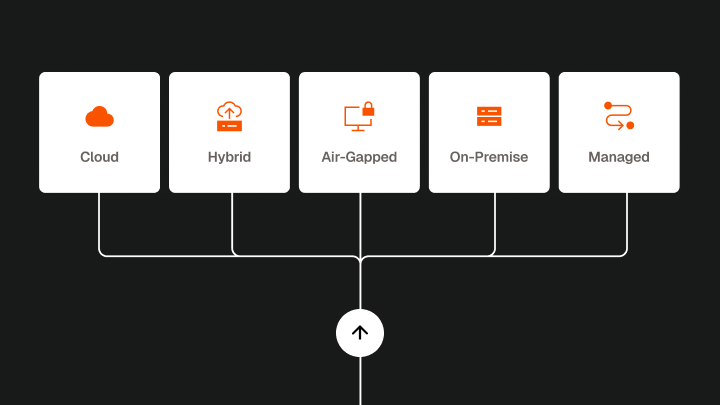
Voxel51’s flexible architecture adapts to your project needs. Agentically extend the tool’s functionality, build custom visualizations, automate workflows, and deploy as you need: on-prem, air-gapped, cloud, or managed service.
3x Faster robotics investigations
“FiftyOne has really helped us speed up investigations. If we see a wrong suction cup grasping an item, we can quickly visualize the issue across all data sources and identify what went wrong.” —Dimitry Pechyoni, Senior Principal Machine Learning Engineer

Multimodal data
Roboflow supports 2D data that works for my current projects. Does Voxel51 support other modalities that I may need?
Roboflow is primarily built for 2D workflows
Teams leveraging Roboflow’s 2D workflows quickly reach a threshold when they have to work with multimodal data that includes 3D point clouds, lidar, radar, video data with temporal tagging, time series, audio, or multi-sensor fusion data.
Voxel51 is natively multimodal
Multimodal data is the future. Voxel51 natively supports the full range of data types production AI teams work with — images, video, 3D point clouds, lidar, radar, sonar, audio, medical imaging, geospatial, custom sensor data, and more. You can visualize, curate, annotate, and evaluate multimodal data with Voxel51.
Pricing
Roboflow prices me based on my project’s data usage. Does Voxel51 also charge based on data?
Roboflow prices based on usage—so costs become unpredictable at scale
Roboflow’s credit-based pricing means data labeling, training, inference, and storage all consume credits. As projects grow and data volumes increase, costs scale in ways that are difficult to forecast.
Voxel51 puts no limit on the data you work with
We believe that no organization should be limited on how much data they can explore, visualize, annotate, and evaluate. Voxel51 does not limit or charge you by the data you bring into the tool, and offers deterministic pricing.
Data-centric
I use Roboflow for data labeling and model inference. Why should I switch?
Roboflow provides limited data analysis
Teams that use Roboflow quickly outgrow the tool since it is optimized for speed to an initial training run, not for the iterative data and model work that production-grade AI models actually require. Teams find reliability and performance to be a bottleneck on large datasets.
Voxel51 is built for production AI
Voxel51 was built for teams shipping reliable, production-ready AI. Model failures are a data problem. The platform goes beyond basic model metrics—giving teams the tools to visualize and understand their data, slice model performance by scenario, root cause failures, and trace them back to the data that caused them.
Comprehensive annotation
I use Roboflow for data labeling. Does Voxel51 provide all the labeling capabilities I need?
Voxel51 gives annotation teams everything they need to create high-quality labels faster.
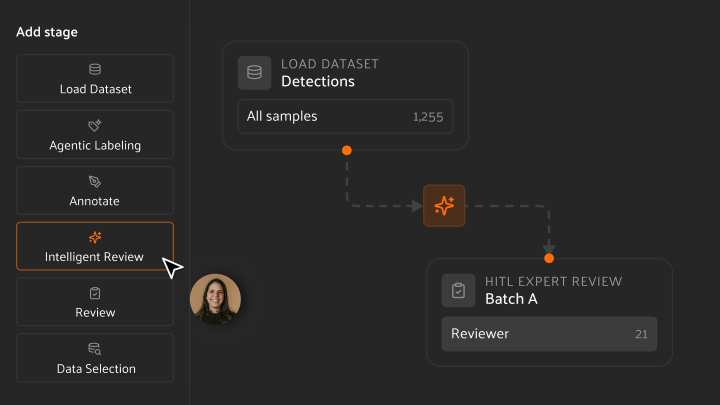
- Label across images, video, and 3D lidar — bounding boxes, SAM2 click-to-segment, cuboids, polylines, polygons, video object tracking, and temporal events.
- Set up and manage annotation projects with configurable multi-stage workflows.
- Prioritize the right data for labeling and perform intelligent QA.
- Use agentic labeling to annotate faster and more accurately.




Maintained 99% fall detection rates for model performance.














Maintained 99% fall detection rates for model performance.
Maintained 99% fall detection rates for model performance.
Extensibility
Roboflow provides some extensibility. Does Voxel51 enable me to extend the platform and customize functionality?
Roboflow’s extensibility is limited
Roboflow's extensibility runs through their own framework and abstraction layer, limiting custom extensions, visualizations, and the controls MLOps team require for compute scheduling and model training.
Voxel51 is fully extensible and customizable
Every team building AI systems has unique requirements, and the ability to extend tools to fit them is just as important as the tool itself. Voxel51 is designed to be extensible and flexible. With the Python SDK and agentic workflows you can extend Voxel51’s functionality, build custom visualizations, plugins, workflows, and automate tasks to fit your specific needs.
Enterprise-ready
Roboflow covers our current requirements. What does Voxel51 offer for building production AI?
Voxel51 is built for enterprise-grade security and scale. Deploy anywhere, cloud, hybrid, air-gapped, or on-premise.
- Work with billion+ samples. Search, query, and retrieve samples from connected data lakes.
- Adopt agentic workflows to label data and automate tasks, and draw faster insights into your data and model performance.
- Automate workflows and collaborate with teams, including sharing datasets, model results, and labeling QA.
- Governance and security with access control and audits.
Speak with the experts
Improve data quality, optimize model performance, and accelerate your AI projects.
© 2026 Voxel51 All Rights Reserved