Why AI teams choose Voxel51 over V7
Voxel51 provides the tools data annotation and ML teams need to make their labeling budgets go further, keep data quality consistently high, and ship reliable models faster. Voxel51 provides an extensible platform built for curation, annotation, and model evaluation — at any scale.
30% increase in model accuracy
Identify edge cases, outliers, duplicates, and mislabeled samples with precision filtering and dynamic slices—so you can build cleaner, leaner datasets that drive better model results.
5+ months of development time saved
Identify your best performing samples, weed out low-quality data, and organize dataset views intuitively — so you can focus on building better models, faster.
30% boost in team productivity
Work with enterprise-level workloads spanning billions of samples across multimodal data in the cloud, on-premise, or air gapped.
Benefits
Voxel51 is a better alternative to V7. Here’s why.
Annotation plus everything around it
Voxel51 connects data annotation to curation and model evaluation, so teams spend their time on labeling the right data and get through it faster with AI-assisted labeling. No integration code, tool switching, or lost context.
Faster and more efficient label review
Spend less time finding and fixing labeling errors. Voxel51 speeds up labeling QA by performing intelligent review to surface annotation mistakes. The same approach flags data gaps before they become model failures.
Flexible and extensible
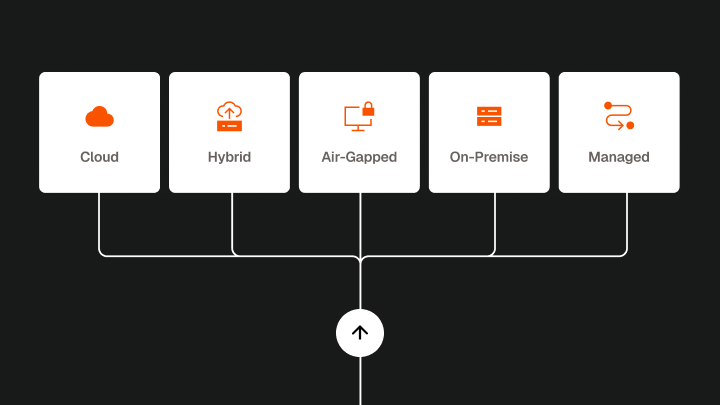
Voxel51’s open and flexible architecture adapts to your project needs. Agentically extend the tool’s functionality, build custom visualizations, automate workflows, and deploy as you need: on-prem, air-gapped, cloud, or managed service.
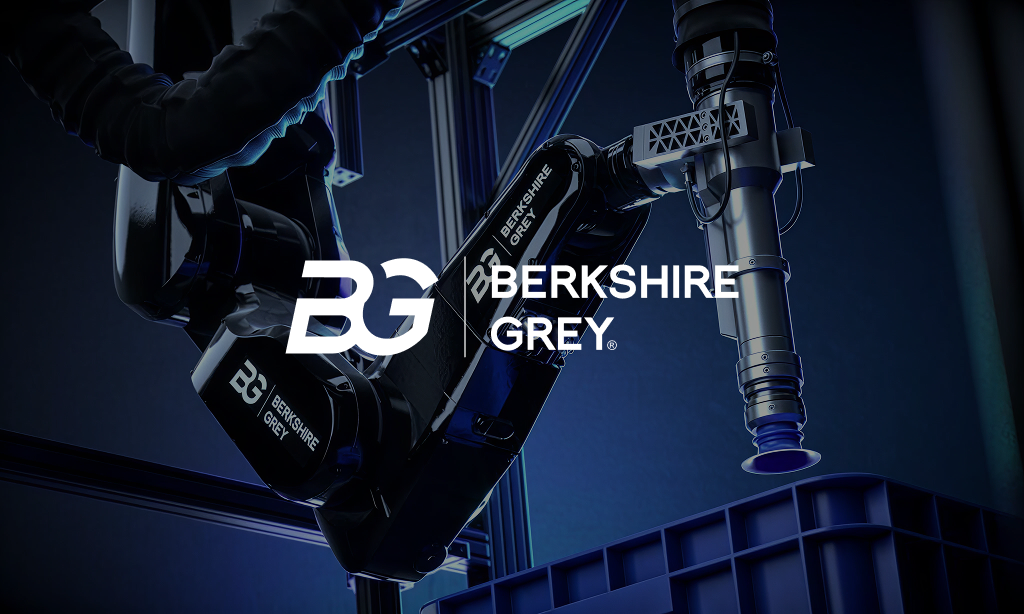
3x Faster robotics investigations
“FiftyOne has really helped us speed up investigations. If we see a wrong suction cup grasping an item, we can quickly visualize the issue across all data sources and identify what went wrong.” —Dimitry Pechyoni, Senior Principal Machine Learning Engineer

Comprehensive annotation
I use V7 for my labeling tasks. Does Voxel51 provide all the annotation capabilities I need?
Voxel51 gives annotation teams everything they need to create high-quality labels faster.
- Label across images, video, and 3D lidar — bounding boxes, SAM2 click-to-segment, cuboids, polylines, polygons, video object tracking, and temporal events.
- Set up and manage annotation projects with configurable multi-stage workflows.
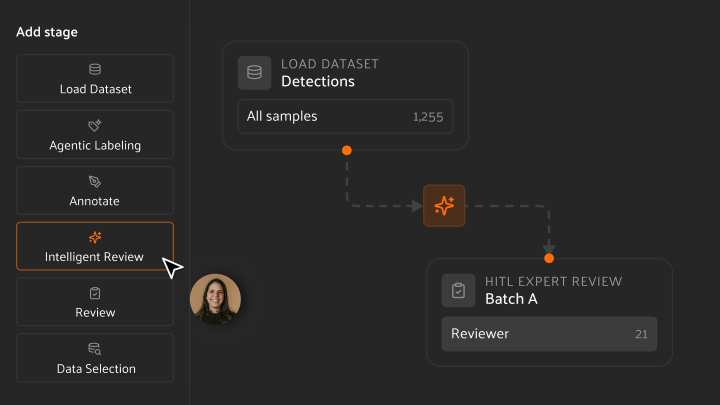
- Prioritize the right data for labeling and perform intelligent QA.
- Use agentic labeling to annotate faster and more accurately.
Annotation, curation, and model evaluation live on the same platform, so annotators and ML engineers work from a shared view of the data — eliminating lengthy handoffs and lost context between teams.
One platform
My team uses V7 for labeling and another tool for the rest of the ML workflow. Does Voxel51 replace both?
V7 annotation sits outside your ML workflow
When annotation lives in a separate tool, every correction cycle becomes a data movement job with handoffs and coordination. With V7, teams quickly realize that integrating with existing cloud infrastructure requires specific configurations that conflict with enterprise security policies. And small labeling fixes become large data jobs that require time-consuming handoffs, adding friction.
Voxel51 keeps annotation, curation, and your data in sync
Voxel51 annotation lives alongside data curation and model evaluation. Labeling mistakes are easy to fix without needing any re-exporting or reconciliation overhead. Voxel51 works with data wherever it already lives—in your S3, GCP, Azure, or any data lake without requiring specific security configurations or data migration.
Multimodal data
V7 supports images, video, and medical imaging. Does Voxel51 go further?
V7 is built for images, video, and medical imaging
V7 Darwin handles standard images, video, and medical formats. Teams building physical AI applications outgrow the platform when their data expands to 3D point clouds, lidar, radar, audio, and multi-sensor fusion data.
Voxel51 supports multimodal data for visual and physical AI
Voxel51 natively supports the full range of data types production AI teams work with — images, video, 3D point clouds, lidar, radar, sonar, audio, medical imaging, geospatial, custom sensor data, and video with temporal tracking. Users can visualize, curate, annotate, and evaluate multimodal data in one platform.
Smart labeling
I currently queue all my data for labeling. Does Voxel51 help me prioritize what to label and review?
V7 doesn’t help you prioritize what to label
Teams routinely label more data than they need to, which drives up annotation cost and time without adding coverage. V7 lacks the guidance teams need to identify the samples worth labeling before the work starts. Data enters the annotation queue without curation, and QA remains sequential as reviewers work through annotations without prioritization.
Voxel51 makes every step of the annotation workflow smarter
Voxel51 smart data selection techniques use embeddings and ML-based sampling to identify unique, representative, and edge-case samples for the labeling queue—and flag redundant or low-quality ones for removal. Agentic labeling reduces the manual effort of creating labels from scratch. Intelligent Review ranks every label by error likelihood, so reviewers start with the highest-risk annotations.




Maintained 99% fall detection rates for model performance.


















Maintained 99% fall detection rates for model performance.
Maintained 99% fall detection rates for model performance.
Enterprise-ready
V7 covers our current requirements. What does Voxel51 offer for building production AI?
Voxel51 is built for enterprise-grade security and scale. Deploy anywhere, cloud, hybrid, air-gapped, or on-premise.
- Work with billion+ samples. Search, query, and retrieve samples from connected data lakes.
- Adopt agentic workflows to label data and automate tasks, and draw faster insights into your data and model performance.
- Automate workflows and collaborate with teams, including sharing datasets, model results, and labeling QA.
- Governance and security with access control and audits.
Speak with the experts
Improve data quality, optimize model performance, and accelerate your AI projects.
© 2026 Voxel51 All Rights Reserved