Few-Shot Image Classification: Prompted VLMs vs. Specialist Models
Author

Research Engineer
I like working on deep learning problems both on the research and engineering side. I’ve deployed multiple models into production, identified problems and their solutions in every aspect of the DL stack from the underlying data, distributed cloud training infrastructure, training algorithms, and production and deployment. Always happy to hear about new challenging problems.
See all articles by Jacob Sela
In this article
Key takeawaysWhy foundation models still need domain knowledgeA new way to teach models with in-context learningWhen examples can close the domain knowledge gapWhen more context can't fix a capability gapWhen to stop prompting VLMs and start training specialist modelsPrompting VLMs with Agentic LabelingPhysical AI has a domain knowledge problemFAQ
Try Voxel51 for yourself
Training a specialist computer vision model has traditionally required collecting and labeling examples of whatever you want it to recognize. But frontier vision-language models (VLMs) offer another option: in-context learning (ICL). By providing a model with examples of a task directly in its prompt, you can teach it to recognize specialized visual concepts without updating its weights.
Consider a dataset of nearly 35,000 drill-core images spanning 35 geological categories. Asked to classify the rocks using only the category names, a frontier VLM achieved just 20% macro-F1. With two labeled examples per category, that score jumped to 73%. No fine-tuning or weight updates. Just a few examples teaching the model which distinctions matter.
But how far can this approach take you? Can VLMs reliably learn unfamiliar visual concepts from a handful of examples? And if a specialist model eventually performs better, when does the improvement justify the additional work of training and maintaining one?
To find out, I tested frontier VLMs across 11 specialized visual datasets using Agentic Labeling in Voxel51. Agentic Labeling lets teams teach VLMs what to recognize through examples, instructions, and feedback, without writing custom prompting pipelines.
For the experiments, I compared how VLMs performed with class names, written descriptions, and increasing numbers of labeled examples, then trained specialist models on the same tasks to see when the performance advantage shifted.
The results suggest that a few examples can go surprisingly far, but the best approach depends on the task, the amount of labeled data available, and the cost of building and maintaining a specialist model.
Join us on November 9 for a deep dive into the findings and practical tips for prompting VLMs to label specialized datasets. Compute will be provided by Nebius AI Cloud.
Key takeaways
- A few labeled examples can make a dramatic difference. Adding one labeled example per class improved VLM macro-F1 on 10 of the 11 datasets I tested.
- Some tasks are niche, not inherently hard. On drill-core rock classification, macro-F1 jumped from 20% to 73% with just two labeled examples per class.
- Prompting and training have different advantages. Specialist models, including a fine-tuned ConvNeXt-T and a DINOv2 linear probe, sometimes overtook prompted VLMs with as few as 5–10 labeled images per class.
- More context can't always fix a capability gap. On the DermaCon dermatology dataset, additional examples barely improved performance. Some diagnostic distinctions may require clinical information that isn't available in the images.
- VLMs can help bootstrap specialist models. Use in-context learning to generate initial labels, validate them with expert feedback, and train a specialist when the growing dataset and production requirements justify it.
Why foundation models still need domain knowledge
In the late 1970s, researchers at SRI International set out to build a computer that could find mineral deposits. The program couldn't identify rocks on its own, so they brought in geologists and interviewed each of them for about 50 hours. Programmers then translated their chains of reasoning into rules the computer could follow.
They called the expert system PROSPECTOR. In 1982, it successfully identified a promising molybdenum deposit in Washington state, and the discovery made the pages of Science.
But PROSPECTOR had a limitation: it could only recognize the distinctions its experts had explicitly taught it. Nearly 50 years later, transferring specialized knowledge into AI systems remains a challenge. Consider DCID-35, a dataset of nearly 35,000 drill-core images spanning 35 rock types. Many look nearly identical to an untrained eye, but geologists know which distinctions matter.
Nearly 50 years later, frontier models are dramatically more capable, but the knowledge acquisition bottleneck hasn't disappeared. A factory inspector can distinguish a copper burr from a scratch on a circuit board. An agronomist can identify dozens of crops from drone imagery. These are distinctions learned through years of experience in a specialized domain, and they aren't necessarily distinctions a foundation model has learned to make.
Frontier models, by contrast, learn concepts from the data available during pretraining, much of it drawn from the public internet. But the concepts industry needs are often defined by processes, environments, and criteria that the public internet never captures. The evidence is unforgiving: zero-shot accuracy on a visual concept follows a log-linear relationship with its frequency in the pretraining corpus (Udandarao et al., 2024).
No frontier model can be pretrained on every specialized concept that matters to every industry. But that doesn't necessarily mean these concepts are beyond the model's capabilities. A model might already have the visual understanding needed to recognize a particular defect, without knowing how an expert defines it. The challenge is finding a way to transfer that knowledge to the model without having to train it from scratch.
A new way to teach models with in-context learning
I've spent the last few years taking whacks at operationalizing a version of this problem: how can we transfer knowledge from a domain expert into a learning system with as little friction as possible? Increasingly, I think the answer lies in in-context learning (ICL): the ability of a model to learn a new task from examples provided at inference time, without retraining or updating its parameters.
I didn't arrive at ICL immediately. I experimented with interactive model training, where experts could provide feedback as a model learned, and more experimental approaches like "neural Lego bricks," which let experts build specialized concepts from simpler ones a foundation model already understood.
Some worked surprisingly well, but they were difficult to put into practice. They required substantial engineering work to build and maintain, slowed down iteration, and often proved brittle. I wanted a way for experts to teach models what they knew without needing an ML engineer to build and maintain a custom system around them.
I believe we're approaching the point where visual ICL is capable enough to become the engine I've been looking for: a way for experts to teach models new concepts simply by showing them what they mean.
Three datasets illustrate the different outcomes of my experiments:
- Drill-core rock classification: A domain knowledge gap. The VLM started at 20% macro-F1 with class names alone but reached 73% with just two labeled examples per class. A specialist model overtook it with around four labeled images per class and approached 100% with more training data.
- Ceramic-substrate defects: Prompting and training work at different scales. The VLM improved from 34% macro-F1 to 59% with one labeled example per class, reaching 78% with 20. It performed well with limited labeled data, but a trained specialist eventually pulled ahead.
- Dermatology: More examples aren't always enough. Neither the VLM nor the trained specialist performed particularly well, and additional examples produced little improvement. Some diagnoses require clinical information that isn't available in photographs alone, which may help explain why prompting didn't improve performance.
When examples can close the domain knowledge gap
One dataset I experimented with illustrates this particularly well: Ceramic-defect, a collection of 7,689 images of surface defects on ceramic substrates used in semiconductor packaging. The images fall into six categories: abnormal thickness, adhesion, edge defect, scar, spot, and uneven.
I wanted to see whether a pretrained VLM could learn to distinguish these defects from a handful of examples, without any fine-tuning. I started by asking the model to classify images using only the six category names. Then I added labeled reference images directly to its prompt, giving it examples of what each defect looked like.
The difference was immediate. In one test, the model classified an adhesion defect as a scar when given only the category names. With one labeled reference image per class, it correctly identified the same image as adhesion. The model hadn't been retrained. It simply had more context for interpreting the categories.
This wasn't an isolated result. With class names alone, the VLM achieved about 34% macro-F1 on the held-out test set. Adding just one labeled example per class increased that score to 59%. With 20 examples per class, it reached 78%.
The dramatic improvement suggests that some model failures are actually failures of task specification. The model may have the underlying visual capabilities, but class names alone don't provide enough information to apply them correctly.
I also compared this approach with two trained specialists: a fine-tuned ConvNeXt-T and a DINOv2 linear probe. With very little labeled data, the prompted VLM performed better. As more training data became available, the specialists caught up and eventually surpassed it, with the best reaching 93% macro-F1 using the full training set.
Because these examples are provided at inference time, developers can test the approach without collecting a large training dataset or fine-tuning a model.
But was this specific to ceramic defects?
I repeated the one-example experiment across 11 datasets, comparing performance with class names alone against performance with one labeled reference image per class. The additional examples improved macro-F1 on 10 of the 11 datasets. For drill-core rock classification, the gain was particularly large, approaching 40 percentage points.
The results suggest that many seemingly difficult classification tasks are really problems of unfamiliar domain knowledge. The model may already have the visual capabilities needed to distinguish the categories, but not know which distinctions are relevant. A few examples can help bridge that gap.
This is consistent with previous research on in-context learning.
- Examples can tell a model which task it's doing. Pan et al. showed that a few examples are often enough for a model to recognize a task and apply what it already knows.
- Prompts can activate knowledge a model already has. Xie et al. proposed that in-context learning helps models identify concepts learned during pretraining.
- Task-specific solutions may already be close to pretrained models. Gan and Isola showed that specialized solutions are so ubiquitous around pretrained weights that even random perturbations can recover them.
With the above works in mind, it's not difficult to imagine how even a few examples can drastically improve VLM performance on specialized tasks.
There was, however, one holdout—DermaCon, a specialized, open-access dermatology image dataset.
When more context can't fix a capability gap
DermaCon is a very different kind of dataset: a few thousand clinical photographs of skin conditions spanning 19 diagnoses, some with barely a dozen examples.
The results were disappointing across the board. A specialist classifier trained on every available labeled image achieved a macro-F1 score of just 25.1%, while a VLM prompted with class names alone scored 20%. With 19 classes, random guessing would yield approximately 5%.
What surprised me was how little additional context helped. On the previous datasets, giving a model a few labeled examples was often enough to clarify an unfamiliar category and substantially improve its predictions. Here, adding examples barely moved the needle. At two examples per class, the VLM reached just 0.235 macro-F1. The same pattern held across every VLM I tried (including Gemma 4 31B, the GPT 5.6 line, the GPT 6 line, GPT 6.1 Sol, GLM 5.3, Claude Opus 5, ).
Neither approach performed particularly well. And that points to a different kind of problem than the ones we encountered with the ceramic-defect and drill-core datasets.
Dermatology is harder because some diagnoses are difficult to distinguish from photographs alone, even for a trained expert. A dermatologist may also consider patient history, symptoms, and how a lesion has changed over time. That information wasn't available to the models. Showing them more examples of visually similar conditions couldn't necessarily supply the evidence needed to tell those conditions apart.
The ceramic-defect task is niche. The dermatology task is hard.
Context can close the gap in the first case. The second may require better reasoning, finer-grained perception, more training data, or information that isn't available in the image at all. If the model doesn't have the capabilities needed for the task, you can keep refining the prompt all day without solving the underlying problem.
When to stop prompting VLMs and start training specialist models
The question isn't just whether a VLM can learn a specialized task from a few examples. It's also how its performance compares with a trained specialist as more labeled data becomes available.
Three datasets illustrate that tradeoff.
In the comparisons I ran, prompted VLMs generally performed better when there were only a handful of labeled examples per class. As I added more training data, the specialist models began to pull ahead, in some cases with as few as 5–10 examples per class. That's not a universal threshold (and it’s one that’s rapidly moving in favor of VLMs), but it illustrates why prompting and training can be useful at different stages of a labeling workflow.
The point where a specialist becomes more accurate isn't necessarily the point where it becomes worth training one. The decision also depends on where you are in the development process.
- When you're exploring a new task, you might have five labeled examples, uncertain category definitions, and no idea whether the task is even feasible. Prompting a VLM lets you test it immediately, without committing to a training pipeline.
- When you're building a dataset, the VLM can generate initial labels while domain experts review mistakes, refine category definitions, and identify the examples worth adding to the training set. At this stage, the ability to iterate quickly may matter more than squeezing out a few additional points of accuracy.
- When you're deploying at scale, the tradeoffs change. With stable categories and enough labeled data, a specialist may offer better accuracy, lower latency, or cheaper inference. The training and maintenance overhead becomes easier to justify when the same model will run millions of times.
The crossover curves tell us when specialists begin outperforming prompted VLMs on accuracy. They don't tell us when the investment in training pays off. That depends on how the model will be used, how frequently the task changes, and what it costs to maintain each approach.
That's the opportunity I find most exciting: lowering the cost of getting started means we can tackle specialized problems that might never have justified a large annotation effort in the first place.
| Type of task | Performance considerations | Operational considerations | Recommended approach |
|---|---|---|---|
| Familiar concepts | Pretrained models can often recognize categories without labeled examples. | Minimal setup, no task-specific training, and easy to adapt as requirements change. | Start with zero-shot VLM. Add examples if needed. |
| Specialized, learnable categories | Few-shot VLMs perform well with limited labels. Specialists can surpass them as labeled data accumulates. | Prompting is fast to bootstrap and flexible as categories evolve. Training adds pipeline development, evaluation, and maintenance overhead, with greater risk of instability when labels are scarce. | Prompt first, train when justified. Use VLMs to bootstrap labels; invest in specialists when accuracy, inference cost, latency, or scale warrants it. |
| Genuinely difficult tasks | Neither prompting nor small scale specialist training necessarily overcomes missing information or model capability limitations. | Collecting more labels and retraining can become expensive without addressing the underlying problem. | Rethink the approach. Add missing context, use specialized tools, or change models before investing in more training. |
Prompting VLMs with Agentic Labeling
The experiments show that a handful of examples can make foundation models surprisingly effective on specialized labeling tasks. But putting that into practice takes more than writing a good prompt.
Without a dedicated workflow, an ML engineer has to write code to assemble prompts, select and label reference images, call a model API, and map predictions back to the dataset. Every change to the examples, instructions, or label taxonomy requires another round of updates and testing. Reviewing predictions and correcting mistakes adds yet another layer of work.
We built Agentic Labeling in Voxel51 to make that process more accessible. Rather than requiring engineers to build and maintain custom prompting pipelines, we want to make it easier to teach models through examples and feedback.
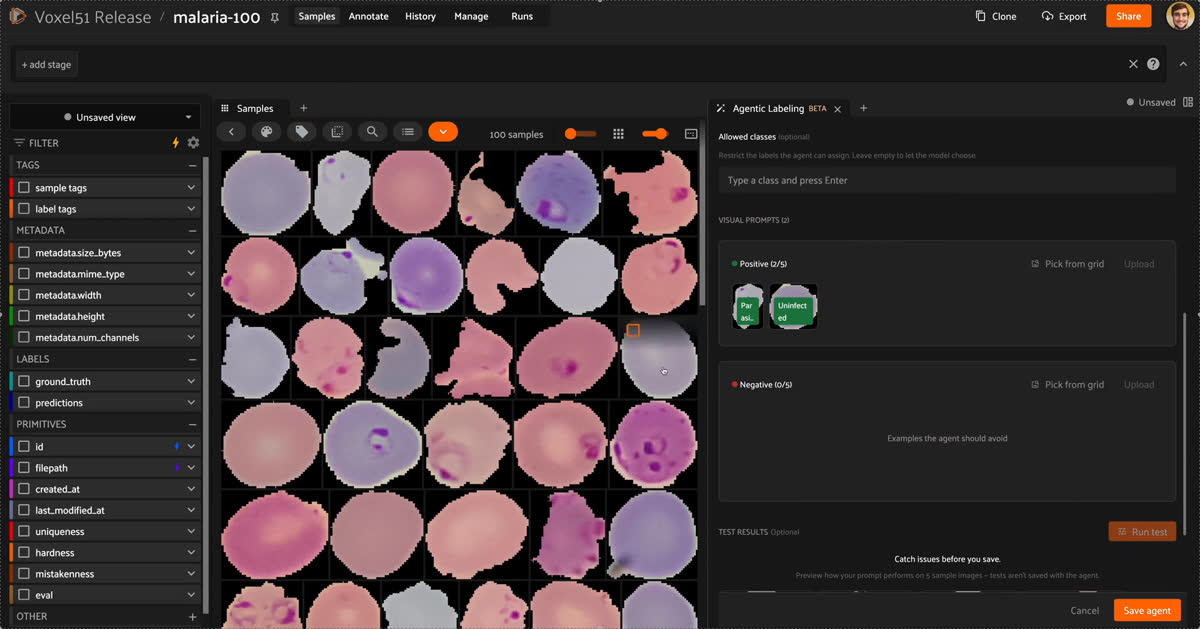
- Define the task. Describe what you want to label, specify the categories and constraints, and provide representative examples.
- Preview and refine. Generate predictions on a small batch, review the results, and adjust the instructions or examples until the model reliably applies your labeling criteria.
- Scale what works. Apply the refined labeling workflow across your dataset instead of manually annotating every sample.
- Train a specialist when it makes sense. Use the growing collection of validated labels to train a task-specific model as the dataset grows.
The underlying idea is simple: if prompting is often enough to bootstrap a specialized labeling task, using it should be as easy as navigating a UI.
Join the workshop on November 9 for a deep dive into the findings and practical tips for prompting VLMs to label specialized datasets. Compute will be provided by Nebius AI Cloud.
Physical AI has a domain knowledge problem
PROSPECTOR needed 50 hours of interviews to capture one geologist's expertise. Today, that same expert could point at a dozen photos, correct 80 predictions over a cup of coffee, and turn a nearly useless model into a passable annotator by lunch.
The broader opportunity is to make transferring domain expertise into AI systems faster and less expensive. Figuring out whether a task needs better instructions, more examples, or a trained specialist is a search problem, and it should be the tool's search, not the expert's.
We are always a few shots away. The job is to find out which shots, get them from the people who have them as efficiently as possible, and know when to stop prompting and start training.
FAQ
A prompted VLM is usually the better starting point when you have only a handful of labeled examples per class. In these experiments, trained specialists pulled ahead at about 6 to 14 labeled images per class. Training one still adds pipeline and maintenance costs.
One labeled example per class improved VLM macro-F1 on 10 of 11 specialized visual datasets. On ceramic-substrate defects, one example per class raised macro-F1 from 34% to 59%, and 20 examples per class reached 78%.
VLMs often struggle because the task is niche, not because it’s hard. The model may already have the visual capability but not know which distinctions matter. Zero-shot accuracy also tracks how often a concept appears in pretraining data.
No. On DermaCon, VLM macro-F1 stayed between about 20% and 28% regardless of the number of examples. Some diagnoses need patient history or changes over time that an image doesn’t contain.
Agentic Labeling is a Voxel51 workflow for labeling data with VLMs from instructions and examples. You define the task, preview and refine predictions, scale what works across the dataset, and train a specialist from the validated labels.
Research Engineer
I like working on deep learning problems both on the research and engineering side. I’ve deployed multiple models into production, identified problems and their solutions in every aspect of the DL stack from the underlying data, distributed cloud training infrastructure, training algorithms, and production and deployment. Always happy to hear about new challenging problems.
See all articles by Jacob Sela
Try Voxel51 for yourself
Loading related posts...
© 2026 Voxel51 All Rights Reserved