LightOnOCR-2: A Compact AI Model Revolutionizing Document OCR
Author

Hacker-in-Residence
Harpreet is Hacker-in-Residence at Voxel51, where he turns cutting-edge AI ideas into open-source prototypes and demos that push the boundaries of deep learning. From building tools that inspire to creating content that educates, Harpreet helps the AI community level up—one wild idea at a time.
See all articles by Harpreet Sahota
In this article
What is document OCR?Breaking the document OCR size-performance tradeoffEnd-to-end document OCR architecture: Simplicity meets performanceMultilingual document OCR excellence with a French focusAdvanced document OCR training techniquesPractical AI OCR model usage with FiftyOneDocument OCR use casesLooking forward to a more accessible document OCR futureDocument OCR resources:
In this article
What is document OCR?Breaking the document OCR size-performance tradeoffEnd-to-end document OCR architecture: Simplicity meets performanceMultilingual document OCR excellence with a French focusAdvanced document OCR training techniquesPractical AI OCR model usage with FiftyOneDocument OCR use casesLooking forward to a more accessible document OCR futureDocument OCR resources:
Try Voxel51 for yourself
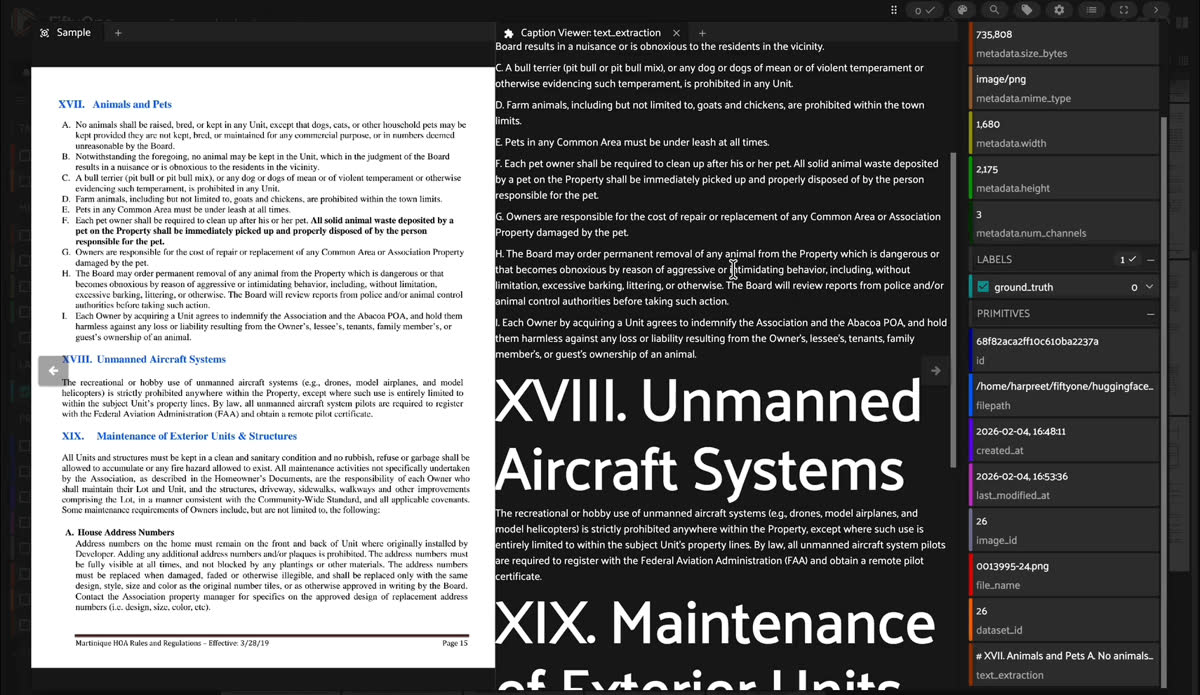
In the world of document digitization, traditional OCR pipelines have long been the bottleneck—fragile multi-stage systems that struggle with complex layouts, multilingual content, and scientific notation. Enter LightOnOCR-2-1B, a revolutionary 1-billion-parameter vision-language model that challenges the status quo by delivering state-of-the-art document OCR performance in a remarkably compact package.
What is document OCR?
Document OCR is a technology that allows machines to read and extract text from scanned documents, images, and PDFs. Traditional OCR systems often struggle with complex layouts, tables, forms, and multilingual content, making accurate text extraction challenging.
Modern AI OCR models like LightOnOCR-2 go beyond basic character recognition by leveraging vision-language understanding to preserve document structure, layout, and even scientific notation. This makes document OCR ideal for document management system OCR applications, enabling faster, more accurate digitization and streamlined workflows.
Breaking the document OCR size-performance tradeoff
What makes LightOnOCR-2 remarkable isn't just its accuracy—it's the efficiency with which it achieves it. The model achieves the highest score on OlmOCR-Bench, a comprehensive document OCR evaluation benchmark, while being 9x smaller than prior best-performing models.
This isn't just a marginal improvement; it's a fundamental shift in what's possible with compact vision-language models. The AI OCR model processes documents at an impressive 5.71 pages per second on H100 GPUs, substantially outperforming larger alternatives. This speed advantage, combined with its smaller footprint, makes LightOnOCR-2 practical for real-world deployment scenarios where computational resources matter.
End-to-end document OCR architecture: Simplicity meets performance
Unlike traditional document OCR systems that rely on brittle multi-stage pipelines (text detection → text recognition → layout analysis → post-processing), LightOnOCR-2 uses a single, unified end-to-end architecture. This approach offers several key advantages:
- Fully differentiable: The entire pipeline can be optimized end-to-end, eliminating error propagation between stages
- Naturally ordered output: The model produces clean, naturally ordered text without requiring complex post-processing heuristics
- Robust to layout complexity: Excels at handling tables, forms, receipts, scientific notation, and multi-column layouts
The AI OCR model is trained at 1540px maximum longest edge resolution, enabling it to capture fine details in dense mathematical notation and small text—critical for scientific and technical documents.
Multilingual document OCR excellence with a French focus
LightOnOCR-2 demonstrates strong multilingual capabilities, with particular emphasis on European languages and French documents. The AI OCR model was trained on a large-scale, high-quality distillation mix that includes extensive coverage of:
- Scanned documents with varying quality and degradation
- French-language content
- Scientific PDFs with dense typography and mathematical notation
This training approach enables the AI OCR model to handle the nuances of different languages and document types without requiring language-specific preprocessing or post-processing steps.
Advanced document OCR training techniques
The development of LightOnOCR-2 incorporates several cutting-edge techniques:
- RLVR optimization: The model uses Reinforcement Learning from Visual Representations (RLVR) with IoU-based rewards to refine its performance, particularly for tasks involving bounding box prediction for embedded images.
- Checkpoint averaging: Multiple model checkpoints are averaged to improve robustness and generalization, reducing variance in predictions across different document types.
- Task-Arithmetic merging: The model leverages task-arithmetic merging techniques to combine capabilities from different training stages, resulting in a more capable and robust final model.
Practical AI OCR model usage with FiftyOne
The AI OCR model integrates seamlessly with FiftyOne, making it easy to apply OCR to document datasets:
import fiftyone as fo
import fiftyone.zoo as foz
# Register and load the model
foz.register_zoo_model_source(
    "https://github.com/harpreetsahota204/LightOnOCR-2",
    overwrite=True
)
model = foz.load_zoo_model("lightonai/LightOnOCR-2-1B")
# Apply to your dataset
dataset = fo.Dataset.from_images_dir("/path/to/documents")
dataset.apply_model(
    model,
    label_field="ocr_text",
    batch_size=8,
    num_workers=2
)
The integration supports efficient batch processing, allowing you to process large document collections quickly. With configurable parameters for maximum tokens, custom prompts, and batch sizes, the model adapts to various use cases and computational constraints.
Document OCR use cases
LightOnOCR-2 excels in several key scenarios:
- Scientific PDFs: Handles dense typography and accurately transcribes LaTeX mathematical notation
- Scanned documents: Robust to moderate degradation, noise, and rotation
- European languages: Strong Latin script support, especially for French
- Complex layouts: Multi-column documents, tables, forms, and structured content
Looking forward to a more accessible document OCR future
LightOnOCR-2 represents a significant step forward in making high-quality document OCR accessible and practical. By combining state-of-the-art performance with compact size and fast inference, it opens up new possibilities for document processing applications. The AI OCR model is released under Apache 2.0 license, making it freely available for both research and commercial use. The team has also released the training dataset and LightOnOCR-bbox-bench evaluation suite, contributing to the broader OCR research community. As document digitization continues to be a critical need across industries—from legal and healthcare to research and education—models like LightOnOCR-2 demonstrate that we don't need to choose between accuracy and efficiency. Sometimes, the best solution is the one that does more with less.
Document OCR resources:
Hacker-in-Residence
Harpreet is Hacker-in-Residence at Voxel51, where he turns cutting-edge AI ideas into open-source prototypes and demos that push the boundaries of deep learning. From building tools that inspire to creating content that educates, Harpreet helps the AI community level up—one wild idea at a time.
See all articles by Harpreet Sahota
Try Voxel51 for yourself
Loading related posts...
© 2026 Voxel51 All Rights Reserved


