In this article
Key components of multimodal AIWhy multimodal AI matters for enterprisesChallenges and limitations of multimodal AICase studies: How enterprises overcome multimodal AI challengesSaaS vs. Enterprise-ready multimodal AI platformsThe Future of multimodal AIWhy Voxel51 enables the future of enterprise multimodal AI
In this article
Key components of multimodal AIWhy multimodal AI matters for enterprisesChallenges and limitations of multimodal AICase studies: How enterprises overcome multimodal AI challengesSaaS vs. Enterprise-ready multimodal AI platformsThe Future of multimodal AIWhy Voxel51 enables the future of enterprise multimodal AI
Try Voxel51 for yourself
As multimodal AI becomes mission-critical for enterprises, AI data strategy teams face a fundamental strategic decision: choose platforms that prioritize immediate convenience, or invest in solutions that provide long-term strategic AI data infrastructure. The most successful data teams recognize that sustainable competitive advantage comes from platforms that offer three strategic AI data capabilities: complete data ownership, unlimited customization, and seamless integration.
Understanding what multimodal AI is, and why it matters, is essential before evaluating the platforms and architectures that can support it. For data strategy teams evaluating multimodal AI platforms, the question isn't whether you need flexibility today, but whether your chosen platform can evolve with your enterprise's increasingly sophisticated AI requirements without requiring costly migrations or architectural rewrites.
Key components of multimodal AI
Multimodal AI systems are designed to understand and connect components from multiple data types—such as text, images, audio, video, and sensor streams—within a single model. While architectures vary, most multimodal AI data systems follow the same set of foundational steps:
Feature extraction (per-modality encoders)
Each modality has its own encoder that transforms raw data into numerical representations.
- Images → CNNs or vision transformers
- Text → language transformers
- Audio → spectrogram encoders or audio transformers
These encoders convert different formats into comparable embedding spaces.
Cross-modal alignment
Once data is encoded, the model aligns the embeddings so the system can understand relationships between modalities. This is where the model learns that:
- A caption describes an image
- A sound corresponds to an event in a video
- A piece of text refers to an object in a frame
Common alignment approaches include shared embedding spaces, cross-attention layers, and joint transformer blocks.
Fusion layer
Fusion architectures combine information across modalities. Approaches include:
- Early fusion: Combine raw features early for unified reasoning
- Late fusion: Produce independent predictions per modality and merge results
- Hybrid fusion: Mix both to balance flexibility and performance
The goal is to let each modality reinforce the others, improving robustness.
Multimodal AI prediction and reasoning
The fused representation is then used to perform downstream tasks like classification, retrieval, captioning, or anomaly detection. Because the model receives richer context, it can make more accurate and interpretable predictions than unimodal systems.
Why multimodal AI matters for enterprises
Multimodal AI delivers capabilities that are difficult or impossible to achieve with single-modality systems. This allows enterprises to deploy more advanced AI capabilities without separate, siloed systems. Other benefits include:
Richer context and higher accuracy
By combining multiple signals (such as video + audio or text + images) multimodal AI models gain a more complete understanding of real-world scenarios, reducing ambiguity and improving prediction quality.
Greater robustness in noisy environments
If one modality is unreliable (e.g., low-light video), others can compensate (e.g., audio or sensor data). This makes multimodal AI systems more resilient in production environments.
Natural human-like reasoning
People use multiple senses to understand the world. Multimodal AI systems mimic this behavior, enabling more intuitive applications like conversational assistants, smart search, and more accurate inspection systems.
Broader range of use cases
Multimodal AI unlocks tasks that require cross-modal understanding, such as:
- Visual question answering
- Video summarization
- Product search with image + text queries
- Multimodal AI anomaly detection
Challenges and limitations of multimodal AI
Closed-source and software-as-a-service (SaaS) approaches to multimodal AI systems present significant limitations around control, customization, and long-term strategic flexibility.
- Vendor lock-in: High switching costs create dependency on external providers for critical ML data infrastructure
- Workflow rigidity: Opinionated pipelines accelerate prototypes, but break in production edge cases requiring custom preprocessing, domain-specific optimizations, or non-standard data formats
- Data security risks: Sending sensitive visual data to third-party services creates compliance issues and additional attack vectors
The fundamental issue with closed-source multimodal AI systems is their opacity to ML engineers who need to understand model behavior at a granular level. When a vision model misclassifies edge cases or exhibits unexpected performance degradation, MLEs cannot inspect the underlying data to diagnose root causes. This severely hampers the iterative debugging process that's essential for production-grade ML systems.
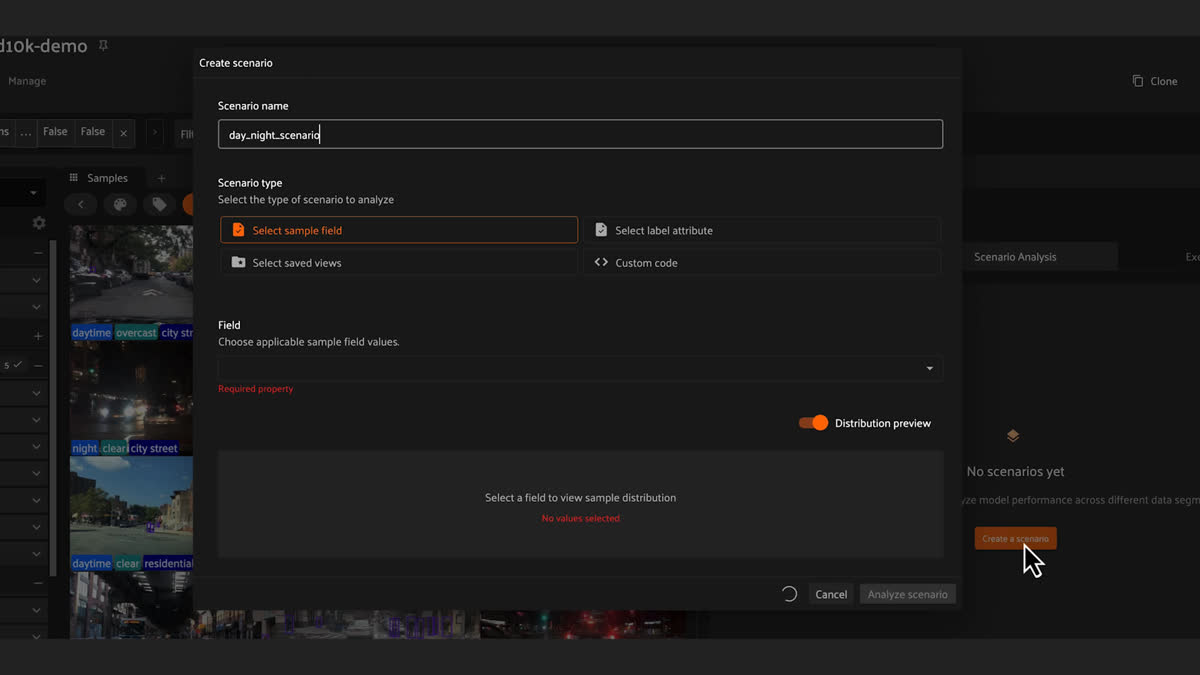
As applications scale, the inability to diagnose failure modes creates technical debt that can require complete system replacement, making the initial ease of onboarding a false economy that masks long-term inflexibility costs.
Case studies: How enterprises overcome multimodal AI challenges
Multimodal AI example: Protex AI accelerates workplace safety
When Protex AI needed to scale their computer vision pipeline across 100+ industrial sites and 1,000+ CCTV cameras, they faced the classic challenge of balancing rapid iteration with production reliability. Their initial script-heavy workflows created operational overhead that slowed model development cycles and made collaboration cumbersome.
Protex AI consolidated their fragmented toolchain into a unified visual AI data engine by adopting a plugin architecture. The team built approximately 10 custom plugins for specialized multimodal AI workflows including data filtering, annotation handoff, and inference job management—tailored precisely to their production needs.
This multimodal AI extensibility example proved transformative. The team achieved a 5x speedup in model iteration while maintaining the production-grade reliability critical for their mission of preventing workplace incidents.
"The plugin framework lets us customize our workflows based on our unique needs, and the mature SDK lets us consolidate more of our pipeline into one tool, avoiding the cost of stitching together multiple systems." - Patrick Rowsome, Head of CV Operations at Protex AI
For safety-critical applications processing real-time video at scale, flexible architecture enabled Protex AI to deliver solutions that have driven 80%+ reductions in workplace incidents for major enterprises including Amazon, DHL, and General Motors.
Multimodal AI example: Adding audio an AI data infrastructure dilemma
When a Fortune 50 Company's data platform team needed to support audio datasets for their ML engineers, they faced a classic AI data infrastructure dilemma: build a custom solution from scratch or adapt existing tooling. Their audio engineering team was drowning in spreadsheets and one-off scripts—exactly the kind of technical debt that data teams work to eliminate.
Rather than committing months of engineering resources to build yet another custom data management system, the data platform team leveraged FiftyOne's Plugin architecture to deliver enterprise-grade audio support in under a week.
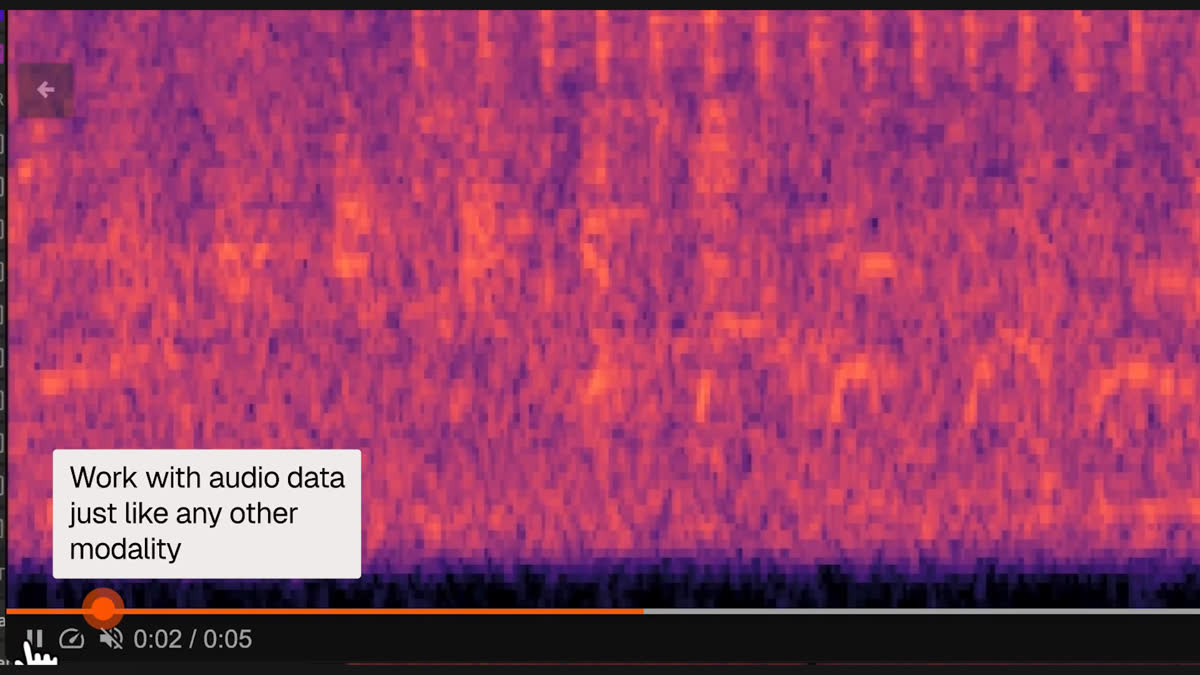
The implementation demonstrated Voxel51's infrastructure-first design philosophy.
- Audio-to-video conversion plugin: Enabled immediate compatibility with existing FiftyOne workflows and visualization capabilities
- Native audio playback capabilities: Eliminated security risks and storage overhead from file conversion processes
- Caption evaluation framework: Provided ML teams with production-ready model debugging capabilities that would have taken months to build internally
In total, we spent 16 hours developing support for an entirely new modality in FiftyOne, enabling us to leverage native features like embeddings and model evaluation on audio recordings.
As a result, the audio engineering team moved from manual, error-prone workflows to a scalable platform that integrates with existing data infrastructure, handles enterprise-scale datasets, and provides the performance and reliability that data teams demand.
SaaS vs. Enterprise-ready multimodal AI platforms
Ultimately the choice between SaaS or enterprise platforms like Voxel51 depends on whether you prioritize immediate convenience or long-term strategic AI data control.
For enterprises deploying product-grade models or handling sensitive data, putting data ownership and customizable workflows at the center of your AI data strategy typically provides better ROI despite higher initial setup requirements.
SaaS vs Voxel51 comparison
The Future of multimodal AI
The future of multimodal AI is rapidly becoming a foundational pillar of next-generation intelligent systems, and the organizations that invest in flexible, future-proof AI data infrastructures today will be the ones that innovate fastest tomorrow.
Advances in model compression and inference optimization are pushing multimodal AI closer to real-time performance, enabling applications such as live video understanding, robotics, and interactive assistants. At the same time, improvements in cross-modal reasoning are unlocking richer capabilities—from explaining visual decisions in natural language to generating multimodal outputs and predicting actions from complex video sequences.
These innovations are complemented by the shift toward edge-ready multimodal systems, which bring intelligent processing directly to devices where data is created. This reduces latency, enhances privacy, and broadens the range of environments where multimodal AI can be deployed.
Why Voxel51 enables the future of enterprise multimodal AI
FiftyOne has emerged as the leading open-source visual AI data management platform with over 3 million installs precisely because it was built around these principles. Unlike traditional SaaS platforms that treat customization as an afterthought, Voxel51 provides a developer-first approach that allows teams to maintain complete control over their data and workflows through an extensible plugin architecture—without sacrificing enterprise-grade reliability or performance.
As multimodal AI evolves, platforms that prioritize openness, extensibility, and long-term adaptability—not closed, fixed pipelines—will define the industry’s future. FiftyOne is uniquely positioned to meet that moment, enabling enterprises to build multimodal AI that is not only powerful today, but resilient to the rapid innovation still ahead.
Loading related posts...
© 2026 Voxel51 All Rights Reserved


