Success detection is the process of deciding whether a robot episode completed its task and storing that decision as an outcome label. Labels come from operators, scripted checks in simulation, or learned detectors such as vision-language models and progress models. Because training sets and success rates are built from these labels, a wrong label can teach a failure as a demonstration or count a failure as a success.
Success detection is deciding, for a recorded robot episode, whether the task was actually completed, and storing that decision as an outcome label. The label might come from the operator who recorded the episode, from a scripted check in a simulator, or from a learned model that watches the video and judges the result. Every success rate and every filtered training set is built on top of these labels.
It's the per-episode half of policy evaluation. A success rate aggregates outcomes across many rollouts, and success detection produces each outcome. The two fail differently. A success rate can be statistically shaky because there were too few rollouts, while a single outcome label can simply be wrong, and wrong labels don't average out when they share a cause, such as a detector that can't see the object from one camera angle.
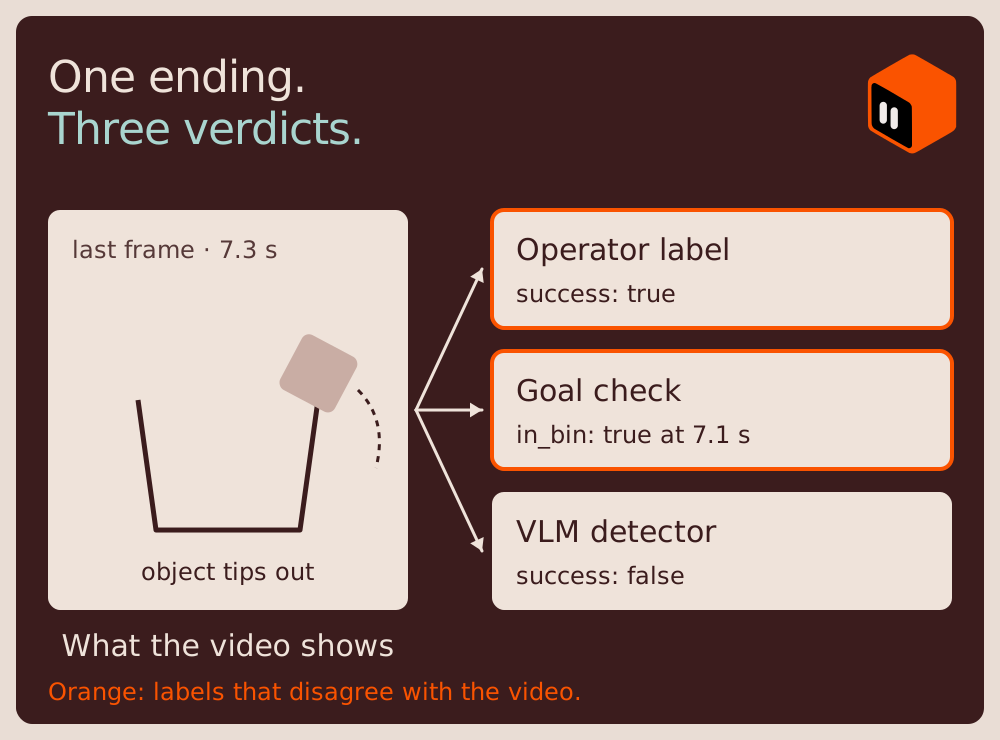
One episode, three outcome labels. A goal check that runs before the final frame can pass an episode that the video shows failing.
Key takeaways
Success detection labels whether each robot episode completed its task.
Labels come from operators, scripted simulator checks, vision-language models, or progress models, and each fails in its own way.
Wrong outcome labels corrupt both training, when failures are kept as demonstrations, and evaluation, when they are counted as successes.
Ways to label success
Source
How it decides
Typical failure
Operator label
The person who recorded the episode marks the outcome
Inconsistent standards between operators, or a default left unchanged
Scripted check
The simulator tests the task's goal conditions
Passes on a momentary state, such as an object that was in the bin when the check ran and tipped out afterward
Vision-language model
A model answers "did the robot complete the task?" from video
Less reliable on new scenes and viewpoints
Progress or reward model
A model scores progress toward the goal over time
Needs a threshold to turn a score into a label
Common sources of robot outcome labels and how each one goes wrong.
How it works
In real-world collection, the operator or a reviewer usually marks the outcome when an episode ends. In simulation benchmarks such as LIBERO, the simulator checks each task's goal conditions directly. Learned detectors are increasingly common at scale. SuccessVQA, from DeepMind in 2023, framed success detection as visual question answering and fine-tuned a vision-language model to answer whether a task was completed, across simulated household tasks, real robot manipulation, and human video. Progress models, a form of learned reward function, score how close an episode is to completion at each step, which also locates where an episode went wrong. Whatever the source, the label is stored with the episode and used to filter training data and compute success rates.
Before you trust a success flag, watch the last few seconds
A success label is a claim about how an episode ended, and it is usually made in a hurry, by a tired operator or a fast check. Many wrong labels are visible in the final seconds of video. The quiet problems:
an object placed in the bin that tips out in the last frames
a success flag left at its default for a whole session
an episode marked as a failure because the task text described a different goal
In Voxel51, DROID has 1,000 real-world manipulation episodes recorded as MCAP, with fields for task prompt, success, and number of grasps, so you can filter by outcome and check the footage behind each label.
Robotics Droid
1,000 episodes
Real-world robot manipulation episodes from DROID, stored as MCAP with three synced cameras and fields for task prompt, success, and number of grasps.
Try this: Filter success to true, then watch the final seconds of five episodes and confirm that each one ends with the task done.
Outcome labels are ground truth for robot learning, and they carry the same risks as any other labels. A failed episode labeled as a success enters the training set as a demonstration of what to do. A success labeled as a failure gets filtered out, along with whatever made it work. In evaluation, a detector that is fooled by the same situation every time biases the success rate in one direction, which no amount of extra rollouts will fix. Spot-checking labels against the final seconds of video, especially for long-horizon tasks, is the simplest guard against label noise in outcomes.
Is success detection the same as a reward function?
Not quite. A reward function scores behavior during learning, often at every step, while success detection produces a final outcome label for a whole episode. Learned progress models sit in between, since a progress score at the end of an episode can be thresholded into a success label.
Can a vision-language model label success reliably?
On familiar tasks and scenes, often yes. Fine-tuned detectors tend to be weaker on new environments, unusual camera angles, and subtle outcomes such as a grasp that holds briefly and then slips, so a sample of their labels should be checked by a person before they are trusted at scale.
Should episodes have partial success labels?
For multi-step tasks, partial labels are often more useful than a single flag. Recording which subtasks were completed, or where progress stopped, shows where policies fail and lets teams keep the successful portion of an episode for training.
Jesse Mostipak is the Director of Growth at Voxel51, where the work is helping humans find and trust what the brand knows, and teaching the Google knowledge graph and the LLMs answering on their behalf to do the same. That question, how knowledge gets built inside a system, is one Jesse has been chasing for years. Earlier versions of it ran through a New York City high school science classroom, data science and machine learning, and developer relations at Kaggle, Posit (formerly RStudio), and Baseten. The answer doesn't change much depending on whether the learner is a teenager, a software engineer, or a knowledge graph. Jesse holds a Master's in Education from CUNY Hunter College. LinkedIn