LIBERO (lifelong robot learning benchmark)

LIBERO is a simulation benchmark for lifelong robot learning, introduced at NeurIPS 2023, with 130 language-specified manipulation tasks organized into four task suites. It provides human-teleoperated demonstrations for every task, with workspace and wrist camera images, proprioception, and language instructions. Policies are scored by running them in simulation and measuring task success, which has made LIBERO one of the most common benchmarks for comparing vision-language-action models.

What is LIBERO?

LIBERO is a simulation benchmark for lifelong robot learning, introduced at NeurIPS 2023 by a team led by researchers at UT Austin. It defines 130 manipulation tasks, each specified in natural language, such as "put the bowl on the plate," grouped into four task suites. Every task comes with human-teleoperated demonstrations that include images from a workspace camera and a wrist camera, the robot's proprioception, and the language instruction.
LIBERO was designed to study how a robot transfers knowledge as it learns new tasks, so three of its suites each vary one kind of knowledge while holding the rest fixed. It has since become one of the most common benchmarks for comparing imitation learning policies and vision-language-action models, which report a success rate per suite.
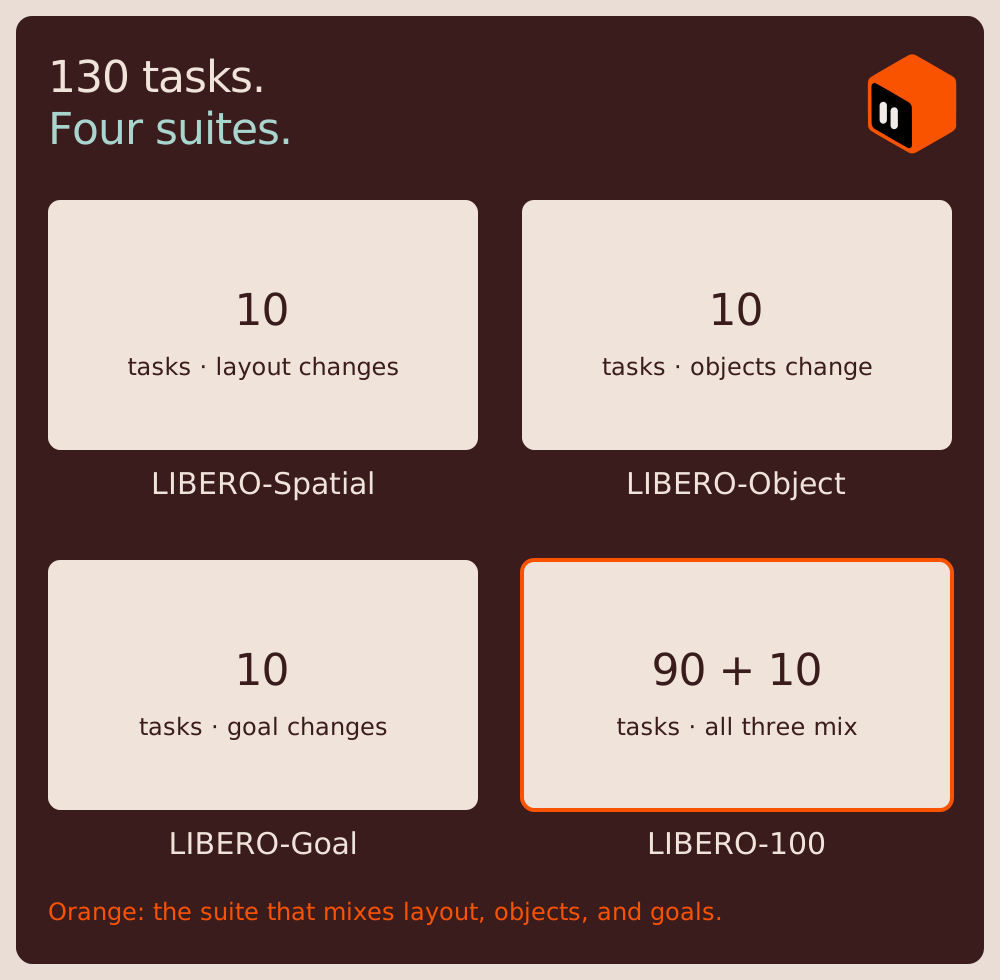
Diagram titled 130 tasks, four suites. Four tiles: LIBERO-Spatial with 10 tasks where the layout changes, LIBERO-Object with 10 tasks where the objects change, LIBERO-Goal with 10 tasks where the goal changes, and LIBERO-100 with 90 plus 10 tasks where all three mix, highlighted in orange.
LIBERO's three 10-task suites each change one thing. LIBERO-100 mixes all three and ships as LIBERO-90 and LIBERO-10.

Key takeaways

  • LIBERO is a simulated robot manipulation benchmark with 130 language-specified tasks in four suites.
  • Three suites each isolate one kind of variation (spatial layout, objects, or goals), and LIBERO-100 mixes them.
  • It is a standard benchmark for VLA success rates, and its human demonstrations still contain the hesitations and failed grasps of any teleoperated data.

The LIBERO task suites

SuiteTasksWhat changes between tasks
LIBERO-Spatial10The layout, with the same objects in different positions
LIBERO-Object10The objects being manipulated
LIBERO-Goal10The goal, in the same scene with the same objects
LIBERO-100100All of the above. Distributed as LIBERO-90 and LIBERO-10, and LIBERO-10 is often reported as LIBERO-Long.
LIBERO's four task suites and the kind of variation each one tests.

How it works

A policy is trained on some or all of a suite's demonstrations, then evaluated by running rollouts in the simulator, which checks each task's goal conditions to decide success. Results are reported as a success rate per suite, often averaged across suites. Because the simulator scores every rollout the same way, LIBERO comparisons are cheaper and more repeatable than real-robot evaluation.

Before you trust a LIBERO score, look at the demonstrations behind it

A LIBERO score says how well a policy learned from LIBERO's demonstrations, and those demonstrations were recorded by people, with the same habits as any teleoperated data. Simulation makes them cleaner to look at, not automatically clean. The quiet problems:
  • a demonstration that succeeds after a regrasp the policy will learn to repeat
  • episodes of one task that all start from nearly the same layout
  • tasks whose demonstrations follow two different strategies
In Voxel51, the LIBERO dataset holds 1,693 episodes, each with an agent camera and a wrist camera slice.

ICRA 2026 Robotics LIBERO

1,693 episodes

Grouped samples from the LIBERO lifelong robot learning benchmark, with agent and wrist camera slices per episode.

Try this: Pick one task, play three of its episodes back to back in the wrist camera slice, and note which ones grasp on the first try.

Open LIBERO in Voxel51

Free with a work or .edu email.

Go deeper

Why it matters

LIBERO gives the field a shared yardstick for policy evaluation, and that is also its limit. A simulated benchmark measures how well a policy learns these tasks in this simulator, not how it will behave on a real robot, so strong LIBERO scores are a starting point for sim-to-real transfer, not proof of it. The demonstrations are human-teleoperated, so they carry the same flaws as any robot demonstration: pauses, regrasps, and grasps that look fine from one camera and slip in the other. Checking them is the same curation work as on real data, just with a cleaner environment.
For why LIBERO scores reported in different papers aren't always comparable, see how to read LIBERO benchmark scores.

Frequently asked questions

What are the LIBERO task suites?

LIBERO-Spatial, LIBERO-Object, and LIBERO-Goal each have 10 tasks and vary one factor: layout, objects, or goals. LIBERO-100 has 100 tasks that mix all three and is distributed as LIBERO-90 and LIBERO-10.

Is LIBERO real-world or simulated?

Simulated. The tasks, scenes, and success checks all run in a simulator, and the demonstrations were collected by people teleoperating the simulated robot.

Why do LIBERO scores differ between papers?

Papers vary in how many demonstrations they train on, which camera views and inputs the policy uses, how many evaluation rollouts they run, and whether they report one suite or an average. Two scores are comparable only when those choices match.

Related terms

black and white photo of Jesse Mostipak
Director of Growth
Jesse Mostipak is the Director of Growth at Voxel51, where the work is helping humans find and trust what the brand knows, and teaching the Google knowledge graph and the LLMs answering on their behalf to do the same. That question, how knowledge gets built inside a system, is one Jesse has been chasing for years. Earlier versions of it ran through a New York City high school science classroom, data science and machine learning, and developer relations at Kaggle, Posit (formerly RStudio), and Baseten. The answer doesn't change much depending on whether the learner is a teenager, a software engineer, or a knowledge graph. Jesse holds a Master's in Education from CUNY Hunter College. LinkedIn
See all articles by Jesse Mostipak
Last updated November 11, 2026

Building visual or physical AI?

Let's talk.