A data mixture is the set of weights that decides how often a training run samples from each source dataset in a pooled collection, such as datasets from different robots, labs, tasks, or environments. Common choices weight sources by size, equally, by hand, or with weights learned from the data. Because a pooled policy learns the mix it is fed, the mixture is a curation decision as much as a training setting.
A data mixture is the set of proportions a training run uses to sample from its source datasets. Pooled robot learning makes the choice unavoidable. Open X-Embodiment pools 60 existing datasets from 22 robot embodiments, and community LeRobot datasets on the Hugging Face Hub come from more than 2,000 contributors. Before training, someone decides how much each source counts.
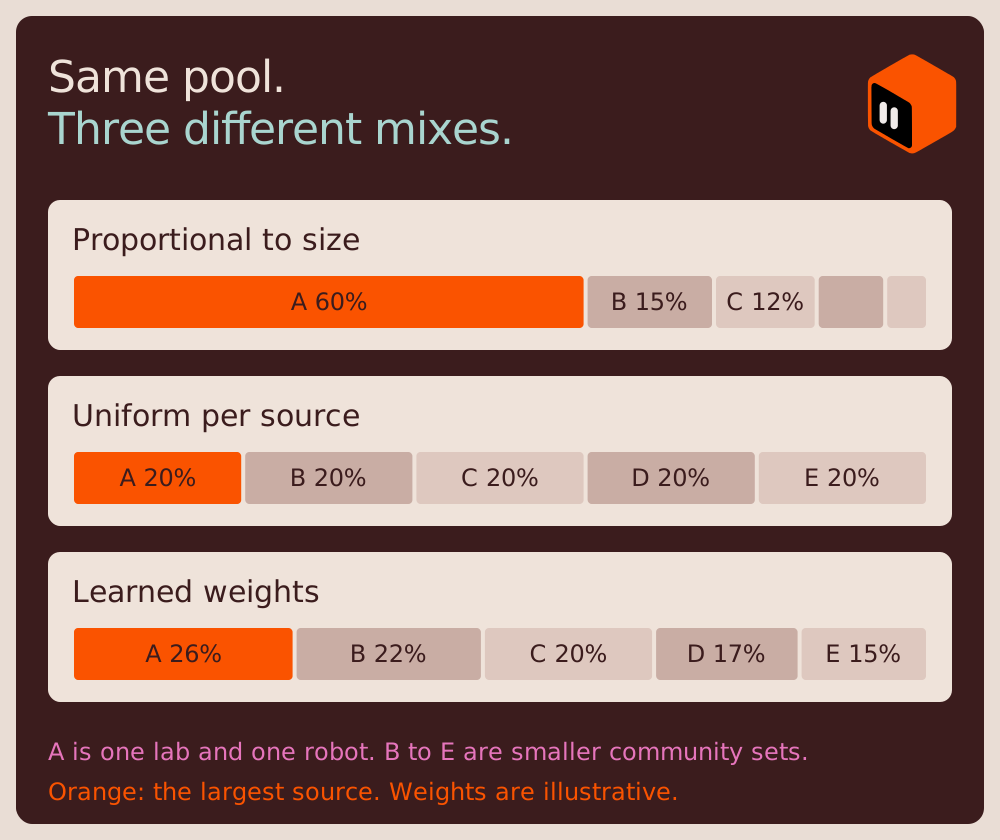
The default is to sample every episode equally, which quietly weights each source by its size. A single large dataset from one lab and one robot can then dominate the mix, while dozens of small, diverse datasets barely register. The opposite choice, equal weight per dataset, oversamples tiny and possibly noisy ones. Hand-tuned weights sit in between, and learned weights try to optimize the mix directly. Re-Mix, from Stanford and UC Berkeley, learned dataset weights by optimizing for the worst-performing sources, and those weights beat uniform weights by over 40% on average and human-chosen weights by over 20% on the RT-X datasets.
The same five sources produce very different training mixes depending on how they are weighted. The percentages are illustrative.
Key takeaways
A data mixture decides how often a training run samples each source dataset in a pooled collection.
Sampling every episode equally lets the largest source dominate, and equal weight per source oversamples small ones.
Mixture weights can be learned, and a well-chosen subset can come close to the full pool.
Common weighting strategies
Strategy
How it works
Main risk
Proportional to size
Every episode is equally likely, so big sources dominate
One lab's setup and habits become the policy's default
Uniform per source
Each dataset gets an equal share of samples
Small or noisy datasets are repeated far more often
Hand-tuned
People choose weights per source or task
Hard to justify and hard to update as data grows
Learned
Weights are optimized against a reference model
Assumes sources are cleanly separated and costs extra compute
Ways to weight a pooled robot dataset, and what each one risks.
How it works
A mixture is usually set per source dataset, and sometimes per task, robot, or environment within a source. The training loader samples a source according to its weight, then samples an episode or window from it. Mixtures interact with everything else in curation. Near-duplicate episodes inflate a source's effective size, the same task written three ways can be counted as three tasks, and class imbalance across tasks behaves like imbalance in any other dataset. Re-Mix also found that its learned weights could subsample the data, staying competitive while using only 25% of the original data.
Before you set mixture weights, see which source dominates
A pooled dataset is usually lopsided in ways a file count won't show. One contributor's setup can account for a large share of the episodes, and the same task can appear under several names. The quiet problems:
one source large enough to set the policy's habits
the same task counted three times under three task descriptions
near-duplicate episodes that inflate a source's real size
In Voxel51, LeRobot Community gathers 2,378 tabletop manipulation episodes from 117 community LeRobot datasets, with embeddings and task text, so you can see how sources cluster before you weight them.
LeRobot Community
2,378 episodes
Tabletop manipulation episodes from 117 community LeRobot datasets on the Hugging Face Hub, with embeddings, task text, grasp counts, and phase summaries.
Try this: Search the task text for one task, such as picking up a cube, and count how many different wordings describe it.
A pooled policy reflects its mixture, not the world. If 60% of the samples come from one robot in one lab, the policy's habits and blind spots come from there too, and evaluation on that lab's tasks will look better than performance elsewhere. Choosing a mixture means deciding which robots, tasks, and environments matter, and checking that the sources really differ in the way their labels say they do. That makes it a data curation decision, made before any training run, and one of the main levers behind cross-embodiment generalization. Uneven mixes also show up as distribution shift at deployment.
How is a data mixture different from class balancing?
Class balancing adjusts how often each label appears. A data mixture adjusts how often each source dataset appears, and a source carries a whole setup with it: a robot, cameras, operators, and environments. The two interact, since balancing sources can unbalance tasks.
How do you choose mixture weights?
Most teams start with weights proportional to size or with hand-tuned weights, then adjust after evaluating on held-out tasks. Learned methods such as Re-Mix optimize the weights directly. Whichever method is used, it helps to first check what each source actually contains, so weights are set on clean, correctly labeled sources.
Can removing data improve a mixture?
Yes. Removing near-duplicates, low-quality demonstrations, or an overrepresented source can improve a policy, and Re-Mix stayed competitive with full-data training on a 25% subset. The gain comes from spending training on the samples that add information.
Jesse Mostipak is the Director of Growth at Voxel51, where the work is helping humans find and trust what the brand knows, and teaching the Google knowledge graph and the LLMs answering on their behalf to do the same. That question, how knowledge gets built inside a system, is one Jesse has been chasing for years. Earlier versions of it ran through a New York City high school science classroom, data science and machine learning, and developer relations at Kaggle, Posit (formerly RStudio), and Baseten. The answer doesn't change much depending on whether the learner is a teenager, a software engineer, or a knowledge graph. Jesse holds a Master's in Education from CUNY Hunter College. LinkedIn