The Sound of Evolution: Whale Song Embeddings in FiftyOne
Author

Chief Community Officer
Jimmy is the Chief Community Officer at Voxel51, where he leads developer relations and growth. With 25+ years of experience connecting developers and enterprises to cutting-edge ML and open-source solutions, Jimmy drives impactful content, events, and education that fuel awareness, adoption, and community engagement.
See all articles by Jimmy Guerrero
In this article
Talk to an AI expert
Can an AI trained on pop songs and podcasts hear the tree of life in whale calls? Turns out: pretty much, yes. We’ve built a Jupyter Notebook that lets you hear it AND see it.
The science behind whale song embeddings
It starts with a preprint — "Phylogenetic signal in marine mammal and bird vocalizations captured by audio foundation models" (Rincón Yepes, 2026) — and its companion repo. The research found that general-purpose audio models like CLAP and AST encode the evolutionary relationships between species about as well as a bioacoustics specialist does. And curiously, even though nobody trained them on animals, phylogeny, or anything of the sort.
Key takeaways
- Whale song embeddings from general-purpose audio models like CLAP and AST encode evolutionary relationships between species about as well as a bioacoustics specialist model does (Rincón Yepes, 2026).
- The demo embeds roughly 1,700 clips across 32 species from the Watkins Marine Mammal Sound Database four ways: CLAP, AST, BEATs-bio, and an MFCC baseline.
- FiftyOne's embeddings visualizer projects the audio vectors to a 2-D plot where clades and families visibly separate when colored by taxonomy.
- The fiftyone-audio-toolkit plugin renders every audio clip as a live, in-browser spectrogram with playback in the FiftyOne App.
- CLAP supports text-to-audio search in FiftyOne, so typing "barking seal" surfaces matching clips with no example audio required.
The sounds come from the Watkins Marine Mammal Sound Database (Woods Hole Oceanographic Institution) — a historic archive spanning seven decades, including the first-ever underwater recording of a marine mammal, a beluga taped in 1949. The demo uses a clean subset: ~1,700 clips across 32 species. Each clip is embedded four ways — CLAP, AST, the specialist BEATs-bio, and a hand-crafted MFCC baseline — so you can compare what each model "hears."
Turn sounds into images with FiftyOne
FiftyOne is the open-source tool for annotating and exploring datasets and evaluating models. The killer feature for this use case is the embeddings visualizer. It allows you to project high-dimensional audio vectors down to a 2-D plot, color by any field, and lasso clusters that stay synced to the media grid.
Pairing it with this project is what makes an abstract statistic tangible. The paper reports a correlation coefficient; FiftyOne lets you watch the family tree assemble itself in a scatter plot, flip between models to see which ones "get it," and click a dot to hear the actual animal. A number becomes an experience.
See it, hear it, search it
We built a demo notebook that wires everything using open-source FiftyOne and the fiftyone-audio-toolkit plugin:
Spectrograms in the grid. Every clip renders as a live, in-browser spectrogram.
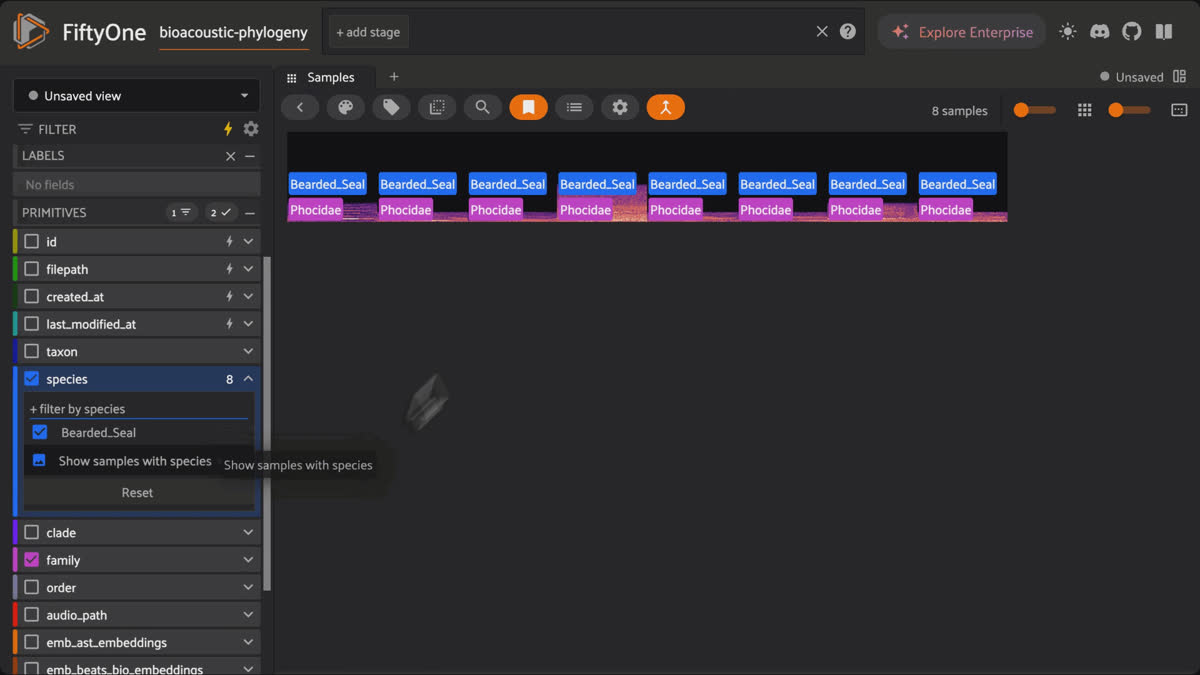
Filtering the FiftyOne grid to bearded seal clips, each rendered as a live in-browser spectrogram.
Play it in the app. Double-click a tile and a player opens with a playhead sweeping across the spectrogram. Listen to a killer whale, then a bearded seal.
Watch models disagree. Flip the embeddings plot between CLAP, AST, BEATs-bio, and MFCC. Color by clade and the whale/seal split appears; switch to the cetaceans and color by family; dolphins, baleen whales, and belugas pull cleanly apart. MFCC? Mush. That contrast is the paper's point.
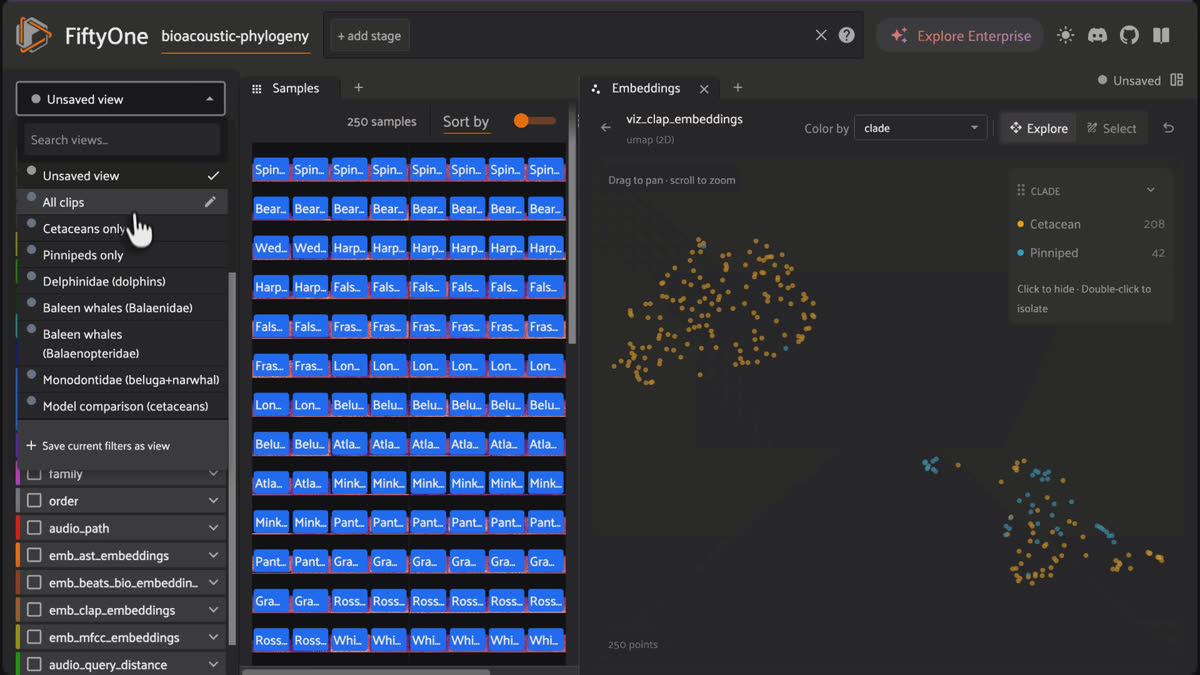
CLAP embeddings plot colored by clade, with cetacean and pinniped points pulling apart and saved views for each group.
| Embedding | What it is | What you see in the plot |
|---|---|---|
| CLAP | General-purpose audio-language model | Clade and family structure separates, also powers text search |
| AST | General-purpose audio transformer | Comparable evolutionary structure |
| BEATs-bio | Bioacoustics specialist | The specialist reference the generalists match |
| MFCC | Hand-crafted acoustic features | Mush |
Search by sound — or by words. Type "barking seal" and CLAP turns your text into a query embedding, then surfaces the clips that match. No example audio required.
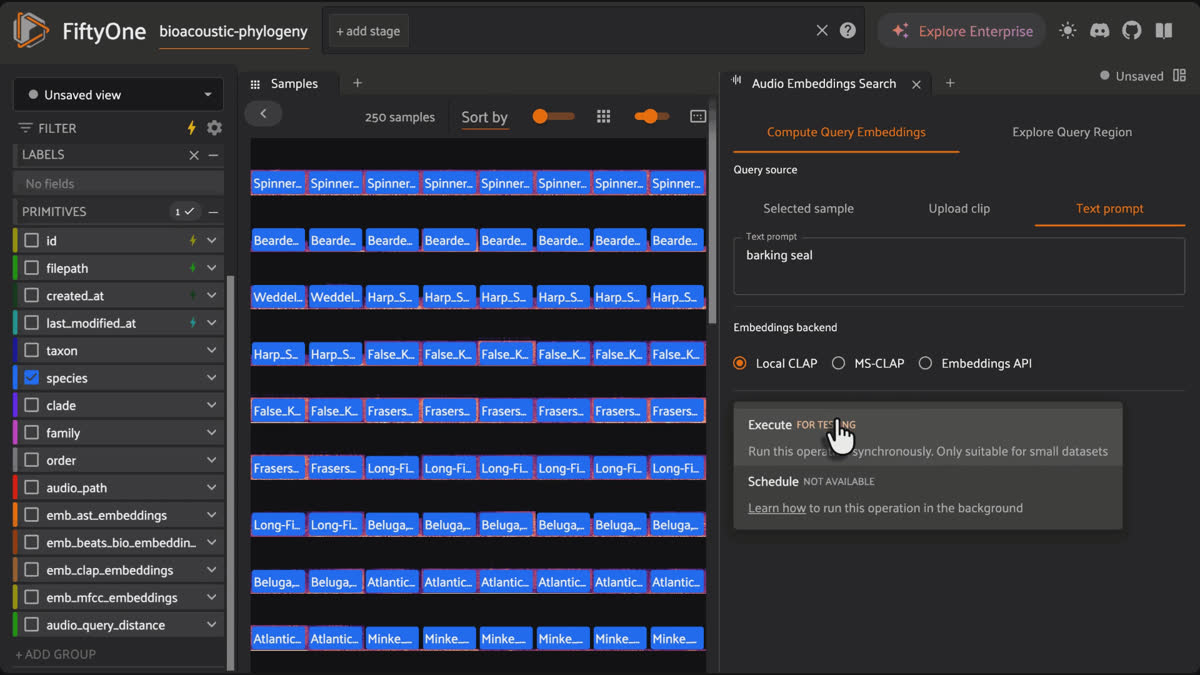
Audio Embeddings Search panel in FiftyOne turning the text prompt barking seal into a CLAP query embedding to surface matching clips.
Next steps
- GitHub: Download the Jupyter Notebook
- The project: bioacoustic-phylogeny-embeddings (preprint arXiv:2607.22458)
- The data: Watkins Marine Mammal Sound Database
- Get FiftyOne: pip install fiftyone → docs (use Python 3.12 for this audio stack)
- The audio plugin: fiftyone-audio-toolkit
- Go deeper: the FiftyOne Brain for embeddings + similarity search
Questions? We have answers.
Yes. CLAP and AST encode the phylogenetic relationships between marine mammal and bird species about as well as a bioacoustics specialist model, despite never being trained on animal sounds.
Use the embeddings visualizer to project high-dimensional audio vectors down to a 2-D plot, color the points by any field, and lasso clusters that stay synced to the media grid.
A historic Woods Hole Oceanographic Institution archive spanning seven decades, including the first-ever underwater recording of a marine mammal, a beluga taped in 1949. The demo uses a clean subset of about 1,700 clips across 32 species.
Yes. With CLAP and the fiftyone-audio-toolkit plugin, a text prompt like "barking seal" becomes a query embedding that surfaces the closest-matching clips.
Chief Community Officer
Jimmy is the Chief Community Officer at Voxel51, where he leads developer relations and growth. With 25+ years of experience connecting developers and enterprises to cutting-edge ML and open-source solutions, Jimmy drives impactful content, events, and education that fuel awareness, adoption, and community engagement.
See all articles by Jimmy Guerrero
Talk to an AI expert
Loading related posts...
© 2026 Voxel51 All Rights Reserved


