Physical AI Data Platform Guide: What You Should Look For In 2026
Author

Product Marketing Manager
As a seasoned B2B product marketing leader, I have a proven track record of accelerating growth through compelling storytelling, messaging, and strategic product positioning. My passion lies in taking complex technology and synthesizing it into a simple, easy to understand narrative that not only resonates but also drives tangible results.
See all articles by Kirti Joshi
In this article
1. Multimodal data support, unified in a single view2. Scenario-based evaluation for edge case discovery3. Data augmentation to identify the long tail4. Eliminate annotation waste5. Expert-level labeling and quality assurance6. Synthetic data pipelines for data coverage7. Workflow extensibility for custom applications8. Security and governanceConcluding thoughts
In this article
1. Multimodal data support, unified in a single view2. Scenario-based evaluation for edge case discovery3. Data augmentation to identify the long tail4. Eliminate annotation waste5. Expert-level labeling and quality assurance6. Synthetic data pipelines for data coverage7. Workflow extensibility for custom applications8. Security and governanceConcluding thoughts
Try Voxel51 for yourself
Physical AI is having its moment. We are in the middle of a shift: intelligence is leaving the screen and entering the world, with real physical actions and consequences. It’s an exciting time indeed. Autonomous vehicles are navigating city streets, robots are stocking shelves, performing industrial inspection, and even assisting with medical surgeries.
And yet, across more than 700+ teams building this technology today, every single one reports that their models underperform or fails.
The 2026 State of Visual & Physical AI study, based on responses from more than 700 professionals working across visual, spatial, and physical AI, found that 78% of teams are generating real value from their visual and physical AI projects and 86% expect its importance to grow over the next three years. But what surfaced behind the failing or underperforming models wasn’t an model architecture or algorithmic issue, but data stack challenges: poor quality data, insufficient training samples for certain scenarios, costly annotation workflows, and data class imbalances.
The companies successfully shipping physical AI in 2026 are the ones with the best data stacks. Your data platform determines whether your team ships or stalls.
- Exceptional teams spend 3x more time on data work than struggling ones
- 89% say data is the primary driver of success
- 36% say less than half of the data they pay to annotate ever reaches production.
- 97% of teams struggle with dataset iteration, 99% call annotation painful.
This guide breaks down the capabilities you need to evaluate physical AI data platforms—whether you build, buy, or piece it together.
1. Multimodal data support, unified in a single view
68% of teams work across three or more modalities, and only 6% work with a single one. Images dominate (92%), but video (63%), time-series (42%), and 3D/LiDAR (38%) are now table stakes for anyone doing robotics, autonomous vehicles, or spatial AI. If point cloud or sensor data is not native modality, your team will spend its best engineering hours writing glue code instead of meaningful data and model work.
A strong physical AI data platform should ingest and synchronize modalities while preserving spatial and temporal relationships.
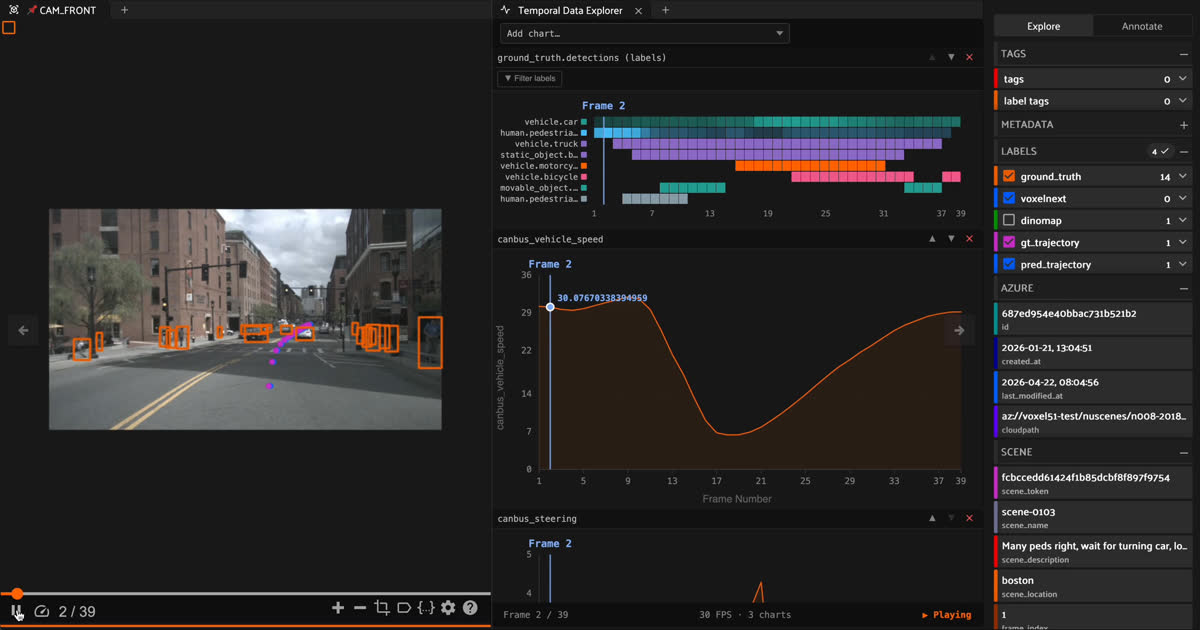
For buying decisions, this is a vendor-consolidation question: every modality you can't unify is another tool, another license, another integration that needs to be taken care of and maintained. For MLEs, it's about whether you can actually see a synchronized view across lidar/radar, images, and video when debugging failures.
We recommend looking for platforms that let you customize views for grouped datasets, offer a native 3D visualizer for point clouds and meshes, and treat sensor fusion as a property of the data layer.
Extensibility is just as important. As requirements for new modalities emerge, you’ll want to instantly add them to your pipeline, instead of waiting for a vendor roadmap or creating that functionality in-house. For example, this Fortune 50 company built an entire audio ingestion pipeline in just two days, gaining audio-visual search and evaluation without months of custom engineering.
2. Scenario-based evaluation for edge case discovery
Every single (100%) survey respondent reports their models underperform or fail at some point. And when things go wrong, 67% are still catching it through manual review, regardless of how mature their organization is. The tools have gotten better, but the human in the loop hasn't gone away.
The best physical AI teams aren't trying to collect more data. They're trying to collect the right data for the scenarios that actually cause weak models. For example, a 94.3% Mean Average Precision score looks great on paper until you realize your detector is 99% accurate in daylight and only 60% accurate at night.

That's where clustering and a real model evaluation workflow come in. These allow you to further dig into the root cause at the sample level. Scenario analysis lets you slice your metrics by weather, scene type, object size, or any condition you define, then click straight through to the samples that are failing. You can see exactly where the model breaks down, and exactly what data you need to fix it.
3. Data augmentation to identify the long tail
Coverage gaps are the #3 data iteration pain point, cited by 43% of practitioners, right behind bad labels (59%) and samples that actively hurt model performance (47%). In physical AI, the consequences are concrete: a model that was never trained on foggy highway conditions or high-contrast conveyor belt scenarios will fail when it encounters them in deployment. The problem isn't the size of your dataset. Scanning thousands of samples tells you nothing about whether the specific failure-mode scenarios you need are actually in there.
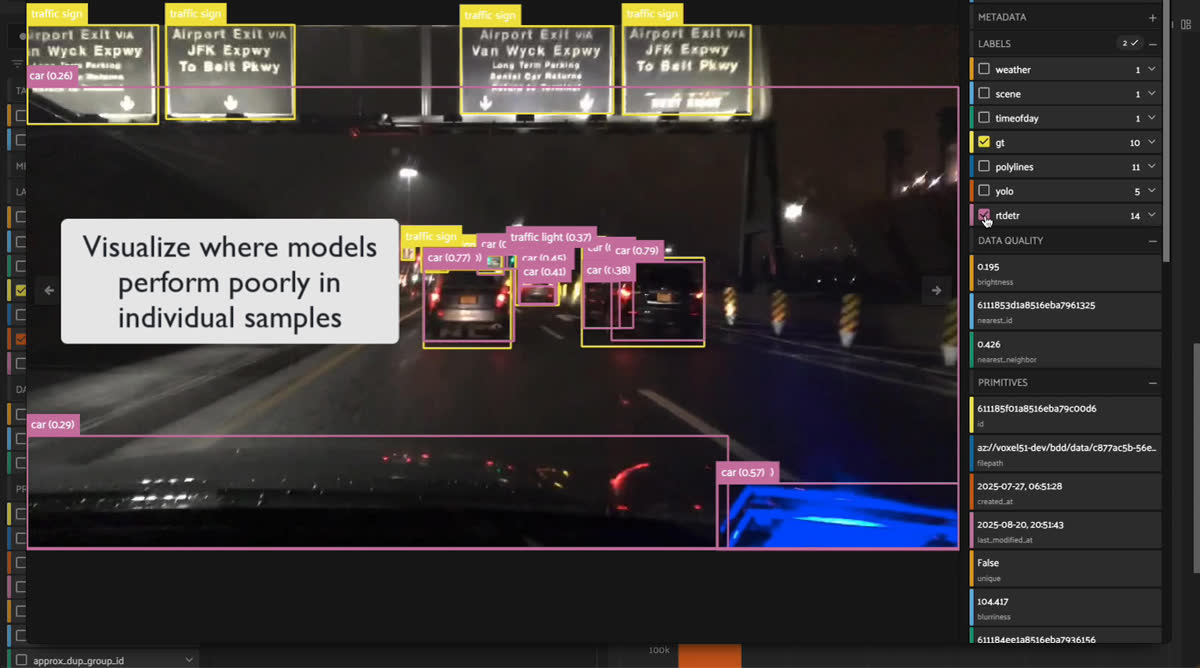
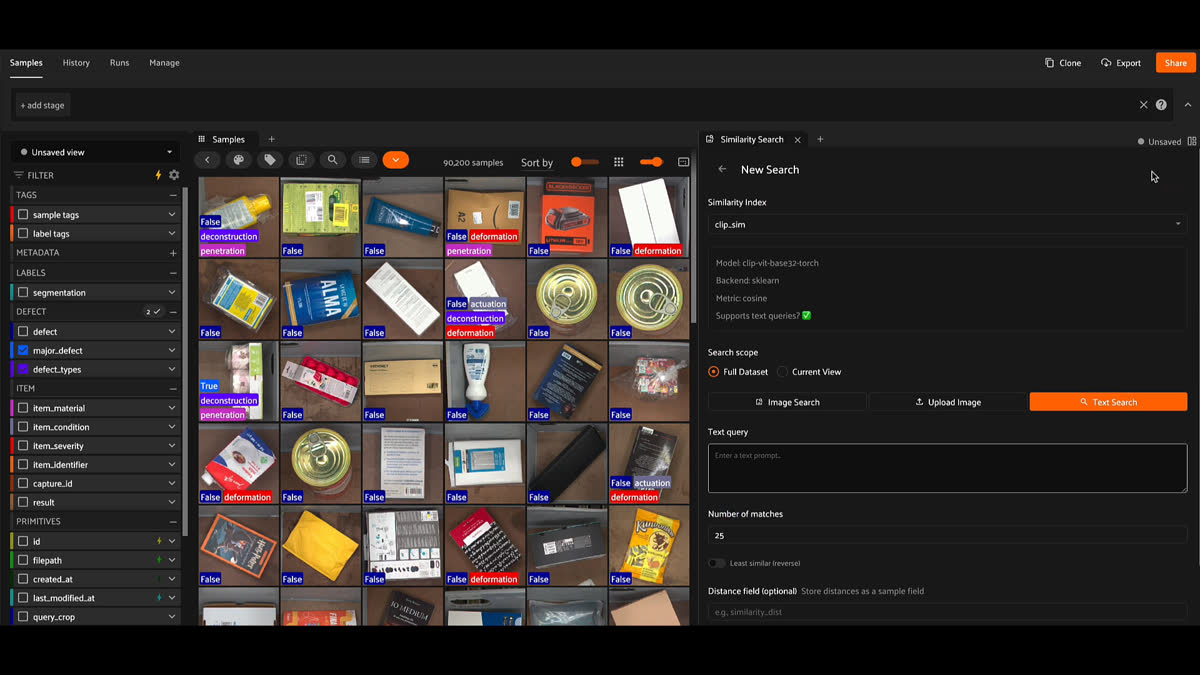
Similarity search and augmentation are the most effective workflows to mitigate these gaps. When evaluating platforms, the questions that matter are: Can you search a large dataset for visually similar scenarios and surface the rare, high-value samples buried in it? Can you query your data lake directly to fill gaps rather than waiting for new collection runs? Similarity search and data lens capabilities make both possible.
4. Eliminate annotation waste
More than a third of teams (36%) say less than half the data they annotate ever makes it to production. 15% say less than a quarter does. And 44% expect annotation costs to keep climbing. That's a lot of budget going toward labeled data that never ships.
The typical workflow has been to label first and figure out what's useful later. But that's backwards. If you curate before you annotate, you only pay to label data that actually matters. Your platform should show you what's redundant, what's missing, and what's quietly degrading your model quality before anything goes to a labeler.
Look for tools that offer active learning workflows to curate the right samples for labeling. Particularly, embedding-based workflows, few-shot retrieval techniques, metadata-based data sampling, and the ability to find similar samples from existing failure modes are useful techniques for curating the right data for labeling.
Teams that work this way ship models with 60–80% less annotated data. And the models generalize better in the real world, not just on benchmarks. The important number worth tracking isn't necessarily the speed of annotation but how much of what you annotate actually ends up being useful for training and in production.
5. Expert-level labeling and quality assurance
59% of teams struggle with bad labels, and 47% can't reliably identify samples that are actively hurting model performance. Even well-curated benchmark datasets contain 3–6% labeling errors that go undetected. At a production scale, that's hundreds of thousands of corrupted training samples. In physical AI, particularly, the stakes of inaccurate labels are way higher. A slightly misdrawn bounding box or a not-so-accurate segmentation mask can throw off spatial reasoning and produce unreliable simulation results downstream, which can have real-world safety implications.
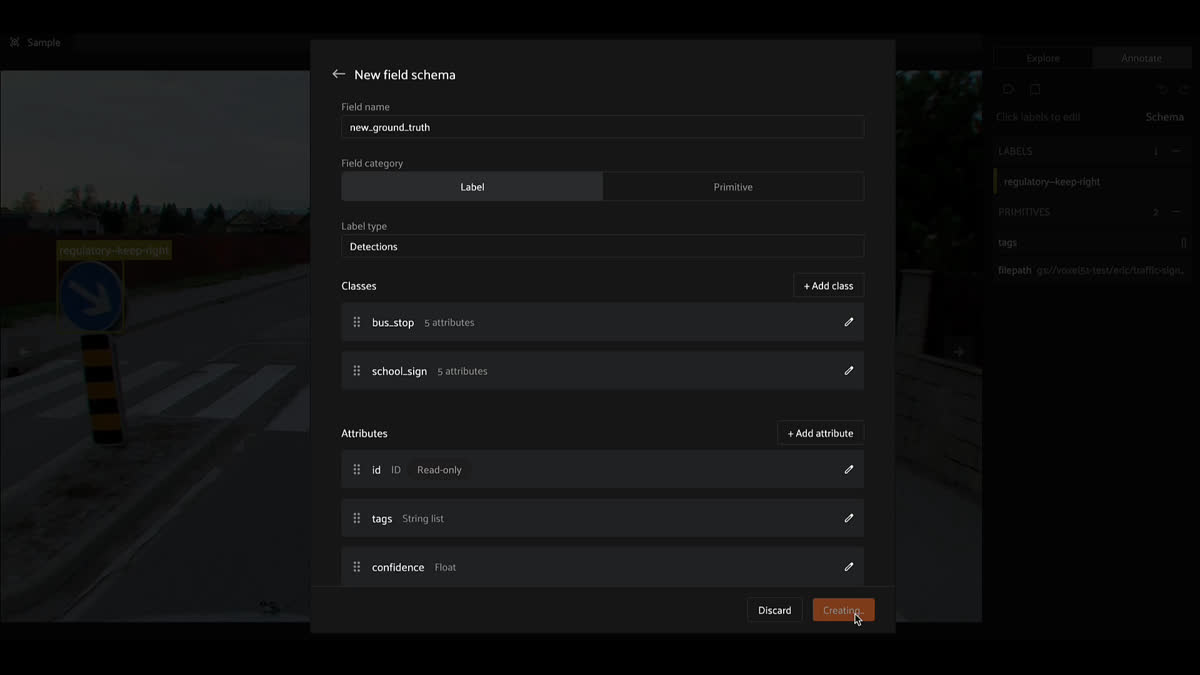
A strong data platform makes it easy for domain experts to catch labeling mistakes and fix them in context, without shuffling data between tools. Native multimodal annotation and built-in QA workflows mean your team can review and correct classifications, detections, and segmentations in one place.
6. Synthetic data pipelines for data coverage
Synthetic data is quickly becoming foundational to physical AI. In fact, 63% of teams believe synthetic data will become their primary training source, yet only 40% use it in production today. The gap exists because collecting real-world edge cases at scale is slow, expensive, and often impossible. Rare safety-critical events, unusual environments, and long-tail scenarios simply cannot be captured reliably through real-world driving or robot operation alone.
Synthetic data generation (SDG) solves this by enabling teams to create controlled variations of the same scene across lighting, weather, traffic, sensor configurations, and environmental conditions. But generating synthetic data alone is not enough. Teams need a workflow that connects real-world data, neural reconstruction, simulation, augmentation, and validation into a single pipeline.

Synthetic scene variations from Porsche's raw driving scenes
We recommend looking for platforms with production-grade integrations into simulation stacks like NVIDIA Omniverse and neural reconstruction pipelines, and proven reference architectures like the Porsche + Nebius + NVIDIA synthetic data pipeline that demonstrate how real and synthetic data can operate together in practice.
7. Workflow extensibility for custom applications
No two organizations will have similar data pipelines. As physical AI systems evolve, teams need the flexibility to adapt workflows without rebuilding their entire infrastructure stack. This means the platform provides the ability to create specialized workflows and build custom functionality.
Look for platforms with open SDKs, flexible plugin frameworks, APIs, and agentic workflow support that allow teams to build custom applications directly on top of the platform. This includes being able to create custom visualizations, workflows, dashboards, and apps.
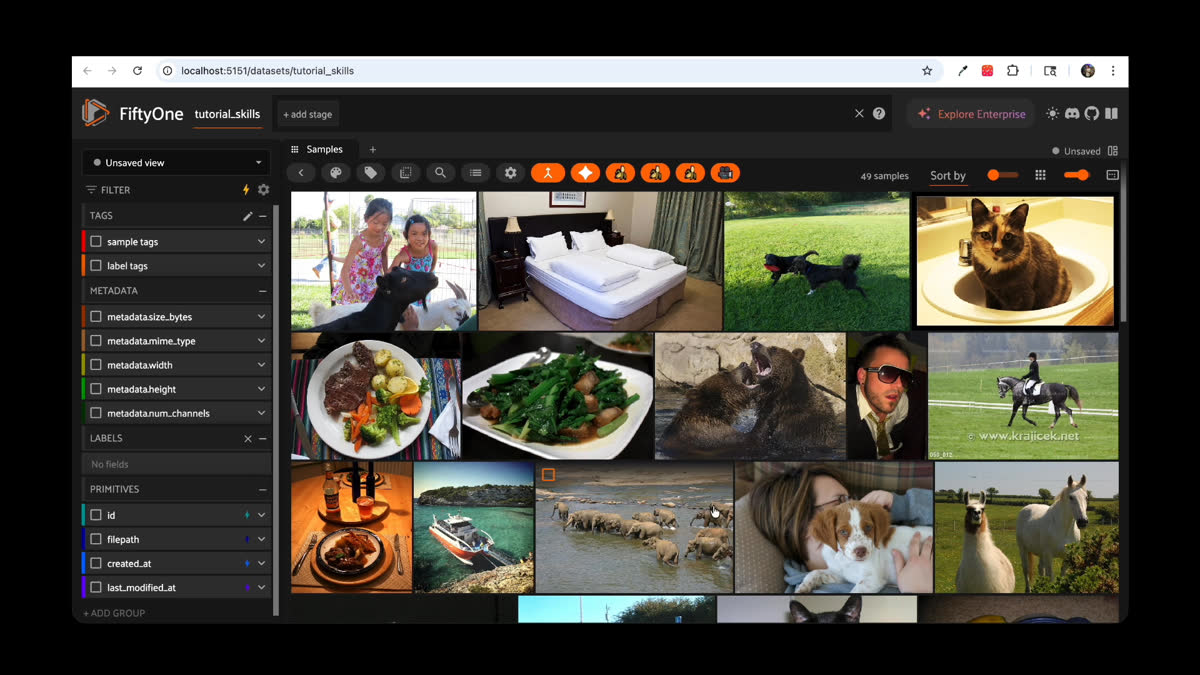
Using your favorite coding assistant and model to build custom applications
8. Security and governance
Physical AI systems often operate in highly sensitive environments where security, governance, and traceability are critical. Proprietary data use rises from 59% in research to 91% in production, raising the stakes on how it’s managed, secured, and governed. A modern data platform should provide enterprise-grade controls for managing access, securing multimodal data, and maintaining clear lineage across datasets, annotations, evaluations, and model versions.
Look for platforms that have built-in role-based access control, audit logs, dataset versioning, secure deployment options, and governance that help teams maintain compliance while enabling collaboration across teams.
Concluding thoughts
The teams that will lead physical AI over the next two years won't be the ones with the biggest models or the most data. They'll be the ones who treat their data stack as strategic infrastructure.
FiftyOne is the leading data platform for physical AI. The platform combines open-source flexibility with enterprise-grade capabilities to help teams understand and analyze their multimodal data, annotate the right samples, close quality and coverage gaps, and build models that perform reliably in the real world.
For the full dataset behind every stat in this post, check out the 2026 State of Visual & Physical AI report.
Want to see where your data practice stands relative to the field? Take this short Physical AI Pipeline Audit.
Product Marketing Manager
As a seasoned B2B product marketing leader, I have a proven track record of accelerating growth through compelling storytelling, messaging, and strategic product positioning. My passion lies in taking complex technology and synthesizing it into a simple, easy to understand narrative that not only resonates but also drives tangible results.
See all articles by Kirti Joshi
Try Voxel51 for yourself
Loading related posts...
© 2026 Voxel51 All Rights Reserved


