Author

Senior Machine Learning Engineer & Researcher
🎓 Ph.D. in Theoretical Physics from Stanford University
See all articles by Jacob Marks
In this article
In this article
Try Voxel51 for yourself
Machine learning anomaly detection (AD) is crucial in mission-critical applications such as fraud detection, network security, and medical diagnosis. Anomaly detection in visual data like images, videos, and satellite imagery is particularly challenging due to the high dimensionality of the data and the complexity of the underlying patterns. Yet visual anomaly detection is essential for detecting defects in manufacturing, identifying suspicious activity in surveillance footage, and detecting abnormalities in medical images.
In this post, you'll learn how to perform visual anomaly detection on visual data using FiftyOne and Anomalib from the OpenVINO toolkit. For demonstration, we'll use the MVTec AD anomaly dataset, which contains visual anomaly data including images of various objects with anomalies like scratches, dents, and holes. This anomalib tutorial covers the following:
- Loading the MVTec AD dataset in FiftyOne
- Training an anomaly detection model with Anomalib
- Evaluating anomaly detection models in FiftyOne
↳ Run the code from this blog post interactively in this Colab notebook
Anomalib tutorial: Setup
Installing dependencies
Make sure you are running this in a virtual environment with python=3.10. Anomalib requires Python 3.10, so make sure you have the correct version installed.
conda create -n anomalib_env python=3.10
conda activate anomalib_env
After this, install Anomalib from source, per the instructions in the Anomalib README, and its dependencies. These might take a moment on Google Colab but should be quick for local installs:
pip install -U torchvision einops FrEIA timm open_clip_torch imgaug lightning kornia openvino git+https://github.com/openvinotoolkit/anomalib.gitInstall FiftyOne from source so you can use the latest version of the Hugging Face Hub integration to load the MVTec AD dataset:
pip install -U git+https://github.com/voxel51/fiftyone.gitWe're ready to go with a few more packages to install. Now you can see why we recommend using a virtual environment for this project!
- huggingface_hub for loading the MVTec AD dataset
- clip for computing image embeddings
- umap-learn for dimensionality reduction
pip install -U huggingface_hub umap-learn git+https://github.com/openai/CLIP.gitAnomalib Tutorial: MVTec AD Anomaly Dataset
Now, let's import all of the relevant anomaly dataset modules we will need from FiftyOne:
import fiftyone as fo # base library and app
import fiftyone.brain as fob # ML methods
import fiftyone.zoo as foz # zoo datasets and models
from fiftyone import ViewField as F # helper for defining views
import fiftyone.utils.huggingface as fouh # Hugging Face integration
And load the MVTec AD dataset from the Hugging Face Hub:
dataset = fouh.load_from_hub("Voxel51/mvtec-ad", persistent=True, overwrite=True)Before moving on, let's take a look at the anomaly dataset in the FiftyOne App:
session = fo.launch_app(dataset)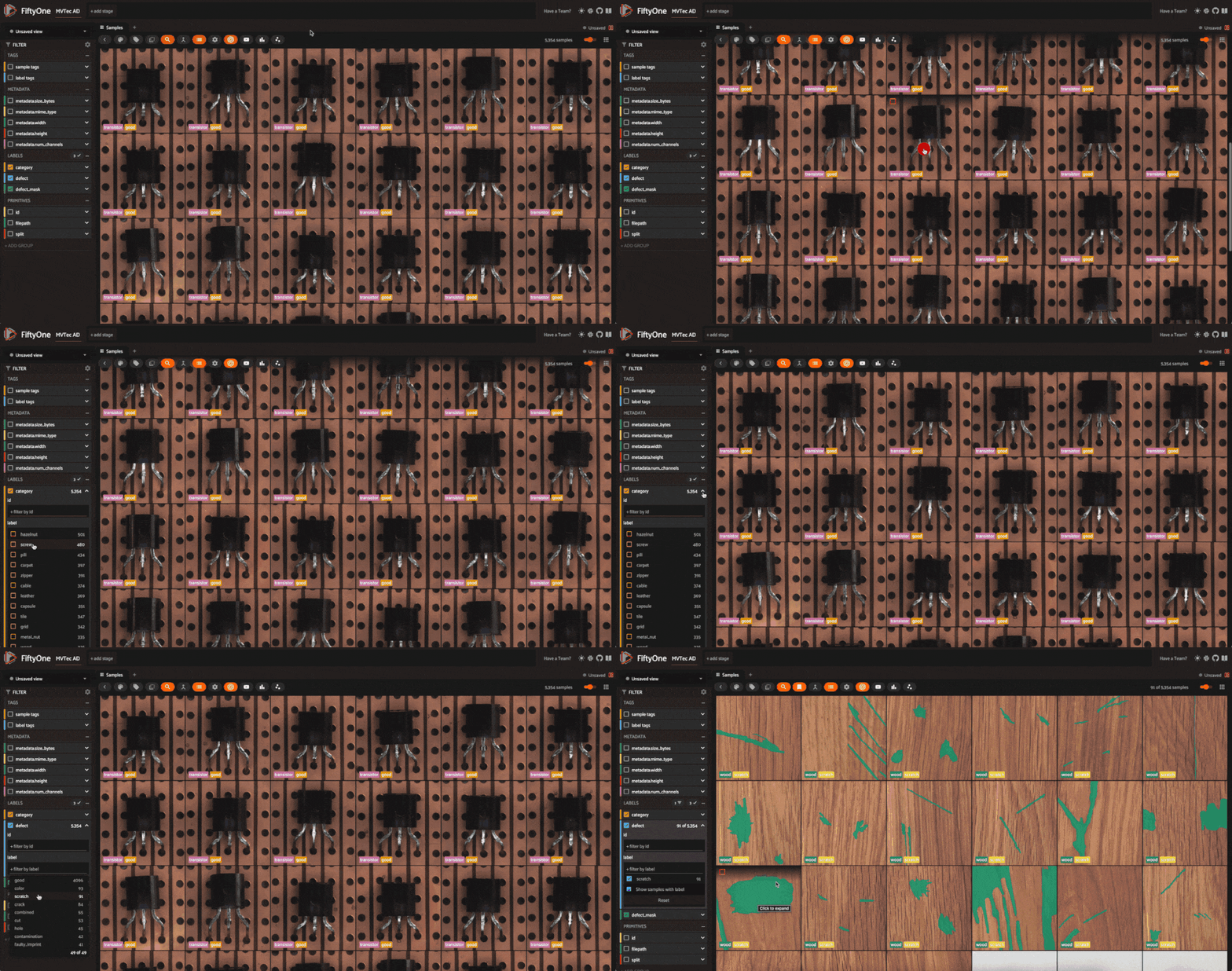
Anomalib tutorial: Machine learning visual anomaly dataset
The machine learning anomaly detection dataset has 5354 images across 12 object categories. Each category has "good" and "anomaly" images with defects like scratches, dents, and holes. Each anomaly picture also has a mask which localizes the defective regions of the image. The defect labels differ across categories, which is typical in real-world anomaly detection scenarios. In these scenarios, you train a different anomaly detection model for each category. Here, we'll go through the process for one category, and you can apply the same steps to other categories.
One more thing to note is that the dataset is split into anomaly datasets for training and test. The training set contains only "good" images, while the test set contains both "good" and "anomalous" images. Before we train a model, let's dig into this particular anomaly detection dataset more.
We can get a feel for the structure and patterns hidden in our data by computing image embeddings and visualizing them in a lower-dimensional space. First, we'll compute embeddings for all the images in the machine learning dataset using the CLIP model:
model = foz.load_zoo_model("clip-vit-base32-torch")  # load the CLIP model from the zoo

# Compute embeddings for the anomaly dataset
dataset.compute_embeddings(
    model=model, embeddings_field="clip_embeddings", batch_size=64
)

# Dimensionality reduction using UMAP on the embeddings
fob.compute_visualization(
    dataset, embeddings="clip_embeddings", method="umap", brain_key="clip_vis"
)
Refresh the FiftyOne App, click the "+" tab, and select "Embeddings". Choose "all_clip_vis" from the dropdown menu. You'll see a scatter plot of the image embeddings in a 2D space, where each point corresponds to a sample in the dataset.
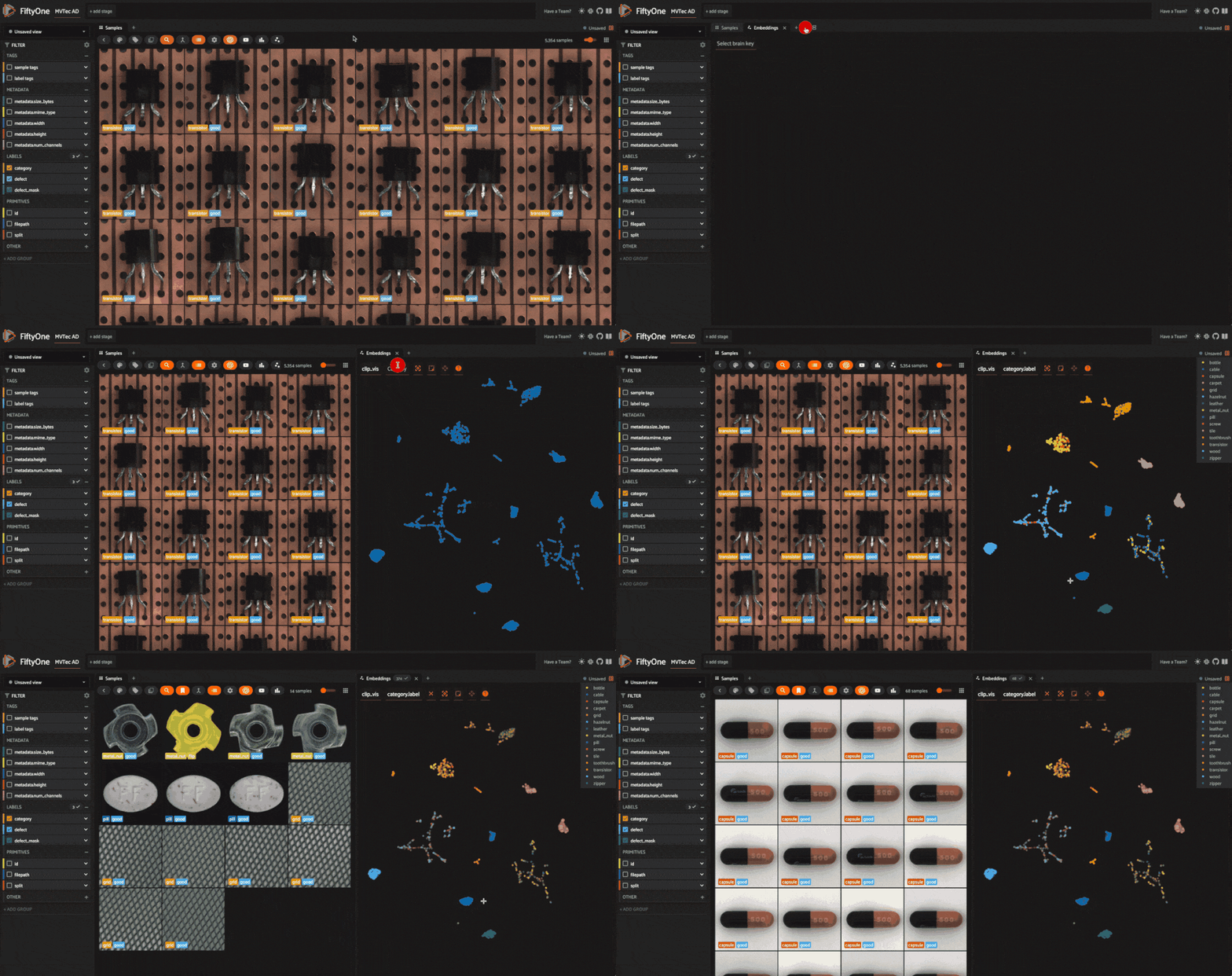
Using the color-by dropdown, notice how the embeddings cluster based on the object category. This is because CLIP encodes semantic information about the images. Also, CLIP embeddings don't cluster within a category based on the defect type.
Anomalib tutorial: Training an ML anomaly detection model
Now that we have a sense of the visual anomaly dataset, we're ready to train an anomaly detection model using Anomalib. Task: Anomalib supports classification, detection, and segmentation tasks for images. We'll focus on segmentation, where the model predicts whether each pixel in the image is anomalous, creating a mask that localizes the defect.
For this Anomalib tutorial, we'll use two algorithms:
- PaDiM: a Patch Distribution Modeling Framework for Anomaly Detection and Localization
- PatchCore: Towards Total Recall in Industrial Anomaly Detection
Preprocessing: We will resize the images to 256x256 pixels for this walkthrough before training the model. Adding this as a transform via Torchvision's Resize class lets us resize the images on the fly during training and inference. Import the necessary modules from Anomalib and helper modules for processing images and paths:
import numpy as np
import os
from pathlib import Path
from PIL import Image
from torchvision.transforms.v2 import Resize

from anomalib import TaskType
from anomalib.data.image.folder import Folder
from anomalib.deploy import ExportType, OpenVINOInferencer
from anomalib.engine import Engine
from anomalib.models import Padim, Patchcore
Now, define some constants to use throughout the notebook.
- OBJECT: The object category we'll focus on. For this walkthrough, we'll use "bottle". If you want to loop over categories, you can get the list of categories from the dataset with the dataset.distinct("category.label").
- ROOT_DIR: The root directory where Anomalib will look for images and masks. Our data is already stored on disk, so we will just symlink files to the directory Anomalib expects.
- TASK: The task we're performing. We'll use "segmentation" for this walkthrough.
- IMAGE_SIZE: The size to resize images to before training the anomaly detection model. We'll use 256x 256 pixels.
OBJECT = "bottle" ## object to train on
ROOT_DIR = Path("/tmp/mvtec_ad") ## root directory to store data for anomalib
TASK = TaskType.SEGMENTATION ## task type for the model
IMAGE_SIZE = (256, 256) ## preprocess image size for uniformity
For a given object type (category), the create_datamodule() function below creates an Anomalib DataModule object. This will be passed into our engine's fit()method to train the model and used to instantiate dataloaders for training and validation. The code might look complex, so let's break down what's going on:
- We create subsets of our data containing only the "good" training images and "anomalous" images or anomaly picture sfor validation.
- We symlink the images and masks to the directory Anomalib expects.
- We instantiate and set up a datamodule from Anomalib's Folder, which is the general-purpose class for custom datasets.
💡 It is also possible to create a torch DataLoader from scratch and pass it to the engine's fit() method. This gives you more control over the data loading process. This is left as an exercise for the reader.
def create_datamodule(object_type, transform=None):
    ## Build transform
    if transform is None:
        transform = Resize(IMAGE_SIZE, antialias=True)

    normal_data = dataset.match(F("category.label") == object_type).match(
        F("split") == "train"
    )
    abnormal_data = (
        dataset.match(F("category.label") == object_type)
        .match(F("split") == "test")
        .match(F("defect.label") != "good")
    )

    normal_dir = Path(ROOT_DIR) / object_type / "normal"
    abnormal_dir = ROOT_DIR / object_type / "abnormal"
    mask_dir = ROOT_DIR / object_type / "mask"

    # create directories if they do not exist
    os.makedirs(normal_dir, exist_ok=True)
    os.makedirs(abnormal_dir, exist_ok=True)
    os.makedirs(mask_dir, exist_ok=True)

    if not os.path.exists(str(normal_dir)):
        normal_data.export(
            export_dir=str(normal_dir),
            dataset_type=fo.types.ImageDirectory,
            export_media="symlink",
        )

    for sample in abnormal_data.iter_samples():
        base_filename = sample.filename
        dir_name = os.path.dirname(sample.filepath).split("/")[-1]
        new_filename = f"{dir_name}_{base_filename}"
        if not os.path.exists(str(abnormal_dir / new_filename)):
            ## symlink anomalous image into Anomalib abnormal dir
            os.symlink(sample.filepath, str(abnormal_dir / new_filename))
if not os.path.exists(str(mask_dir / new_filename)):
## symlink mask into Anomalib mask dir
os.symlink(sample.defect_mask.mask_path, str(mask_dir / new_filename))
## Create a DataModule in Anomalib
datamodule = Folder(
name=object_type,
root=ROOT_DIR,
normal_dir=normal_dir,
abnormal_dir=abnormal_dir,
mask_dir=mask_dir,
task=TASK,
transform=transform
)
datamodule.setup()
return datamoduleNow, we can put it all together. The train_and_export_model() function below trains an anomaly detection model using Anomalib's Engine class, exports the model to OpenVINO, and returns the model "inferencer" object. The inferencer object is used to make predictions on new images.
def train_and_export_model(object_type, model, transform=None):
    ## Train model on our data
    datamodule = create_datamodule(object_type, transform=transform)
    engine = Engine(task=TASK)
    engine.fit(model=model, datamodule=datamodule)

    ## Export model into OpenVINO format for fast inference
    engine.export(
        model=model,
        export_type=ExportType.OPENVINO,
    )
    output_path = Path(engine.trainer.default_root_dir)


    openvino_model_path = output_path / "weights" / "openvino" / "model.bin"
    metadata = output_path / "weights" / "openvino" / "metadata.json"
## Load the inference object from export
inferencer = OpenVINOInferencer(
path=openvino_model_path,
metadata=metadata,
device="CPU",
)
return inferencerLet's try this with
PaDiMe first. The training process should take less than a minute:model = Padim()
inferencer = train_and_export_model(OBJECT, model)And just like that, we have an anomaly detection model trained on the "bottle" category. Let's run our inferencer on a single image and inspect the results:
## get the test split of the dataset
test_split = dataset.match(F("category.label") == OBJECT).match(F("split") == "test")

## get the first sample from the test split
test_image = Image.open(test_split.first().filepath)

output = inferencer.predict(image=test_image)
print(output)
ImageResult(image=[[[255 255 255]
[255 255 255]
[255 255 255]
...
[255 255 255]
[255 255 255]
[255 255 255]]
...
[255 255 255] [255 255 255]
[255 255 255]]], pred_score=0.7751642969087686, pred_label=1, anomaly_map=[[0.32784402 0.32784402 0.32784414 ... 0.3314721 0.33147204 0.33147204]
[0.32784402 0.32784402 0.32784414 ... 0.3314721 0.33147204 0.33147204]
[0.32784408 0.32784408 0.3278442 ... 0.33147222 0.33147216 0.33147216]
...
[0.32959 0.32959 0.32959005 ... 0.3336093 0.3336093 0.3336093 ]
[0.3295899 0.3295899 0.32958996 ... 0.33360928 0.33360928 0.33360928]
[0.3295899 0.3295899 0.32958996 ... 0.33360928 0.33360928 0.33360928]], gt_mask=None, gt_boxes=None, pred_boxes=None, box_labels=None, pred_mask=[[0 0 0 ... 0 0 0]
[0 0 0 ... 0 0 0]
[0 0 0 ... 0 0 0]
...
[0 0 0 ... 0 0 0]
[0 0 0 ... 0 0 0]
[0 0 0 ... 0 0 0]], heat_map=[[[153 235 255]
[153 235 255]
[153 235 255]
...
[153 236 255]
[153 236 255]
[153 236 255]]
...
[153 238 255]
[153 238 255]
[153 238 255]]], segmentations=[[[255 255 255]
[255 255 255]
[255 255 255]
...
[255 255 255]
[255 255 255]
[255 255 255]]
...
[255 255 255]
[255 255 255]
[255 255 255]]])The output contains a scalar anomaly score pred_score, a pred_mask denoting the predicted anomalous regions, and a heatmap anomaly_map showing the anomaly scores for each pixel. This is all valuable information for understanding the model's predictions. The run_inference() function below will take a FiftyOne sample collection (e.g. our test set) as input, along with the inferencer object and a key for storing the results in the samples.
It will run the model on each sample in the collection and store the results. The threshold argument acts as a cutoff for the anomaly score. If the score is above the threshold, the sample is considered anomalous. In this example, we'll use a threshold of 0.5, but you can experiment with different values.
def run_inference(sample_collection, inferencer, key, threshold=0.5):
    for sample in sample_collection.iter_samples(autosave=True, progress=True):
        output = inferencer.predict(image=Image.open(sample.filepath))

        conf = output.pred_score
        anomaly = "normal" if conf < threshold else "anomaly"

        sample[f"pred_anomaly_score_{key}"] = conf
        sample[f"pred_anomaly_{key}"] = fo.Classification(label=anomaly)
        sample[f"pred_anomaly_map_{key}"] = fo.Heatmap(map=output.anomaly_map)
        sample[f"pred_defect_mask_{key}"] = fo.Segmentation(mask=output.pred_mask)
Let's run inference on our test split and visualize the results in the FiftyOne App:
run_inference(test_split, inferencer, "padim")
session = fo.launch_app(view=test_split)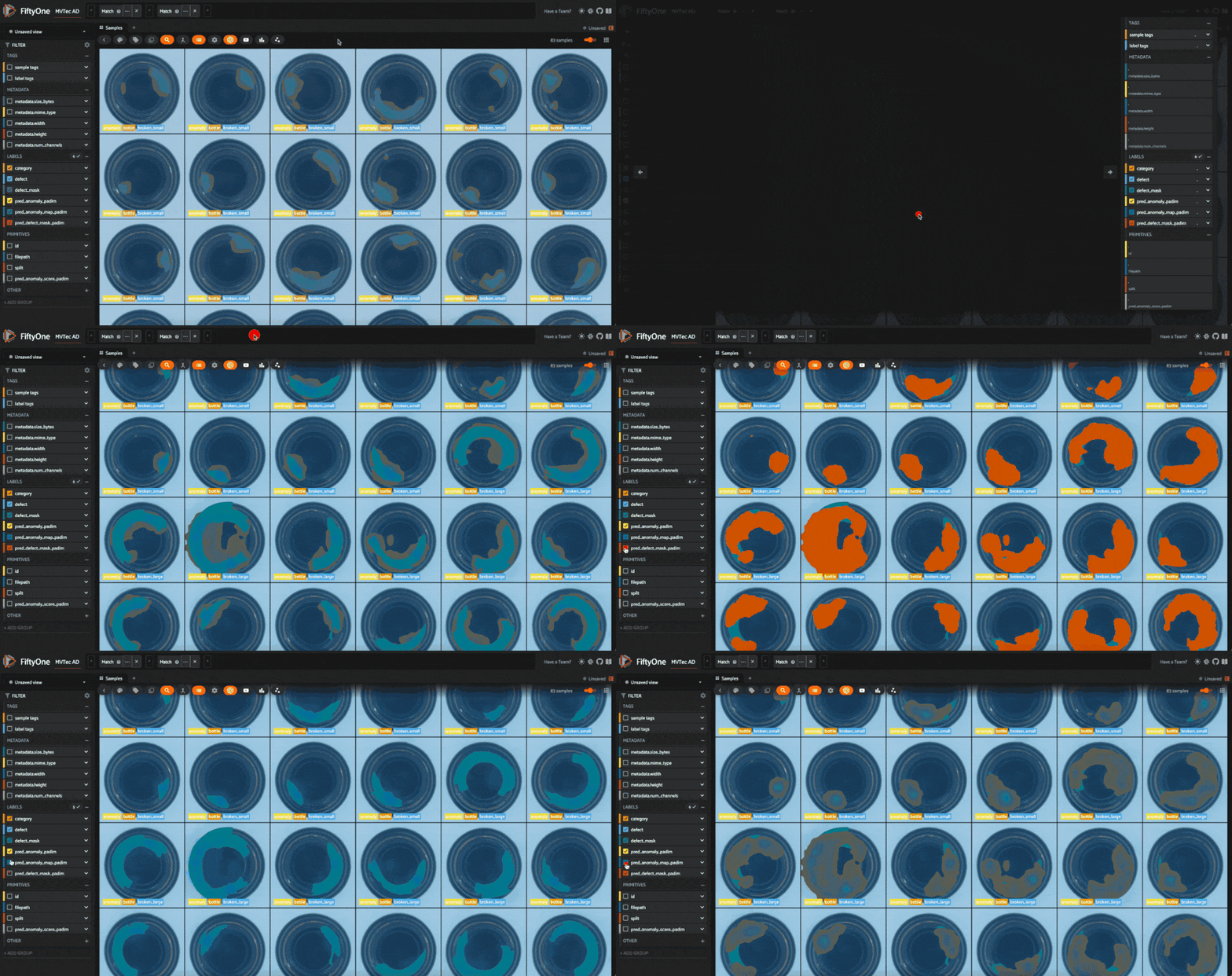
Anomalib tutorial: Evaluating ML anomaly detection models
We have a machine learning anomaly detection model, but how do we know if it's good? For one, we can evaluate the model using precision, recall, and F1 score metrics. FiftyOne's Evaluation API makes this easy.
We are going to evaluate the full-image classification performance of the anomaly detection model, as well as the segmentation performance. We need to prepare our data for evaluation. First, we need to add null masks for the "normal" images to ensure the evaluation is fair:
for sample in test_split.iter_samples(autosave=True, progress=True):
    if sample["defect"].label == "good":
        sample["defect_mask"] = fo.Segmentation(
            mask=np.zeros_like(sample["pred_defect_mask_padim"].mask)
        )
We also need to ensure consistency in naming/labels between ground truth and predictions. We'll rename all of our "good" images to "normal" and every type of anomaly to "anomaly":
old_labels = test_split.distinct("defect.label")
label_map = {label:"anomaly" for label in old_labels if label != "good"}
label_map["good"] = "normal"
mapped_view = test_split.map_labels("defect", label_map)
session.view = mapped_view.view()
For classification, we'll use binary evaluation, with "normal" as the negative class and "anomaly" as the positive class:
eval_classif_padim = mapped_view.evaluate_classifications(
    "pred_anomaly_padim",
    gt_field="defect",
    eval_key="eval_classif_padim",
    method="binary",
    classes=["normal", "anomaly"],
)
eval_classif_padim.print_report()
               precision    recall  f1-score   support

      normal       0.95      0.90      0.92        20
     anomaly       0.97      0.98      0.98        63

    accuracy                           0.96        83
   macro avg       0.96      0.94      0.95        83
weighted avg       0.96      0.96      0.96        83
The visual anomaly detection model we've trained performs quite well on the classification task. If we go back to the app and sort by anomaly score, we can see that certain anomalies tend to have higher scores than others. In this example, contamination instances tend to have very high or low scores relative to broken_small and broken_large. When we put this model in production, we might be more likely to miss certain anomalies.
Other machine learning anomaly detection models, or ensembles of models, might be more robust to this. For segmentation evaluation, we will only be interested in pixel values of 0 (normal) and 255 (anomaly), so we will filter our report for these "classes":
eval_seg_padim = mapped_view.evaluate_segmentations(
    "pred_defect_mask_padim",
    gt_field="defect_mask",
    eval_key="eval_seg_padim",
)
eval_seg_padim.print_report(classes=[0, 255])
              precision    recall  f1-score   support

           0       0.99      0.96      0.98 63343269.0
         255       0.60      0.89      0.72 3886731.0

   micro avg       0.96      0.96      0.96 67230000.0
   macro avg       0.80      0.93      0.85 67230000.0
weighted avg       0.97      0.96      0.96 67230000.0
Anomalib tutorial: Comparing ML anomaly detection models
Just because machine learning anomaly detection is unsupervised doesn't mean we can't compare models and choose the best one for our use case. We can train multiple models on the same data and compare their performance using metrics like F1 score, precision, and recall. We can also compare the models visually by inspecting the masks and heatmaps they generate. Let's repeat the training process for the PatchCore model and compare the two models:
## Train Patchcore model and run inference

model = Patchcore()

## This will take a little longer to train, but should still be < 5 minutes
inferencer = train_and_export_model(OBJECT, model)

run_inference(mapped_view, inferencer, "patchcore")

## Evaluate Patchcore model on classification task
eval_classif_patchcore = mapped_view.evaluate_classifications(
    "pred_anomaly_patchcore",
    gt_field="defect",
    eval_key="eval_classif_patchcore",
    method="binary",
    classes=["normal", "anomaly"],
)

eval_classif_patchcore.print_report()
              precision    recall  f1-score   support

      normal       0.95      1.00      0.98        20
     anomaly       1.00      0.98      0.99        63

    accuracy                           0.99        83
   macro avg       0.98      0.99      0.98        83
weighted avg       0.99      0.99      0.99        83
eval_seg_patchcore = mapped_view.match(F("defect.label") == "anomaly").evaluate_segmentations(
    "pred_defect_mask_patchcore",
    gt_field="defect_mask",
    eval_key="eval_seg_patchcore",
)
eval_seg_patchcore.print_report(classes=[0, 255])
session.view = mapped_view.shuffle().view()
precision recall f1-score support
0 0.99 0.95 0.97 47143269.0
255 0.60 0.85 0.70 3886731.0
micro avg 0.95 0.95 0.95 51030000.0
macro avg 0.80 0.90 0.84 51030000.0
weighted avg 0.96 0.95 0.95 51030000.0The metrics back up what we see in the app: PatchCore has much higher recall for the "anomaly" class but lower precision. This means it's more likely to catch anomalies but also more likely to make false positive predictions. After all, PatchCore is designed for "total recall" in industrial anomaly detection.
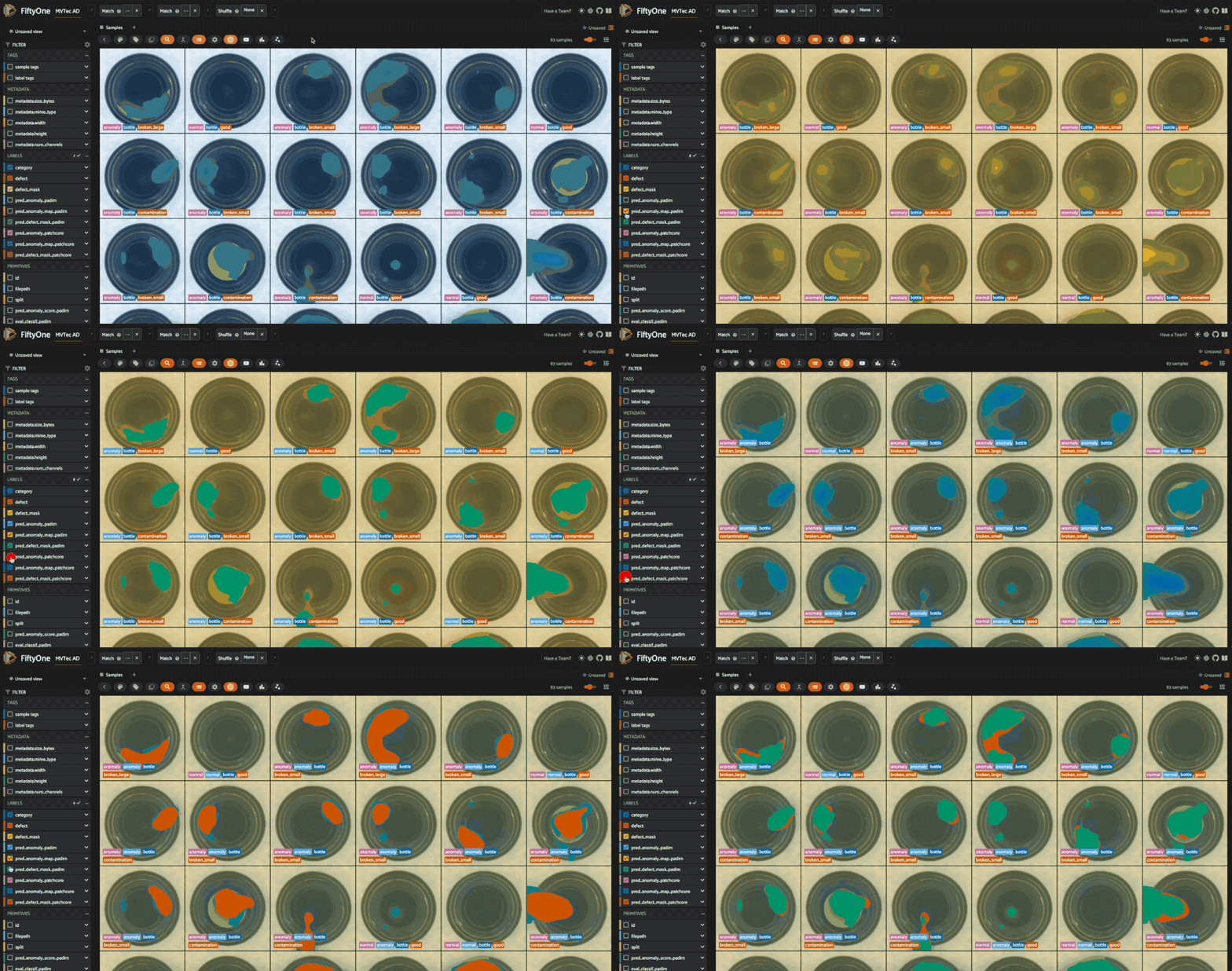
Looking at the heatmaps, we can also see what types of anomalies each anomaly detection model is better at detecting. An ensemble of the two models might be more robust to different types of anomalies.
Creating your own machine learning anomaly detection models
In this walkthrough, we learned how to perform anomaly detection on visual data using FiftyOne and Anomalib. While we trained two anomaly detection models, we only scratched the surface of what is possible with visual anomaly detection. If you want to improve performance, there are many other knobs you can turn:
- Algorithm: We only used PaDiM and PatchCore. Anomalib currently supports over 20 algorithms
- Backbone: The architecture of the model used for feature extraction
- Hyperparameters: Parameters specific to the anomaly detection algorithm. For PatchCore, this includes coreset_sampling_ratio and num_neighbors
- Data augmentation: Techniques to artificially increase the size of the training set and improve the model's generalization
- Custom Solutions: It’s never too late to introduce a new algorithm/technique
See how you can apply visual anomaly detection at scale with FiftyOne and Anomalib. Talk to a member of our team to explore how this workflow fits your own dataset and production pipeline.
Senior Machine Learning Engineer & Researcher
🎓 Ph.D. in Theoretical Physics from Stanford University
See all articles by Jacob Marks
Try Voxel51 for yourself
Loading related posts...
© 2026 Voxel51 All Rights Reserved