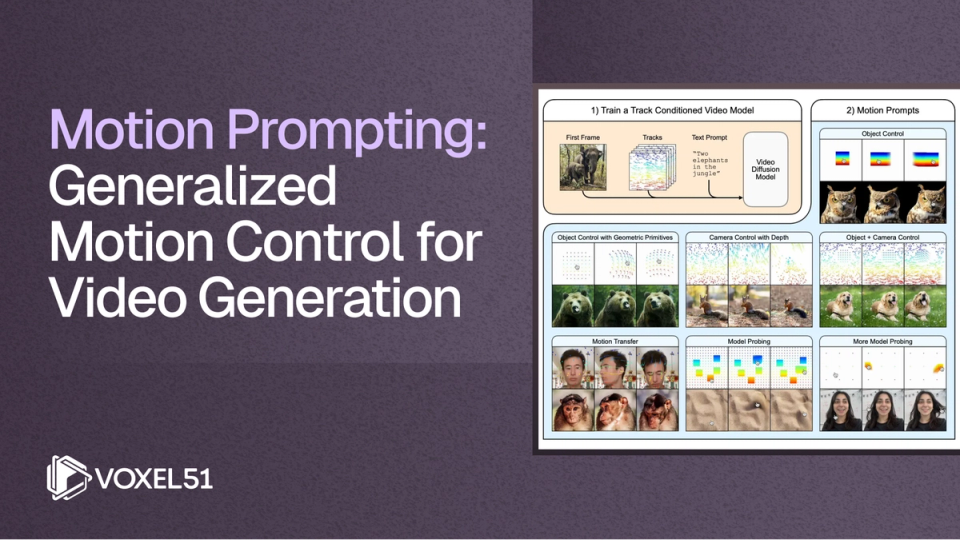
Toward Smarter Generative Models: Insights from Diffusion Research and the Rise of Action-Conditioned Video Generation
Author

Senior Developer Advocate
Paula is a Senior DevRel at Voxel51 with a CV/ML PhD and over 20 years in tech. She brings deep expertise in AI solution architecture, generative AI, and IoT, with a proven track record of driving adoption through community building and developer engagement. LinkedIn
See all articles by Paula Ramos
In this article
Try Voxel51 for yourself
A few years ago, I created a series of demos on Generative AI and diffusion models, mostly Stable Diffusion examples, to show what these technologies could do. The reactions were always the same: “This looks amazing... but how do we use this in a real scenario?” It was clear that artists and designers immediately saw value, but for production systems, robotics pipelines, or industrial workflows, the connection felt distant. Generative models were impressive, but their practical purpose remained unclear.
This year at NeurIPS, we finally reached the moment where that question begins to be answered. The diffusion orals revealed not just how these models can be trained more efficiently, but why they generalize and how they avoid memorizing data despite billions of parameters. At the same time, new momentum is building around action-conditioned video generation. This direction turns generative models into tools for predicting what the world will look like when an agent takes a specific action. Together, these developments mark a transition from generative AI as a creative tool to generative AI as a predictive, decision-making engine for Physical AI.
In this blog, I explore both threads, what the latest diffusion research tells us, and why action-conditioned video generation is emerging as the next significant milestone for intelligent systems that operate in the physical world.
1. What We Learned from the NeurIPS Diffusion Orals
Diffusion models continue to dominate generative modeling, but some of their biggest challenges are becoming clearer: slow training, massive computational cost, and surprisingly little theoretical understanding of why they generalize. The oral sessions this year offered fresh answers.
One of the highlights was the work on Representation Entanglement for Generation (REG). Instead of forcing diffusion transformers to discover semantics from scratch, REG injects a high-level semantic embedding, such as a class token from a pretrained vision model, directly into the diffusion process. The model learns low-level structure and global meaning simultaneously. This dramatically accelerates training, improves quality, and adds almost no overhead at inference time. The main takeaway is that diffusion models become easier to train when we expose them to semantic structure from the start, rather than relying on them to reconstruct it through millions of training iterations.
A second set of orals explored a deeper theoretical question: why do diffusion models generalize at all? Flow-matching research showed that randomness in the training targets does not drive generalization. In fact, in high dimensions, the stochastic and closed-form training objectives behave almost identically. Instead, another phenomenon seems to be responsible.
The Best Paper presentation clearly introduced this concept: diffusion models exhibit implicit dynamical regularization during training. Early in training, the model enters a regime in which it produces realistic, diverse samples and behaves like an accurate generative model. If training continues for too long, the model eventually shifts into a memorization regime, but this transition happens later as the dataset grows. That means larger datasets create broader windows of time during which models generalize well, even without explicit regularizers.
These diffusion orals collectively show that training can be accelerated, that generalization arises from the dynamics of optimization rather than noise, and that memorization is less of a threat when training is stopped in the natural generalization window. For anyone building large generative models, either for images or video, these insights shape how we think about scaling and stability.
2. The Rise of Action-Conditioned Video Generation
While diffusion research helps us understand how to train generative models more effectively, a parallel movement is reshaping how we think about prediction and control in Physical AI: action-conditioned video generation. Instead of simply producing coherent video clips, these models aim to generate future states that depend directly on the actions an agent takes.
This shift is essential because it transforms video generation from a visual task into a dynamic reasoning task. Rather than asking a model to “show a scene,” we ask it to show how the scene evolves when something acts within it, a robot moving its arm, a vehicle turning at an intersection, a drone adjusting its flight path, or a plant responding to environmental changes.
Designing models that can do this is significantly more complex than classical video generation. The model must maintain identity consistency across frames, maintain temporal coherence, and respect physical constraints. It needs to understand motion, cause and effect, and how small changes accumulate over time. These requirements make action-conditioned video generation much closer to building a world model than producing a video clip.
This direction is gaining momentum because it promises to give robots, autonomous vehicles, agricultural systems, and healthcare tools the ability to simulate the consequences of different choices before acting in the real world. It offers a safe, scalable, and controllable way for intelligent systems to learn from imagined experience rather than relying solely on expensive or risky physical trials. And when combined with diffusion-style architectures, action-conditioned generation becomes even more powerful: diffusion provides stability and high-quality visual modeling, while action conditioning adds intention and control.
3. Why These Two Threads Belong in the Same Story
Diffusion research and action-conditioned video generation may appear unrelated, but they actually reinforce one another. Diffusion work gives us more efficient training, better generalization, and a clearer understanding of when models begin to memorize. Action-conditioned video generation applies these strengths to a more ambitious purpose: modeling how the world changes when an agent takes an action. This raises generative modeling from producing static content to making predictions, the kind of predictions robots, autonomous vehicles, agricultural systems, and healthcare tools rely on to act safely and intelligently.
As these capabilities evolve, we also inherit a new responsibility: ensuring that the predictions we generate are meaningful, stable, and trustworthy. In action-driven scenarios, realism alone is not enough. The model must respect causality, physical dynamics, and temporal coherence. Diffusion research shows that models pass through distinct phases during training: they generalize well early on, but eventually begin to drift or memorize if training continues unchecked. Detecting these inflection points is essential for any Physical AI system that will operate in the real world.
A promising step forward is building visual diagnostic tools that reveal how models evolve during training. Imagine an interface that loads both training examples and generated outputs, measures their similarity, and displays how those relationships change across checkpoints. By moving through training time, practitioners could clearly see when a model transitions from producing genuinely novel predictions to unintentionally reproducing elements of its training data. Such interactive validation layers would allow us to monitor drift, identify early signs of memorization, and better understand the dynamics of learning. Ultimately, these systems help ensure that generative models remain reliable, interpretable, and aligned with real-world expectations, qualities that become essential as Physical AI moves into safety-critical domains.
We are entering a phase where generative AI is not defined by how beautifully it produces images or videos, but by how reliably it generates actionable predictions. To reach that future safely, we must combine diffusion’s theoretical insights with rigorous validation pipelines, dynamic evaluation metrics, and interpretability tools that ensure our models behave as expected, especially when their predictions influence real-world decisions.
Stay Connected:
Follow me on Medium: https://medium.com/@paularamos_phd
Follow Me on LinkedIn: https://www.linkedin.com/in/paula-ramos-phd/
Join the Conversation: Discord Fiftyone-community
What is next?
I’m excited to share more about my journey in the intersection between Visual AI and Agriculture. If you’re interested in following along as I dive deeper into the world of computer vision in agriculture and continue to grow professionally, feel free to connect or follow me on LinkedIn. Let’s inspire each other to embrace change and reach new heights!
Don’t miss the upcoming events about Visual AI in Agriculture; check them out at https://voxel51.com/computer-vision-events/. Or if you want to join this fantastic team, it’s worth taking a look at this page: https://voxel51.com/jobs/
Senior Developer Advocate
Paula is a Senior DevRel at Voxel51 with a CV/ML PhD and over 20 years in tech. She brings deep expertise in AI solution architecture, generative AI, and IoT, with a proven track record of driving adoption through community building and developer engagement.
See all articles by Paula Ramos
Try Voxel51 for yourself
Loading related posts...
© 2026 Voxel51 All Rights Reserved