In this article
Efficient automated data labeling techniques for machine learningThe importance of labeled datasetsThe challenge of manual data labelingThe efficiency benefit of automated data labelingReal-world applications for automated data labelingAdvanced automatic data labeling with FiftyOneFinal thoughts on automated data labeling
In this article
Efficient automated data labeling techniques for machine learningThe importance of labeled datasetsThe challenge of manual data labelingThe efficiency benefit of automated data labelingReal-world applications for automated data labelingAdvanced automatic data labeling with FiftyOneFinal thoughts on automated data labeling
Try Voxel51 for yourself
Over the last decade, computer vision has evolved from a niche research discipline into a mission-critical technology that underpins many aspects of modern life. Automotive manufacturers rely on CV-driven machine learning to power self-driving systems, healthcare providers use medical imaging for disease detection, retailers deploy object detection to track inventory, and government agencies apply computer vision for large-scale security surveillance. Across these industries, automated data labeling has become a foundational requirement for training reliable computer vision models.
The explosion of image and video data has also created an unprecedented demand for high-quality labeled datasets. Traditionally, annotating visual data has relied on manual labeling workflows—an approach that struggles to keep pace with the scale, speed, and complexity of modern machine learning projects. As a result, organizations are increasingly turning to efficient data labeling methods that reduce human effort while maintaining accuracy. Automated data labeling with machine learning leverages models, heuristics, and feedback loops to generate annotations at scale, offering a more scalable and consistent alternative to manual annotation.
As machine learning and AI continue to drive innovation across healthcare, automotive, retail, and security, the shift from manual annotation to automated data labeling techniques is becoming essential. These technologies are transforming dataset creation by accelerating annotation workflows, lowering costs, and improving labeling consistency without sacrificing data quality. This article explores the evolution of data labeling techniques, examines the core technologies that enable automated data labeling, and demonstrates how data labeling tools like FiftyOne streamline annotation workflows—helping data scientists and AI practitioners rapidly scale computer vision models while maintaining high-quality labeled data.
What is Automated Data Labeling?
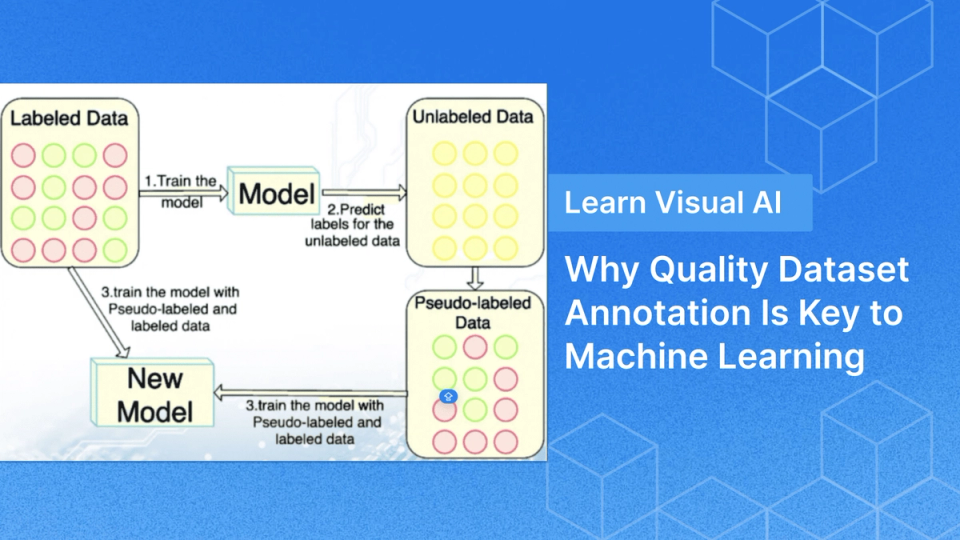
Automated data labeling seeks to automate data labeling tasks, improving efficiency by leveraging machine learning pipelines or pre-trained models to suggest labels, limiting human input primarily to validation or targeted corrections.
Efficient automated data labeling techniques for machine learning
Automated data labeling is not a single approach but a collection of complementary techniques designed to balance speed, accuracy, and human oversight. Modern systems combine intelligent model-driven predictions with selective human input, focusing expert effort where it matters most. The following techniques represent some of the most effective and widely adopted strategies for automating data labeling in machine learning workflows.
- Active Learning: The system flags uncertain or highly informative samples for human review, while it auto-labels straightforward examples.
- Weakly Supervised Learning: Partial or uncertain labels are refined using high-level rules. A bounding box guess might be adjusted by the system.
- Leveraging Pre-Trained Models: A model trained on broad data (e.g., ImageNet) annotates new samples, which humans then refine. Iterating these improvements can train the model further, creating a virtuous cycle.
The importance of labeled datasets
Behind every successful machine learning or CV application is a robust training dataset of images or videos annotated with relevant objects, classes, or attributes. Accurate data labels enable machine learning models to interpret visual data efficiently and generalize to new inputs, while incomplete or inconsistent datasets negatively impact a model’s performance.
Annotations serve as reference points during both training and validation, helping models refine predictions by providing clear examples of correct object classification, segmentation, and localization. Accurate labels clearly delineate object boundaries and consistently represent object classes, whereas inaccurate labels often misrepresent object locations, sizes, or categories, leading to errors and reduced model reliability.
The challenge of manual data labeling
Although labeled data is critical, manual labeling is labor-intensive, prone to fatigue, bias, and human error, especially with thousands or millions of images. As datasets grow, manual annotation increasingly becomes a bottleneck, driving organizations toward automated data labeling solutions that significantly reduce human effort while maintaining or enhancing labeling quality.
The manual data labeling workflow
Historically, the manual data labeling process for computer vision has looked like this:
- Identify objects/features: An annotator locates items of interest in each image or video frame (e.g., bounding boxes around cars, tumors in scans).
- Assign labels: Each object or region receives an appropriate label (e.g., "person," "car," "tumor").
- Quality check: A second round of review might spot inconsistencies or mistakes.
Though direct, this becomes overwhelming with millions of data points, introducing several challenges associated with manual labeling, outlined in the table below:
Employing human annotators or external services is expensive and slow. Large-scale data labeling tasks can span weeks or months. Even expert teams may label data differently, introducing subjective bias (e.g., varying interpretations of partial occlusions). Scaling limits manual dataset annotations that require continuous updates (like autonomous vehicle footage) quickly becomes cumbersome and impractical. These efficiency difficulties underscore the necessity of automated data labeling for modern, large-scale computer vision initiatives.
The efficiency benefit of automated data labeling
One standout advantage of automated data labeling is efficiency. The dramatic reduction in time and costs, achieved by using efficient automated labeling techniques for machine learning algorithms can not be under stated. Automatic labeling for bulk annotation tasks, results in quicker dataset turnarounds and allows human effort to be reserved for more complex or ambiguous edge cases.
Other efficiency benefits of automatic data labeling for machine learning are:
Improved scalability
Manual efforts might suffice for modest projects, but fail to scale for massive data streams. Machine learning automated data labeling pipelines, however, improve with volume:
- Effectively handle vast, diverse datasets
- Adapt quickly to dynamic environments, like new road signs or store layouts
Consistency and reduced bias
Humans can inadvertently produce inconsistent labels, especially under pressure. Automated data labeling systems employ the same logic every time, generating uniform bounding boxes, categories, or segmentation masks, resulting in more consistent automated data. This uniformity reduces label noise and boosts overall dataset quality.
Enhanced accuracy
Automated data labeling enhances accuracy by enabling the annotation of a wider variety of images, including rare cases and complex features often tedious for humans, leading to better model generalization. Additionally, these systems continuously improve their own precision over time by learning from human feedback through confirmation and correction loops.
Real-world applications for automated data labeling
Medical imaging
In healthcare, MRI or X-ray images often require labeling to detect tumors or fractures. Automated data labeling pinpoints potential anomalies, drastically reducing a radiologist’s effort. This shorter cycle propels machine learning-driven diagnostics and speeds up critical refinements.
Self-driving cars
Autonomous vehicle systems rely on huge datasets containing cars, pedestrians, and road elements. Automated data labeling rapidly annotates camera feeds, letting self-driving companies adapt to changing conditions. As roads evolve, these pipelines keep the labeled data current without overtaxing human teams.
Retail object recognition
Retailers monitor inventory, warehouse workflows, and customer interactions through computer vision. Automated data labeling supports swift recognition of new products, quick re-annotation for seasonal changes, and accurate tracking despite constantly shifting store layouts. This ensures models stay relevant without relentless manual interventions.
Fully automated labeling pipelines
While expert oversight may still be necessary, routine labeling tasks are rapidly approaching full automation, particularly in familiar domains. Feedback loops continually refine algorithms, enabling near real-time generation of labeled data. Ultimately, we're moving toward on-demand systems where prior knowledge automatically annotates datasets, humans provide essential corrections, and the process iterates seamlessly.
Advanced automatic data labeling with FiftyOne
Practical automated labeling requires strong infrastructure for dataset management, refinement, and quality control. Enter FiftyOne, which supports every stage of efficiency with your machine learning workflow.
Automated data labeling efficiency with FiftyOne
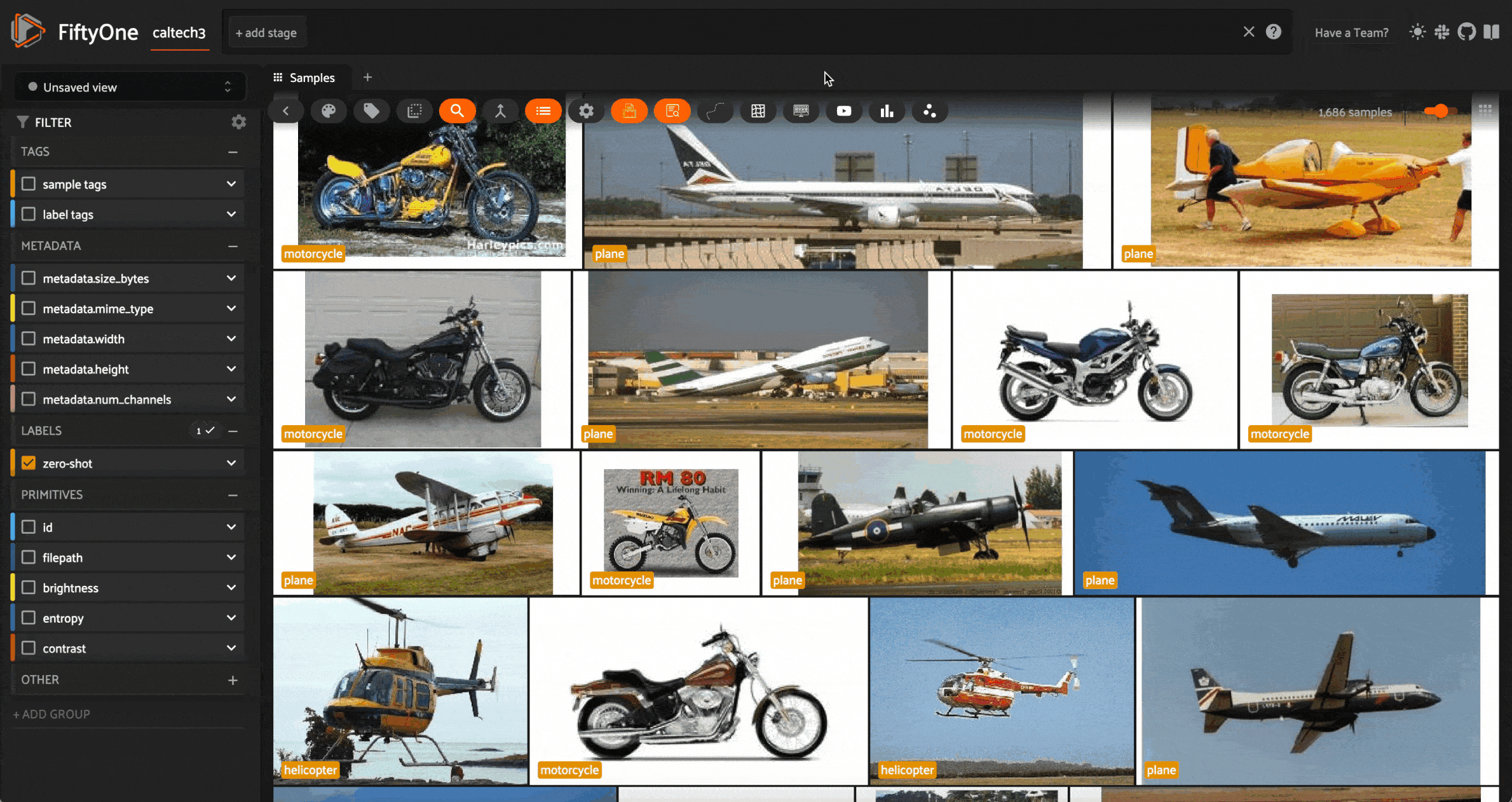
FiftyOne integrates with various ML frameworks and active learning setups, acting as a central hub for:
- Uploading and versioning unlabeled data
- Merging auto-labeled results from models or weak supervision
- Visualizing annotations in a user-friendly interface
- Allowing rapid validation and edits
By consolidating data and tools, FiftyOne helps you assess label consistency and overall dataset integrity in one place.
Automated data labeling: Key FiftyOne features
- Integration with Active Learning Frameworks: FiftyOne pinpoints ambiguous data points that need human attention. Updated labels are fed back to retrain the system.
- Refinement Tools: If bounding boxes or categories are somewhat accurate, FiftyOne’s GUI allows quick corrections. This human-in-the-loop synergy maintains quality without starting from scratch.
- Collaboration Features: Teams often have multiple subject matter experts. FiftyOne lets users share datasets, track annotation changes, and unify feedback, ensuring consistent labeling and accountability.
Final thoughts on automated data labeling
Automated labeling marks a pivotal shift for machine learning and computer vision. By taking over repetitive annotation, teams reduce costs, expedite model development, and broaden project scopes. Crucially, automating labeling can also improve quality, ensuring thorough coverage of complex, real-world data.
Future trends in automated data labeling include emerging machine learning techniques like Natural Language Processing (NLP). NLP creates richer, context-aware semantic annotations by linking textual descriptions to images, and employing self-supervised machine learning models that train on unlabeled data to become proficient at auto-labeling with reduced human intervention.
Accelerate your machine learning workflow today
Whether you are building diagnostic tools, self-driving systems, or advanced retail analytics, embracing automated labeling can help you outpace manual bottlenecks. With the right pipelines and platforms like FiftyOne, you achieve scalable, high-quality results that adapt with incoming data. Consider integrating automated labeling into your CV workflow now to unlock faster, more accurate model outcomes. Image Citations
- Lin, Tsung-Yi, et al. "Microsoft COCO: Common Objects in Context." COCO Dataset 2017 Validation Split, cocodataset.org, 2017, https://cocodataset.org/#home. Accessed 24 Mar. 2025.
Loading related posts...
© 2026 Voxel51 All Rights Reserved