Exploring CarCrashNet Crash Simulations with FiftyOne
Author

Chief Community Officer
Jimmy is the Chief Community Officer at Voxel51, where he leads developer relations and growth. With 25+ years of experience connecting developers and enterprises to cutting-edge ML and open-source solutions, Jimmy drives impactful content, events, and education that fuel awareness, adoption, and community engagement.
See all articles by Jimmy Guerrero
In this article
Talk to an AI expert
MIT and Toyota Research Institute just open-sourced CarCrashNet, a benchmark of more than 15,000 structural crash simulations. We loaded its published assets into FiftyOne, an open-source visual AI tool built for images and video, not finite-element physics, to see how far one tool could take crash simulation data.
Key takeaways
- CarCrashNet is the first large-scale open benchmark for data-driven structural crash simulation, from MIT and Toyota Research Institute, with 14,742 bumper-beam and 825 full-vehicle simulations totaling 6.65 TB.
- FiftyOne handled four data types in one app: crash videos, static figures, tabular benchmark metrics, and learned embeddings.
- FiftyOne's multi-camera group slices, built for autonomous vehicle rigs, map directly onto synced iso, side, and top crash simulation views.
- The paper's static benchmark table becomes a sortable, filterable leaderboard with best-in-class results auto-tagged.
- The raw field data isn't public yet, but the demo notebook's ingestion path is ready the moment it ships.
What Is CarCrashNet? 15,000+ Open Source Crash Simulations
CarCrashNet is the first large-scale open benchmark for data-driven structural crash simulation, from MIT and Toyota Research Institute. It bundles 14,742 bumper-beam pole-impact simulations and 825 full-vehicle crash simulations across three industry-standard models — Dodge Neon, Toyota Yaris, Chevrolet Silverado — all run in the open-source solver OpenRadioss and validated against Ansys LS-DYNA and physical crash tests. Total footprint: 6.65 TB of finite-element mesh trajectories. It's paired with CrashSolver, a hierarchical neural surrogate that beats three transformer/geometric baselines on every vehicle in the benchmark.
One catch: the raw per-case field data isn't public yet — it ships once peer review wraps. What is public right now are the real preview videos, figures, and reported benchmark numbers from the project repo — and that turned out to be plenty to build something worth showing off.
Why Use FiftyOne for Simulation Data?
FiftyOne is an open-source toolkit for annotating, exploring, curating, and understanding visual datasets — built for browsing images and video, filtering on metadata, running embedding-based analysis, and comparing model results, all in one interactive app.
It's usually shown off with detection/segmentation datasets. This wasn't that. It was a chance to see whether the same tool holds up on scientific simulation data it was never explicitly designed for. Check out the demo notebook and try it for yourself.
Multi-Camera Crash Views, Embeddings, and a Live Benchmark Leaderboard
The demo notebook builds four FiftyOne datasets from CarCrashNet's published assets: synced multi-camera crash videos, static figures, a sortable benchmark leaderboard, and an embeddings view that traces how each crash unfolds over time.
Real data, not synthetic — every video, figure, and number traces back to the actual published paper and repo.

Synced multi-camera crash simulation frames in FiftyOne, organized with group slices to switch between iso, side, and top views.
One tool, four data types — video, static images, tabular metrics, and learned embeddings, all queryable the same way, in the same app.
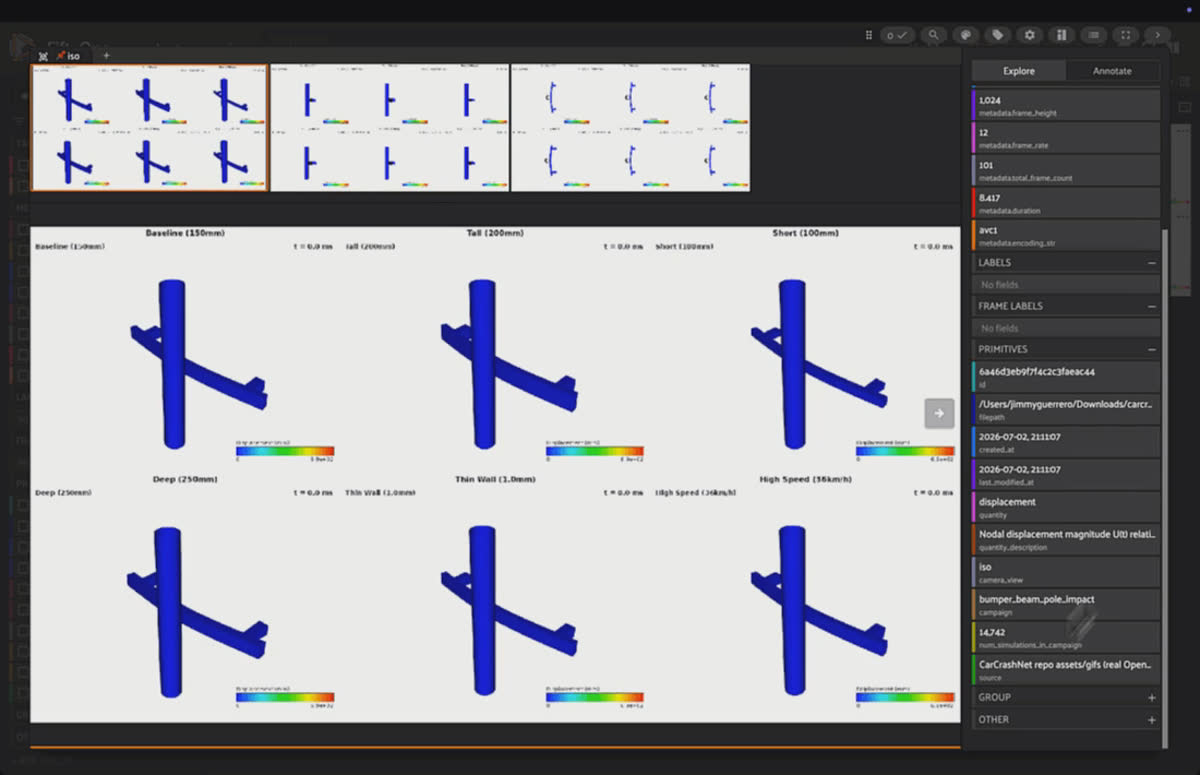
Synced multi-camera crash simulation frames in FiftyOne, organized with group slices to switch between iso, side, and top views.
Groups do double duty — FiftyOne's multi-camera group-slice feature, built for autonomous-vehicle rigs, turns out to be exactly the right abstraction for synced iso/side/top crash-simulation views. Nobody built it for this.
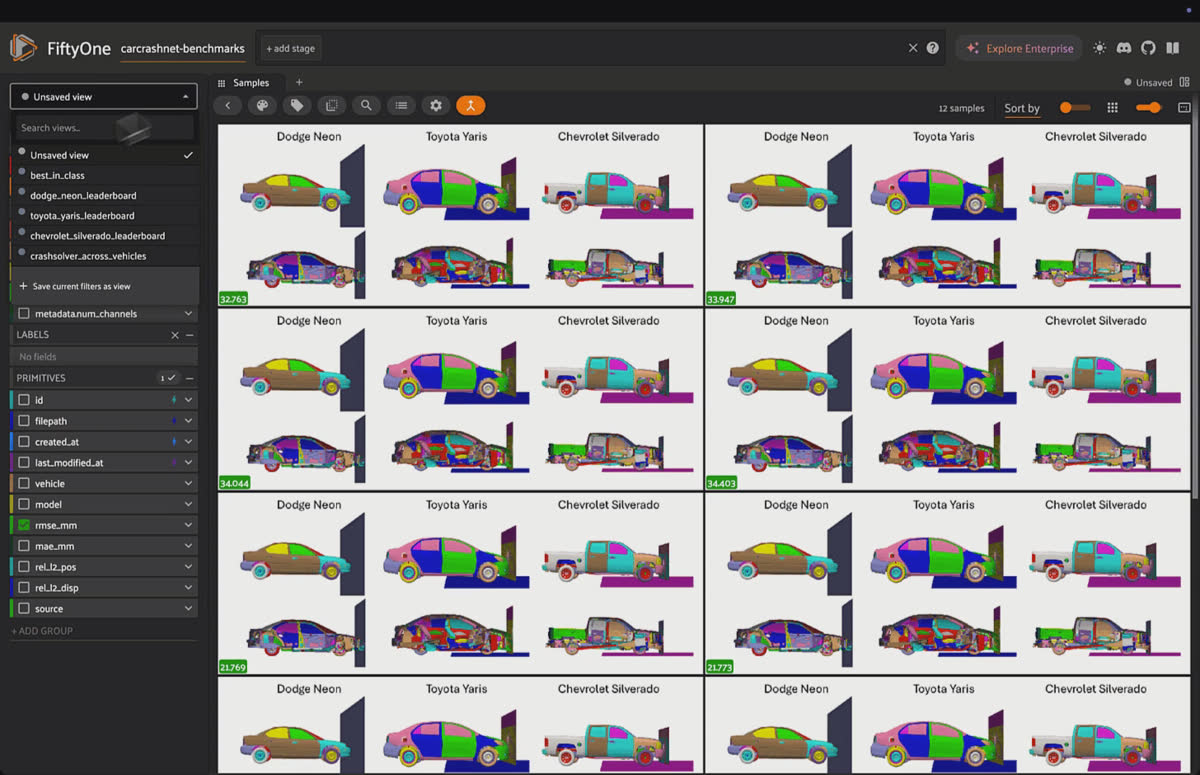
CarCrashNet's 12-row benchmark table as a sortable, filterable leaderboard in FiftyOne, with best-in-class results auto-tagged across all three vehicles.
A dead paper table becomes a live leaderboard — 12 benchmark rows, now sortable and filterable, with "best-in-class" auto-tagged instead of eyeballed off a PDF.
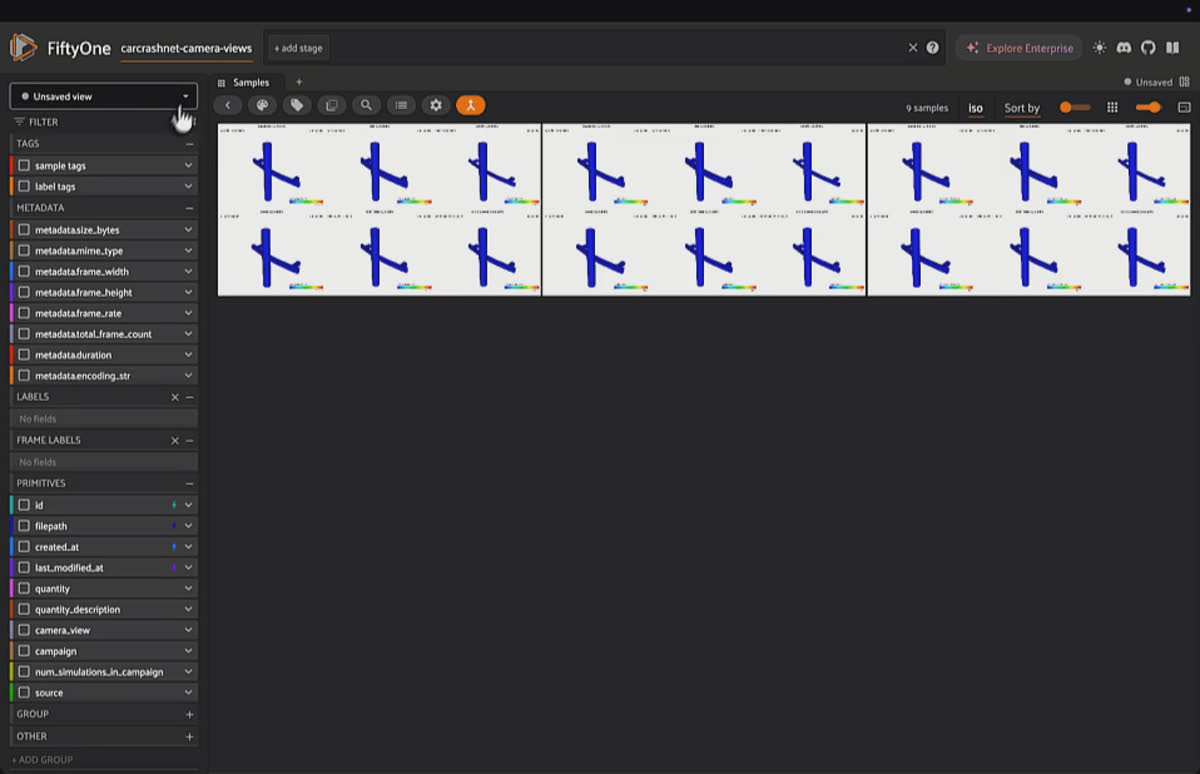
Reloading a saved view in FiftyOne to reapply CarCrashNet crash simulation filters in one click.
Saved views = zero re-derivation — the filters you'd normally rebuild every session are one click away.
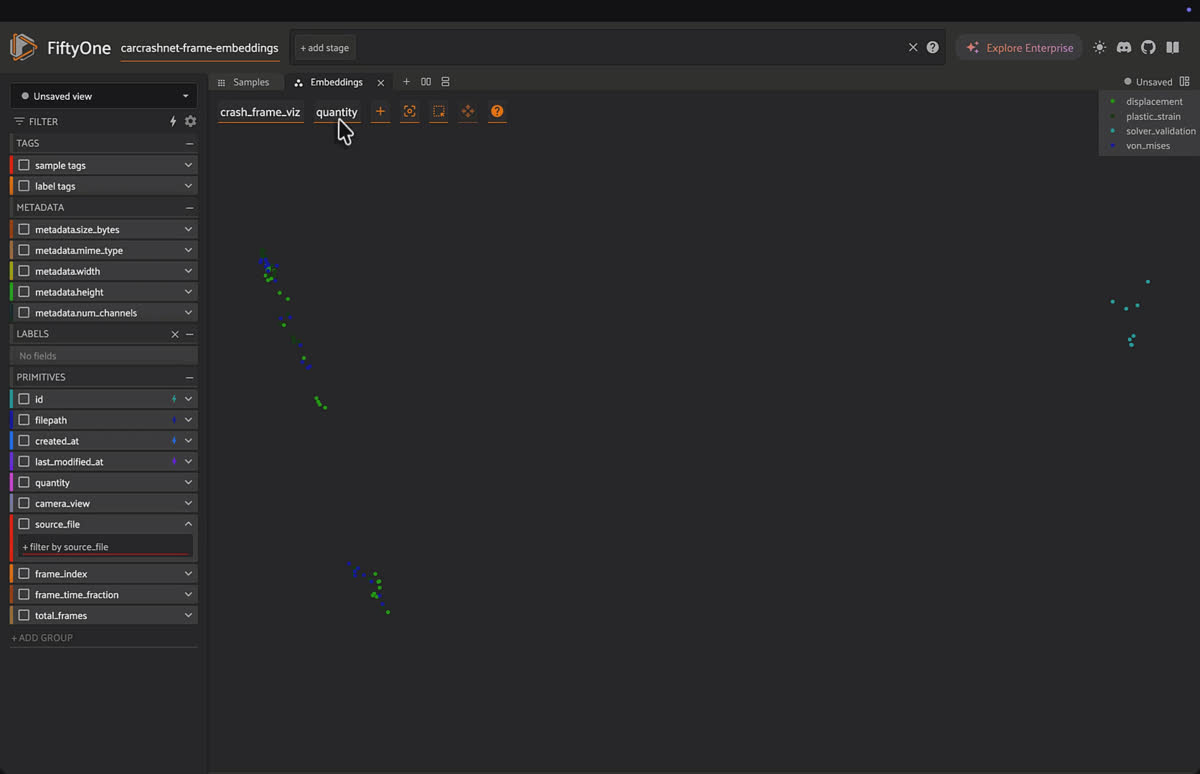
Sampled CarCrashNet crash frames in FiftyOne's embeddings panel, projected to 2D to show whether physical field or camera angle dominates the visual signal.
Embedding panel — sampled crash frames, embedded and projected to 2D, reveal whether physical field or camera angle dominates the visual signal — and each crash traces a real, plottable path through that space as it unfolds over time.
Remember that the raw 6.65 TB field dataset isn't public yet, but the moment it ships, the ingestion code in the demo notebook is ready to go!
Next steps: Run the CarCrashNet Demo Notebook
Run it yourself. The notebook downloads real assets, builds four FiftyOne datasets, computes embeddings, and launches the app.
Watch for the real release. Once CarCrashNet's raw VTKHDF field data goes public, the notebook's last section sketches the exact ingestion path (mesh → colored point cloud → FiftyOne group-slices per timestep) to drop it straight in.
FAQ
Is the CarCrashNet dataset publicly available?
Partially. The preview videos, figures, and reported benchmark numbers are available now in the project repo. The raw 6.65 TB of per-case finite-element field data will be released once peer review is complete.
What vehicle models does CarCrashNet include?
Three industry-standard models: the Dodge Neon, Toyota Yaris, and Chevrolet Silverado. All simulations were run in the open-source solver OpenRadioss and validated against Ansys LS-DYNA and physical crash tests.
Can FiftyOne work with simulation data?
Yes. Although FiftyOne is built for visual AI datasets, this demo loads crash videos, static figures, tabular benchmark metrics, and embeddings into a single app, with multi-camera group slices handling the synced simulation views.
What is CrashSolver?
CrashSolver is the hierarchical neural surrogate model released alongside CarCrashNet. It outperforms three transformer and geometric baselines on every vehicle in the benchmark.
Resources
- Paper: arXiv:2605.07098
- Code / assets: github.com/Mohamedelrefaie/CarCrashNet
- FiftyOne docs: docs.voxel51.com
- FiftyOne Brain (embeddings): docs.voxel51.com/user_guide/brain.html
- FiftyOne on GitHub: github.com/voxel51/fiftyone
Chief Community Officer
Jimmy is the Chief Community Officer at Voxel51, where he leads developer relations and growth. With 25+ years of experience connecting developers and enterprises to cutting-edge ML and open-source solutions, Jimmy drives impactful content, events, and education that fuel awareness, adoption, and community engagement.
See all articles by Jimmy Guerrero
Talk to an AI expert
Loading related posts...
© 2026 Voxel51 All Rights Reserved


