How the Volkswagen Group Is Building a Physical AI Data Flywheel with Voxel51, NVIDIA, and Microsoft Azure
Author

Co-founder and CEO
Dr. Brian Moore is Co-founder and CEO of Voxel51, where he leads the strategy and vision of the company and is actively involved in the design and execution of the core software infrastructure. Brian holds a Ph.D. in Electrical Engineering from the University of Michigan, where his research was focused on efficient algorithms for large-scale machine learning problems with a particular emphasis on computer vision applications. He has authored dozens of articles in peer-reviewed journals and conference proceedings on various topics in machine learning, statistics, and optimization.
See all articles by Brian Moore
In this article
Try Voxel51 for yourself
Automotive is one of the clearest proving grounds for physical AI. Advanced driving systems increasingly depend on models that can perceive, reason about, and act in the physical world, using data collected from real vehicles operating in complex, changing environments.
In physical AI, that makes real-world data one of an automaker’s most valuable assets. Models improve by learning from the environments and behaviors they encounter, which means vehicles on the road can contribute to a growing body of experience that is difficult to reproduce anywhere else. For automakers with large connected fleets, that data advantage compounds over time.
Today at GTC Berlin, Porsche, Volkswagen Group brands, and CARIAD announced that they are jointly building a shared AV data flywheel, with Porsche leading the initial implementation and ecosystem integration together with NVIDIA, Microsoft, and Voxel51. With a fleet generating data equivalent to 11,000 average drivers per day, the Volkswagen Group is leading the development of a physical AI stack that connects fleet data to simulation, training, and evaluation.
- Volkswagen is building the physical AI stack. It brings its connected fleet, real-world driving data, vehicle platform, and system requirements to build a faster development loop for advanced driving systems.
- Voxel51 provides the data layer for the flywheel. Our multimodal data platform turns raw fleet data into high-quality training and simulation inputs, then connects model failures back to the scenarios and data needed for the next iteration.
- NVIDIA provides data retrieval, generation and simulation technologies including NVIDIA Cosmos Data Factory for preparing, augmenting, and evaluating training data, NVIDIA Omniverse NuRec libraries for reconstructing real-world drives, and open models and tools for testing driving systems in simulation. Read NVIDIA's announcement here.
- Azure provides the infrastructure. It supplies the cloud and compute needed to run these workflows securely at fleet scale on infrastructure Volkswagen already uses.
The collaboration brings together specialized systems across the AV workflow to create a reference architecture for automakers building the next generation of advanced driving systems.
The data layer turns raw driving logs into better physical AI models
The data layer finds the few seconds of driving that matter and turns them into training, simulation, and evaluation sets. A large connected fleet creates an enormous amount of driving data. The challenge is that the scenarios most likely to expose weaknesses in an autonomous driving system are often the least common.
That long-tail problem is well documented in AV research. Rare interactions, unusual combinations of road users, and safety-critical events occur infrequently in naturalistic driving data, but they are exactly the cases that tend to reveal gaps in perception, prediction, and planning. Researchers have found that extracting these corner cases from real-world driving data is itself a critical step in building realistic test and simulation workloads.
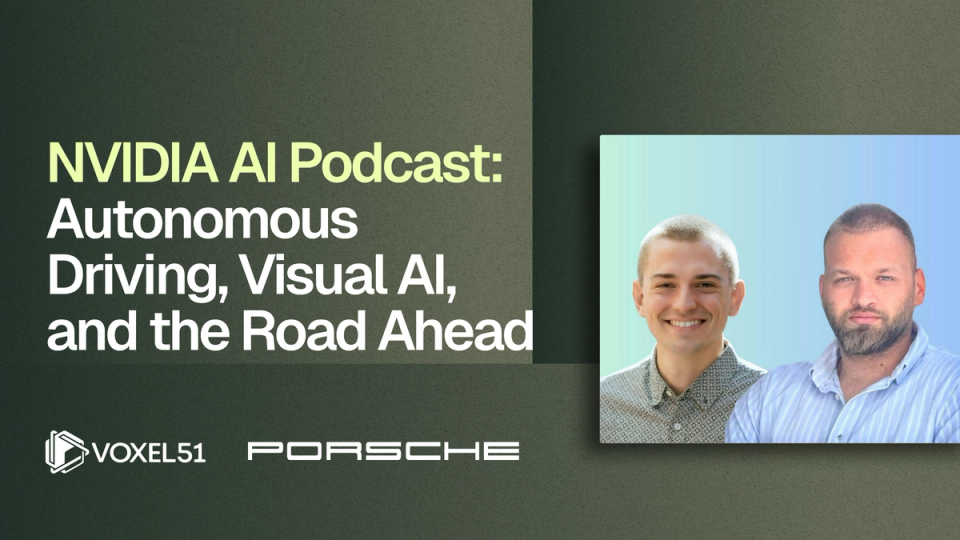
When we first started working with Porsche in 2024, Tech Lead Tin Stribor Sohn framed the challenge this way:
“Not all data has the same value for the model. Training data contains redundancies and imbalances, and much of it starts out unlabeled. We need automated labeling to understand the data, scenario detection to find what is new or important, and curation to remove what is redundant.” – Autonomous Driving, Visual AI, and the Road Ahead with Porsche and Voxel51, NVIDIA AI Podcast
At fleet scale, that becomes a data infrastructure problem. A behavior observed in fleet data may occupy only a few seconds inside hours of driving logs, and the same failure mode may appear only a handful of times across millions of miles. The challenge for Volkswagen Group was turning that event into a well-defined data slice that can be retrieved across the fleet and used to construct simulation scenarios, training data, and evaluation cohorts.
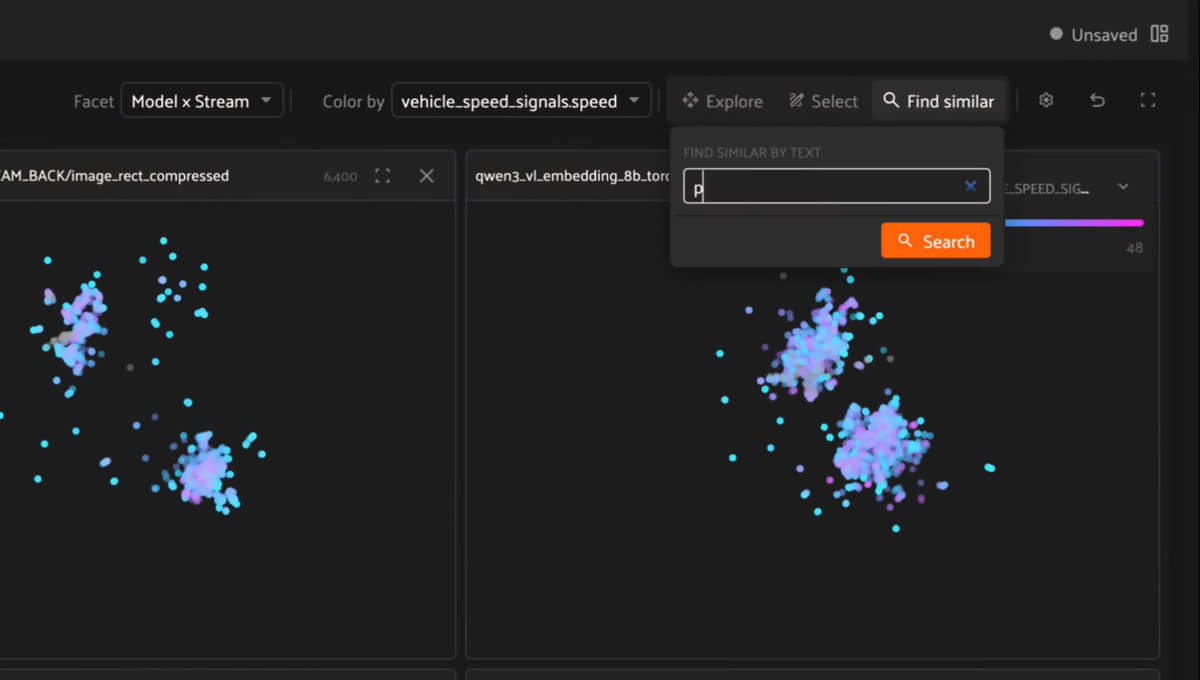
Natural language search over segment-level embeddings retrieves matching segments within long, multimodal episodes.
Voxel51 powers the following workflows in Volkswagen Group’s AV data flywheel: multimodal search and retrieval, automated labeling, scenario-based curation, dataset balancing, training data selection, and model validation.
Virtual validation: testing driving-software releases on reconstructed drives
For Porsche and the Volkswagen Group, virtual validation of driving-software releases is one of the first applications of the data flywheel. The team renders reconstructed camera inputs from real drives and compares simulated outputs with real-world measurements. The aim is to make testing repeatable, shorten feedback cycles, and reduce dependence on physical test drives.
Reconstruction is unforgiving. A camera calibration that's off by a few degrees or a LiDAR clock offset won't stop a reconstruction job. It produces a scene that scores fine and looks wrong, hours of GPU time later — with every downstream simulation inheriting that error.
So before a drive goes anywhere near a GPU, Voxel51 audits the raw recording across roughly 80 checks covering sensor integrity, timing, calibration, trajectories, actors, and coordinate frames. The audit reads MCAP files directly, and the fastest checks complete in a fraction of a second per drive, making it practical to validate data across an entire fleet.
Each check records whether it passed, failed, or could not run, so missing inputs are not mistaken for valid data. Those results determine whether a recording is suitable for downstream reconstruction and simulation, where gaps in calibration, synchronization, projection, or metadata can compromise scene fidelity.
“Simulation is transforming how autonomous vehicles are developed, turning real-world driving experience into a continuous cycle of learning and improvement,” said Rishi Dhall, vice president of automotive at NVIDIA. “With Voxel51’s data platform and NVIDIA Omniverse NuRec and Cosmos, Volkswagen Group can turn fleet data into high-fidelity simulation scenarios to accelerate the development and validation of next-generation driving systems.”
From Voxel51, engineers can launch and track NVIDIA Omniverse NuRec reconstructions and data generated from NVIDIA Cosmos runs. Each synthetic output is automatically checked for quality and remains linked to the source clip, generation recipe, and model that produced it. Completed reconstructions return with the original camera view, the rendered output, and the reconstructed 3D scene ready for the team’s simulator.
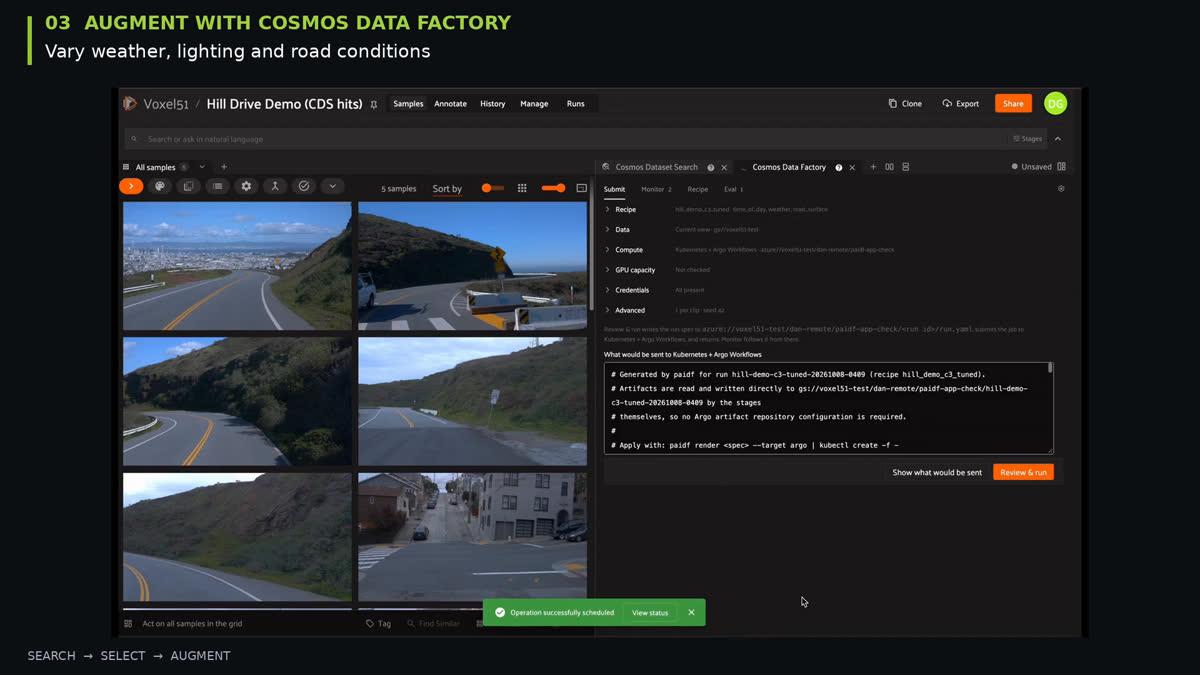
Porsche searching and augmenting autonomous vehicle data footage in Voxel51, with search powered by Cosmos Data Factory.
Voxel51 evaluates each reconstruction across multiple dimensions rather than collapsing quality into a single score. Image quality is measured by camera and object class, with separate checks for vehicles and pedestrians so localized failures are not hidden by aggregate metrics. Each run then enters a review queue, where engineers can approve it for simulation, route it back for retraining, or reject it.
Each stage runs as a job on Microsoft Azure, where the Volkswagen Group manages its fleet data. Azure provides the storage and compute needed to scale data processing, reconstruction, and simulation while keeping those workloads inside the Volkswagen Group’s existing security, identity, and regional governance model.
For a deeper look at the architecture and workflow, read the technical walkthrough from Daniel Gural, Voxel51’s Head of Technical Partnerships.
Porsche is playing a key role in the development of a shared AV data flywheel across Volkswagen Group brands, using Cosmos Data Factory through Voxel51 on Microsoft Azure. This collaboration is expected to reduce repeated physical test drives by up to 90% and shorten AI regression test cycles by up to 85%.
Why Porsche and Volkswagen Group own the loop but don’t build tools
The Volkswagen Group recognized early that the data and software development loop would become a core source of competitive advantage. A common data model lets driving data and scenarios created in one project carry forward across vehicle programs, software releases, and brands. Over time, every new drive expands that scenario base, while reconstructed scenes can be reused across future development and validation cycles.
Volkswagen wanted to own the data, models, and development loop that differentiate their self-driving systems. But owning that loop didn’t require building every piece of the underlying data infrastructure themselves.
“The key to really industry-leading performance is to harness the data that your company has access to. You need to own the development and iteration loop, even if you don’t build every layer of the stack yourself.” — Brian Moore, CEO, Voxel51
Voxel51 is an end-to-end data platform that fits into existing development environments, so teams can move across the physical AI workflow without losing context or stitching together disconnected point tools.
Voxel51 is also extensible by design. Teams can bring their own models, define custom scenario logic, connect existing data and infrastructure, and adapt workflows as their physical AI stack evolves. The platform provides the underlying data system without dictating how the driving system itself is built.
This lets the Volkswagen Group retain control of the data, models, and iteration strategy that differentiate its driving system, while using proven infrastructure to move faster.
Why fleet data is the advantage in AV
Consumer expectations for what a car should do are changing quickly. According to a McKinsey survey, one in four consumers globally would switch brands for better self-driving features. From automated parking and lane assist to increasingly capable Level 3 systems, advanced driving is becoming a more important part of the vehicle purchase decision.
The significance of this shift extends beyond consumer demand. Across industries, companies are realizing that proprietary data can become a durable advantage in AI. In automotive, that advantage is especially powerful because connected fleets continuously generate real-world experience that competitors cannot easily replicate.
As that data grows across millions of logged miles, its value depends on how quickly teams can turn what happens on the road into the next useful training, simulation, and evaluation workload.
Voxel51 helps the Volkswagen Group run that loop as a connected system, with a common data layer across that physical AI stack. As models and simulation techniques evolve, teams can adapt the workflow around them without rebuilding the underlying data infrastructure each time.
Try Voxel51 at app.voxel51.com, or contact sales to see how we can fit into your existing AV stack.
FAQ
It's a shared system that connects fleet data to simulation, training, and evaluation for advanced driving systems. Porsche, Volkswagen Group brands, and CARIAD announced it at GTC Berlin, with Porsche leading the initial implementation alongside integrations from NVIDIA, Microsoft, and Voxel51.
Voxel51 is the data layer. It handles multimodal search and retrieval, automated labeling, scenario-based curation, dataset balancing, training data selection, and model validation. It also audits raw recordings with about 80 checks before reconstruction.
The Volkswagen Group expects to cut the effort for repeated physical test drives by up to 90% and to shorten development cycles by up to 85%.
On Microsoft Azure, inside the Volkswagen Group's existing security, identity, and regional governance controls.
Co-founder and CEO
Dr. Brian Moore is Co-founder and CEO of Voxel51, where he leads the strategy and vision of the company and is actively involved in the design and execution of the core software infrastructure.
Brian holds a Ph.D. in Electrical Engineering from the University of Michigan, where his research was focused on efficient algorithms for large-scale machine learning problems with a particular emphasis on computer vision applications. He has authored dozens of articles in peer-reviewed journals and conference proceedings on various topics in machine learning, statistics, and optimization.
See all articles by Brian Moore
Try Voxel51 for yourself
Loading related posts...
© 2026 Voxel51 All Rights Reserved